What should you look at?
First, work out how much space you need for fresh and frozen food. The European Commission says that the energy label for refrigeration appliances includes information such as annual energy consumption, storage volumes and noise levels. Consider all these details together for each model you’re looking at.
Fridge
Consider one if: you mainly need space for fresh food and the capacity suits your shopping habits.
Bear in mind: a model without a freezer compartment won’t meet your freezing needs. Factor in any separate appliance you plan to keep.
Fridge freezer
Consider one if: you regularly use both the fridge and freezer compartments in a single appliance.
Bear in mind: the split between fridge and freezer space varies by model and needs to suit your habits.
Separate freezer
Consider one if: you need more frozen storage than a fridge freezer suited to your other needs can provide.
Bear in mind: if it’s an addition to your fridge, this appliance will also run continuously. Check the energy use of both appliances.
| What matters to you |
What to check |
Who is this for? |
| Energy use |
The kWh/year on the label and the usable capacity of appliances that meet the same storage needs. |
If my energy bill is the reason for replacing an appliance, I want to compare it with a solution that genuinely suits me. Around 36% of consumers put this energy-use comparison at the heart of their decision. |
| Suitable capacity |
The usable litres for fresh and frozen food, as well as the number of appliances already in use. |
If my shopping rarely fills the available space, or regularly overflows, capacity matters more than extra features. Around 29% of consumers prioritise getting the right capacity. |
| Space for frozen food |
The capacity of the freezer compartment and, if you’re adding an appliance, its annual energy use. |
I regularly freeze food and need to choose between the space offered by a fridge freezer and that of a separate appliance. For around 21% of consumers, how space is divided between fresh and frozen food is the main concern. |
| Maintenance and ease of use |
Whether the relevant compartment has No Frost and the noise level of the model. |
If defrosting is a hassle or the appliance is near a living area, I want to consider how it will work day to day. Around 14% of consumers prioritise maintenance and convenience above all. |
Brands to compare
The details below relate to the specific models mentioned, not every appliance made by each brand.
Bosch
Built-in and freestanding fridge freezers to consider depending on the space available and how much freezer capacity you need.
- Bosch lists 200 L of fridge space and 70 L of freezer space for the KIV875SE0, with LowFrost. The KGN36VWED is listed at 237 L and 89 L, with Total No Frost.
- These capacities and features are specific to each model. Check its label and dimensions before deciding.
Liebherr
A brand to consider if built-in installation, noise or specialist compartments are important to your choice.
- Liebherr lists a total capacity of 255 L, a noise level of 32 dB and BioFresh compartments for its ICBSd 5122 built-in fridge freezer.
- BioFresh doesn’t prove that your energy bill will be lower. Check the annual energy use and dimensions of the model you’re considering.
Electrolux
Freezers to compare if frost management and built-in installation requirements are important to you.
- Electrolux lists No Frost, 212 L net capacity, 236 kWh/year and 35 dB for the EUN7NE18S built-in freezer.
- These details don’t apply to other Electrolux models. Check the label and the space available for the model you choose.
Appliances to consider on Joybuy
These models illustrate three different needs: keeping fresh and frozen food together in a fridge freezer, choosing a convertible appliance for separate storage, or opting for a small fridge for fresh food. How suitable they are depends on the capacity you need and how they compare with your current appliance.
 Image unavailable
LG GBBSJ1CCSW, 333 L fridge freezer, class C
An option for combining refrigeration and freezing in one appliance. The model name indicates a capacity of 333 L and class C; check the label for the capacity of each compartment and the kWh/year before comparing it with your current appliance. Its NatureFRESH, DoorCooling+ and LinearCooling features don’t, on their own, prove that it uses less energy.
View on Joybuy
 Image unavailable
AUCMA, 291 L convertible chest freezer, class E
Worth considering if you need a separate appliance that can be used as either a freezer or a fridge. This 291 L chest freezer is listed as convertible and comes with a removable basket. Check the energy use for the mode you plan to use, as well as the space needed to open and ventilate it.
View on Joybuy
 Image unavailable
Samsung RB33B612EBN, 344 L fridge freezer, class E
Another fridge freezer to consider if you regularly use both the fridge and freezer. Its listed capacity is 344 L. Check how the space is divided between compartments, the kWh/year on the label and the space available for installation before comparing it with a different format.
View on Joybuy
 Image unavailable
Candy CFQQ5T817EPS, four-door fridge freezer, 467 L
This 467 L fridge freezer is designed for households with substantial storage needs, so make sure you need a large format before choosing it. The model name indicates Total No Frost and class E. Compare the capacity of each compartment and the kWh/year with those of appliances suited to your shopping habits. Also check its installation dimensions.
View on Joybuy
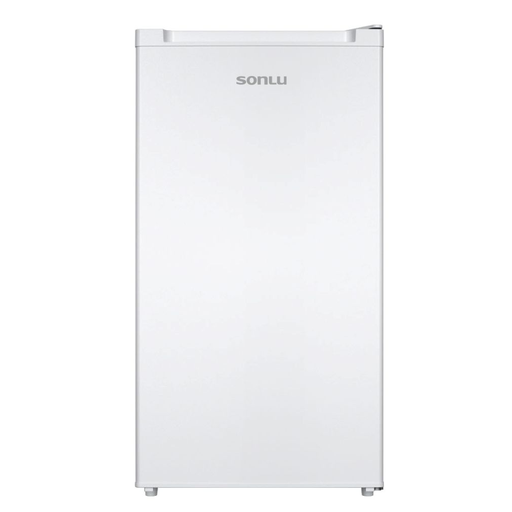 Image unavailable
Sonlu CS-100L, 82 L fridge, class E
Consider this model if 82 L of fresh-food storage is enough for your needs. This fridge has a single door and no freezer compartment. Check its exact dimensions against the space available and consult its label before comparing energy use.
View on Joybuy
Frequently asked questions
Is the energy rating enough to predict how much a new fridge will use?
No. The European Commission says that the label for refrigeration appliances also shows annual energy use in kWh and storage volumes. Compare these figures across models that can meet the same needs, then check them against the information available for your current appliance.
Where can I check the details of a specific model?
Check the energy label and its QR code to find the model’s entry in EPREL, the European register presented by the European Commission. Make sure the model number and variant match the appliance you’re considering.
When should you keep a fridge that’s still working?
If it still meets your storage needs, start by checking how you use and maintain it, then compare its energy-use details with those of a possible replacement. ADEME recommends buying according to your actual needs and keeping appliances for as long as possible. Age alone isn’t enough to show whether buying a new one is worthwhile.
Which temperature settings should you check?
In its manufacturer guidance, Electrolux recommends 4 °C or below for the fridge and −18 °C for the freezer. Check your model’s manual; changing the setting won’t resolve an operating fault.
What should you arrange for your old appliance when replacing it in France?
When you buy a new appliance, including through distance selling, the retailer must offer to take back your old one under the “one-for-one” principle, according to the government departments responsible for the ecological transition. Confirm the practical arrangements for collection and delivery before placing your order.


