Households focused on fresh food
You shop for several days at a time and mainly need space for fruit, vegetables, dairy products and meals you’ll eat soon. Fridge capacity matters more to you than a large freezer compartment.


If you mainly store fresh food and meals you’ll eat over the next few days, prioritise fridge space. A fridge-freezer is a good fit if you regularly use both compartments for fresh and frozen food. Consider a separate freezer if you need more room for frozen portions than your current appliance offers, and have space for another appliance. Compare the capacity of each compartment and the exact model’s kWh/year rating: as ADEME points out, refrigeration appliances run continuously.
You shop for several days at a time and mainly need space for fruit, vegetables, dairy products and meals you’ll eat soon. Fridge capacity matters more to you than a large freezer compartment.
You keep some meals chilled and freeze others. Comparing the capacity of each compartment will help you decide whether a fridge-freezer suits the way you organise your food.
You regularly freeze prepared portions or stock up on food. If your current compartment is no longer big enough, check the capacity and space requirements of a separate freezer.
First, work out where your food will go, then check the space available for installation and the energy consumption of the appliance you choose.
Consider it: if you mainly use chilled storage and already have enough room for your occasional freezing needs.
The trade-off: on its own, it won’t meet a significant need for frozen storage.
Consider it: if you regularly use both chilled and frozen storage and want them in one appliance.
The trade-off: its total capacity can be misleading if one compartment is too small for the way you use it.
Consider it: as an extra appliance when frozen portions and frozen food are the main reason you need more space.
The trade-off: you’ll need to allow space for it and factor in the energy consumption of an additional appliance.
| What to consider | What to check | Who it matters to |
|---|---|---|
| Space for fresh food | Compare fridge capacity separately from freezer capacity, rather than looking at the total capacity alone. | When I need to keep my groceries fresh for several days, I don’t want to give up that space for an oversized freezer. Around 40% of consumers would put fresh-food capacity at the top of their list. |
| Balance between the two compartments | Check the capacity of each compartment and the layout of the storage in the model you’re considering. | If I keep meals for the next few days and also freeze portions, I need to use both spaces regularly. For around 30% of consumers, this balance would be their top priority. |
| Extra freezer space | Measure the space available and compare the freezer capacity and kWh/year rating of a separate appliance. | When the portions I want to freeze already fill the space available, I first look for more room for them. Around 30% of consumers would put this need for freezer space first. |
For the domestic refrigeration appliances covered, the European Commission’s energy label runs from A to G. Check the annual consumption in kWh alongside the stated capacities: the energy rating alone won’t tell you whether the balance between compartments suits your needs. Also check the external dimensions and noise level if these matter for where you plan to install it.
A fridge-freezer might offer plenty of litres overall but not enough in the compartment you use most. The labelling information described by the European Commission lets you compare fridge and freezer capacities separately.
Estimate how much space your groceries and frozen portions usually take up, then compare each compartment in the exact model you’re considering.
A separate appliance gives you more room for frozen food, but it also runs continuously, as ADEME points out.
Compare the kWh/year rating shown for the model you’ve chosen and check that you’ll regularly use the extra capacity.
Its electricity consumption will add to that of the other refrigeration appliances in your home.
No Frost or a dedicated fresh-food zone can be useful for maintenance and organisation, but features vary by model. They don’t determine how much space each compartment offers.
Once you’ve compared capacity, dimensions and kWh/year, check the features included with the exact model.
The range includes freestanding and built-in fridge-freezers that combine chilled and frozen storage.
The range lets you compare fridge-freezers with specialist compartments for fresh food.
The range includes fridges and fridge-freezers, with some built-in models.
The range includes fridge-freezers to compare by format, maintenance features and installation requirements.
These Joybuy fridge-freezers combine chilled and frozen storage for households that use both. To choose between them, compare the capacity of each compartment with your groceries and prepared meals, then check the installation requirements and energy label for the exact model.
 Image unavailable
Worth considering if you’re looking for a fridge-freezer for fresh groceries and frozen portions. The model name indicates a total capacity of 344 L and an energy rating of E; compare the capacity of each compartment with your needs before choosing.
 Image unavailable
Consider this model if you want to organise fresh groceries and frozen portions in a four-door appliance. It’s listed with a total capacity of 467 L, an E energy rating and Total No Frost. Its stated width of 83,3 cm makes it especially important to check that it will fit through doorways and into your chosen space.
 Image unavailable
An option to compare if you want to organise fresh and frozen food separately in a three-door format. The model name indicates a total capacity of 360 L, an E energy rating, Total No Frost and My Zone. Check the manual for the clearance needed around the appliance.
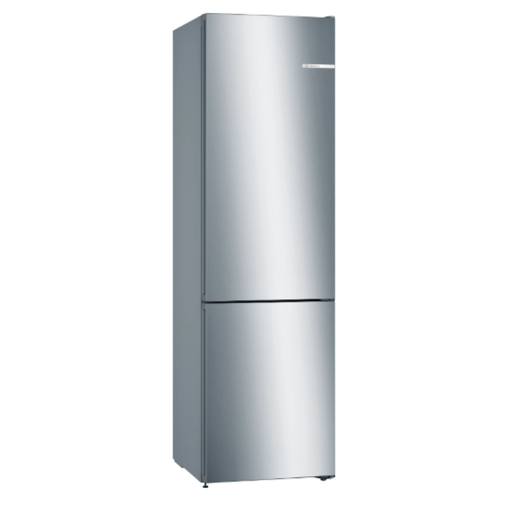 Image unavailable
Worth comparing if you use both chilled and frozen storage in one appliance. The product name indicates a total capacity of 368 L, an E energy rating and a stainless steel finish; look at the capacity of each compartment rather than the total alone. If noise matters where you plan to install it, check the label for the exact model too.
 Image unavailable
Worth considering if you want to store both fresh groceries and frozen food. The product name indicates a total capacity of 333 L and a C energy rating. The layout includes a separate chill compartment: check the capacities that suit your needs on the label for the exact model.
For the domestic fridges and freezers covered, compare the A to G energy rating, annual consumption in kWh, compartment capacities and noise information shown by the European Commission. The fridge and freezer capacities will help you decide whether the appliance suits your groceries and the meals you prepare.
No. Also check the kWh/year rating and how capacity is divided between chilled and frozen storage. The rating doesn’t replace choosing an appliance sized for the food you actually store; ADEME points out that refrigeration appliances run continuously.