People with a narrow kitchen
If you’re replacing an appliance in a narrow passage or tight recess, check the installation requirements, ventilation and access to drawers before choosing a capacity.


First, choose an appliance whose instructions allow it to be installed in the space you’ve measured, taking ventilation and door clearance into account. Then compare the fridge and freezer capacities you need. In an open-plan kitchen, also check the stated noise level, but don’t treat it as a guarantee of a quiet experience.
If you’re replacing an appliance in a narrow passage or tight recess, check the installation requirements, ventilation and access to drawers before choosing a capacity.
Your fridge shares your living space, so compare the stated noise levels and bear vibrations and intermittent sounds in mind.
Whether you choose a compact appliance or a fridge-freezer depends on your shopping habits, the usable capacity of each compartment and the space available.
Consider this if: your food fits in a smaller capacity and you don’t need a large freezer compartment.
Check: some models have a small freezer compartment, while others have none; a compact footprint also limits storage capacity.
Consider this if: you regularly store fresh and frozen food and need two compartments.
Check: a fridge-freezer isn’t necessarily narrow; check its width, height and depth, as well as the door clearance.
Consider this if: you have a cabinet designed to accommodate a built-in appliance.
Check: the internal dimensions, ventilation and cabinet door fittings must match the model’s installation diagram.
Consider this if: you want to place a freestanding appliance between cabinets, without a cabinet door attached to its own door.
Check: permitted clearances vary by model; placing an appliance between cabinets doesn’t make it a built-in model.
| Consideration | What to check | Who should prioritise it? |
|---|---|---|
| Installation and door clearance | Measure the width, height and depth; check clearances, ventilation, and that the doors and drawers can open. | If your recess or passage is narrow, the appliance needs to fit and the drawers must remain accessible. Around 36% of consumers put installation suitability first. |
| Acoustic comfort | Compare the stated noise levels and, if available, listening tests for the exact model. | In an open-plan kitchen, you may want to limit the noise you hear in your living space without compromising on a suitable size. Around 29% of consumers prioritise acoustic comfort. |
| Storage capacity | Compare the fridge and freezer capacities in litres separately, as well as the layout and cooling type. | If your shopping includes fresh and frozen food, the capacity of each compartment matters more than the total capacity alone. Around 21% of consumers prioritise suitable storage. |
| Energy consumption | Once you’ve found a suitable size and capacity, compare the kWh/year shown on the energy label. | Among appliances that suit your space and needs, you can compare the stated annual energy consumption. Around 14% of consumers make this their top priority. |
The depth, ventilation, cabinet door fittings and space needed to remove the drawers can all prevent an appliance from fitting.
Compare the internal dimensions of the space with the installation diagram for the exact model, including the required clearances.
You may then need to adapt the cabinet or arrange installation work.
A built-in appliance is designed for a suitable cabinet and cabinet door; a freestanding appliance placed between cabinets may not have the same features.
Check the permitted installation method and, for a built-in appliance, the door fixing type, such as sliding rails or fixed hinges.
An incompatible cabinet or cabinet door may need adapting.
The stated noise level doesn’t fully describe how different sounds or vibrations will be perceived.
Use the energy label to narrow down your options, then look for listening tests of the exact model, if available.
Two compact models can differ in whether they have a freezer compartment and how much it holds.
Check the fridge and freezer capacities separately and compare them with your storage habits.
Worth considering for compact, tabletop-style freestanding fridges.
Worth considering for some freestanding fridge-freezers placed next to cabinets.
Worth considering when you know the recess dimensions for a built-in appliance.
Worth considering for a built-in fridge-freezer with separate fridge and freezer compartments.
Worth considering when replacing a built-in appliance with a sliding-rail cabinet door.
These models include built-in, freestanding and fridge-freezer options, so you can compare how they fit, their storage capacity and the space they take up.
 Image unavailable
Consider this if you’re looking for a built-in appliance with both fridge and freezer compartments.
Stated capacity: 249 l. TwinTech No Frost. Class E.
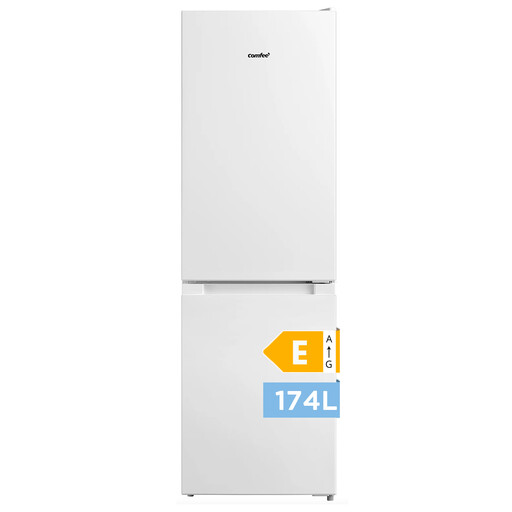 Image unavailable
Consider this if you’re looking for a freestanding fridge-freezer with a stated height of 150 cm.
Stated capacity: 174 l, comprising 115 l for the fridge and 59 l for the freezer. 4-star freezer, reversible door.
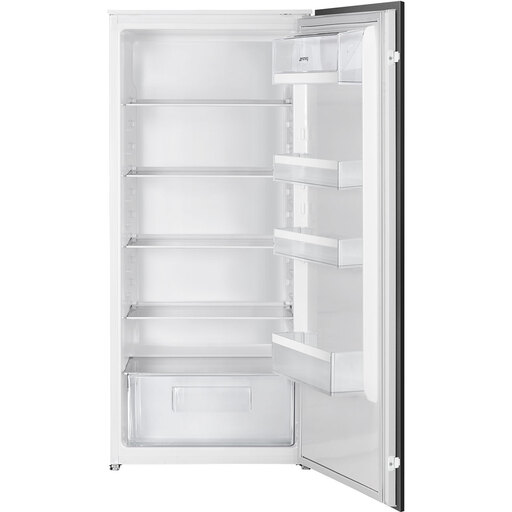 Image unavailable
Consider this if you’re looking for a built-in one-door appliance for refrigeration.
Stated capacity: 188 l. Class E.
 Image unavailable
Consider this if you need a freestanding fridge-freezer with a stated compact width of 54 cm.
Stated capacity: 227 l, comprising 153 l for the fridge and 74 l for the freezer. 4-star freezer, reversible door.
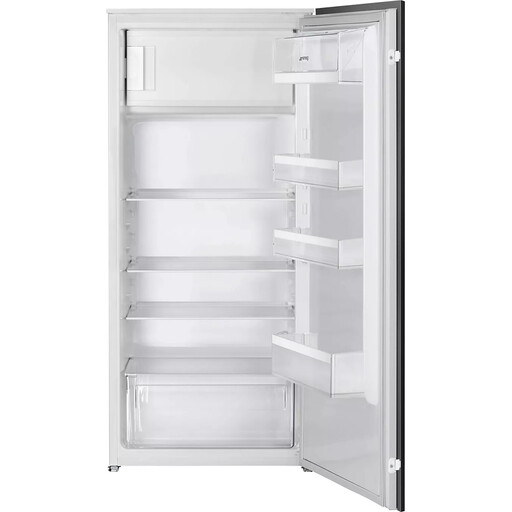 Image unavailable
Consider this if you’re looking for a built-in one-door fridge-freezer for a suitable cabinet.
Stated capacity: 188 l. Class E.
Measure the internal dimensions of the space and compare them with the model’s instructions, including the required clearances and ventilation. Also check the direction and angle the doors need to open so you can remove the drawers and trays. For a built-in appliance, check how the cabinet door is fitted.
No. It doesn’t fully describe vibrations or how different sounds will be perceived. It lets you compare the stated noise emissions; also look for listening tests of the exact model, if available. UFC-Que Choisir points out that noise perception is subjective.
Choose based on the capacity you need and the space available. A compact model may suit you if a smaller capacity is enough, while a fridge-freezer combines refrigeration and freezing. Check the capacity of each compartment, as compact models don’t all have a freezer of the same size.
Compare the annual energy consumption in kWh, capacities and noise emissions of models that already suit your installation. According to the European Commission, the label for relevant domestic refrigerators has included this information on an energy scale from class A to G since 1 March 2021. The label alone can’t tell you whether an appliance will fit your recess.