Households preparing several meals in advance
If your meals and containers take up several shelves, check the usable space between them and how much room the drawers take up. Anses recommends not overcrowding food, so air can circulate.


Start by choosing fridge capacity and shelves to suit your containers. A fridge-freezer is a good option if you also freeze portions. Before upgrading to a larger appliance, check that you’ll make regular use of the extra capacity, then compare the kWh/year figures of models with similar configurations and capacity. For food kept chilled, Anses recommends setting the fridge below 4 °C. The temperature setting and how you store food remain essential, whatever features are advertised.
If your meals and containers take up several shelves, check the usable space between them and how much room the drawers take up. Anses recommends not overcrowding food, so air can circulate.
A fridge-freezer gives you a separate space for portions to freeze. Check the fridge and freezer capacities separately: the total capacity doesn’t tell you how much room will be left for chilled meals.
If the appliance is near a living area, compare its noise level too. ADEME points out that fridges and freezers run continuously. Check the kWh/year figure before choosing more capacity or features than you need.
First, decide whether you need to freeze portions. A fridge without a freezer suits chilled storage when you don’t need an integrated freezer. In a fridge-freezer, some of the total capacity is given over to freezing. Either way, choose enough fridge space for the meals you usually prepare, rather than for occasional bulk storage.
Consider this if: you keep your meals in the fridge and don’t need an integrated freezer.
Bear in mind: you’ll need another appliance if you want to freeze portions.
Consider this if: you chill meals while regularly freezing other portions or ingredients.
Bear in mind: the total capacity includes the freezer, so check how much space is available for fresh food.
| Criteria | What to check | Who it’s for |
|---|---|---|
| Capacity and storage | Compare the capacity in litres of the fridge compartment alone and check that your meals fit between the shelves without being crammed in. | When I prepare meals for several days, I want to be able to store my containers while leaving room for air to circulate. Around 42% of consumers would put fridge capacity and layout first. |
| Temperature control | Check the available settings and where the coldest area is, as shown in the manual. Look for alerts if you open the door frequently. | If ready-to-eat meals are kept chilled for several days, I want to be able to control the temperature and spot a door that hasn’t been closed properly. Temperature control would be a priority for around 33% of consumers. |
| Energy use and space | Compare kWh/year and noise levels in dB across models with similar configurations and capacities, then measure the space available. | In a kitchen near a living area, I want an appliance that suits my usual storage needs without overlooking its noise or energy use. Around 25% of consumers would prioritise these practical considerations. |
Anses recommends setting the fridge below 4 °C and says the temperature in the coldest part should be between 0 °C and 4 °C. When comparing appliances, the European Commission says the energy label provides information including annual energy use, storage capacities and noise emissions. This information doesn’t replace checking the dimensions of your containers and the space where you plan to put the appliance.
Two appliances with a similar total capacity may divide the space differently between the fridge and freezer. The usable space for fresh meals may not suit the dishes you want to store.
Compare the capacity of each compartment and measure your tallest containers before choosing a shelf layout.
ADEME points out that a larger size and extra features can increase the electricity costs of an appliance that runs continuously.
Choose a fridge to suit the meals you usually prepare, then compare the kWh/year figures of models with similar capacities and configurations.
No Frost or a specialist compartment doesn’t mean you can skip setting the appliance correctly, leaving room for air to circulate or following food storage guidance.
Check the temperature settings available for the model you’re considering and monitor the temperature in the coldest part, in line with Anses guidance.
An appliance may fit in its allotted space but still obstruct a walkway or prevent the doors from opening fully. The dimensions of the space also matter for a built-in model.
Measure the route to the kitchen, the space where the appliance will go and the door swing. Check the manual for the exact model to find out how much clearance it needs.
The details below apply to the models listed, not to each brand’s entire range. They highlight what to compare for your meals, kitchen and freezer use.
Two freestanding Bosch fridge-freezers show how capacity and noise levels can vary between models.
The CBNsda 572i fridge-freezer is an example of a large-capacity model with specialist compartments.
The GBB72BM9CQ1 is an example of a large-capacity fridge-freezer with air circulation and connectivity features.
The WFNF82EOXFR is an example of a freestanding fridge-freezer with separate capacity figures for the fridge and freezer.
These fridge-freezers are suited to households that want to keep meals chilled and have a freezer too. For each model, check that the fridge capacity suits your containers and find out how you can adjust the temperature before choosing.
 Image unavailable
Worth considering if you store lots of meals and use a freezer too. Check how much of the listed 467 L is fridge capacity and whether the appliance will fit in your kitchen.
The model description lists four doors, Total No Frost and an E energy rating. Check the temperature settings available on this model before buying.
 Image unavailable
If you alternate between chilled meals and frozen portions, check how the listed 360 L is divided between the two compartments and whether there’s enough height for your containers.
The model description lists three doors, Total No Frost, Wi-Fi, My Zone and an E energy rating. If alerts or precise temperature control matter to you, check which features are available on the model you’re considering.
 Image unavailable
If you’re planning to chill meals and freeze a few portions, look at the space allocated to each compartment rather than focusing only on the listed 344 L capacity.
The model description lists an E energy rating. Check the manual to find out how to set the temperature and whether the alert features suit your needs.
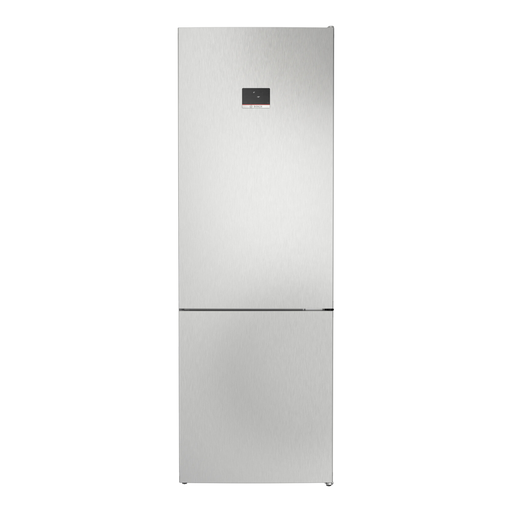 Image unavailable
This model is worth considering if your meals regularly take up a lot of space, provided the fridge compartment and the space available meet your needs.
The model description lists a total capacity of 440 L and a D energy rating. Measure the route to your kitchen and check the temperature settings available for this model.
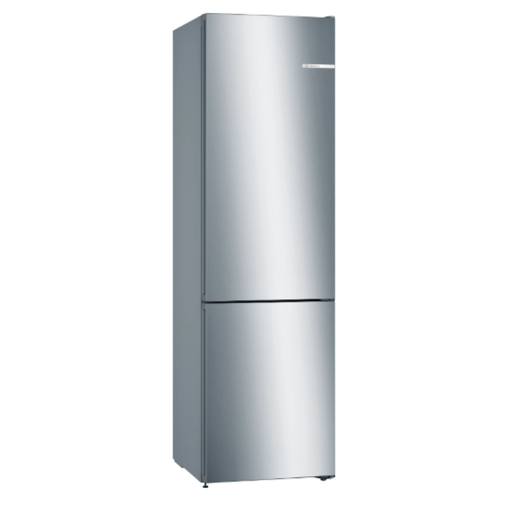 Image unavailable
To keep meals chilled while storing frozen portions too, compare the capacity of each compartment and the internal layout with the size of your containers.
The model description lists a total capacity of 368 L and an E energy rating. Check the temperature settings, dimensions and clearance needed for installation.
Anses recommends setting the fridge below 4 °C and says the temperature in the coldest part should be between 0 °C and 4 °C. Check this area and follow the storage instructions for each food too: no model can guarantee food safety on its own.
No. In a fridge-freezer, some of the total capacity is taken up by the freezer. Compare the fridge capacity with the dimensions of your containers and dishes. Anses recommends not overcrowding food so that air can circulate.
Compare the kWh/year figures on the energy labels of models with similar configurations and capacities, rather than looking only at their energy ratings. The European Commission says the label also gives storage capacities and noise levels. ADEME points out that a larger size and extra features can increase electricity costs.
It can be helpful if the door is opened frequently or might be left ajar, but it doesn’t replace checking the temperature. Bosch Electroménager France lists open-door and temperature-rise alerts for the KGN33NWDA and KGN392LAG. Check they’re available on the model you’re considering.