Which appliances should you check first?
Start with the energy use and frequency of use of your current appliances, then compare them with replacements of a suitable capacity. The same energy label won’t meet every household’s needs.
| Priority |
What to check |
My needs |
| Fridge or fridge-freezer |
Compare the kWh/year and compartment capacities of models suited to the same needs. If possible, note the energy use of your current appliance. |
My appliance stays on all the time. I want to find out whether replacing it would reduce its energy use without unnecessarily increasing the capacity. |
| Freezer |
Check the kWh/year, the freezer capacity you need and the installation requirements. The European Commission says the EU energy label shows annual energy use. |
I have a separate freezer and want to check whether its capacity still matches what I store. |
| Dishwasher |
The European Commission says the label shows kWh per 100 cycles. Compare this figure for the Eco programme, along with water use per cycle and capacity, then consider how many cycles you run each year. |
I run cycles often, but the size of the appliance also needs to suit my usual loads. |
| Hob |
Identify the type of hob you’re replacing, how often you cook and any installation requirements. The European Commission states that hobs are not required to carry an energy label. |
I often cook on an electric hob and want to assess a replacement based on how I use it, rather than relying on an energy rating that doesn’t exist for this product. |
| Oven |
Before considering a replacement, think about how often you use the oven, how much capacity you need and the condition of your current one. |
If I rarely use my oven, I’d rather check how much it contributes to my energy use than replace it just because it’s old. |
| Repair |
If an appliance breaks down, contact the retailer if a warranty may apply, check which parts are available and ask for a quote. For dishwashers, the repairability index indicates how easy a model is to repair, according to the ministry responsible for the ecological transition. |
I want to find out whether my appliance can be repaired before deciding to buy another one. |
A guide to the brands
The models featured here include fridge-freezers from LG, Samsung and Sonlu, as well as a compact Bob dishwasher and a built-in Samsung dishwasher. Rather than choosing by brand name alone, compare each model’s energy use, capacity and installation requirements with your current appliance and household needs.
Fridges and dishwashers on Joybuy
These models offer two possible replacement options: a fridge-freezer that runs continuously, or a dishwasher with a capacity suited to your usual loads. Compare their specifications with those of your current appliance before deciding.
 Image unavailable
LG GBBSJ1CCSW, 333 L, Class C
Worth considering as a replacement for a fridge-freezer with a similar capacity. The product specifications show 169 kWh/year for 333 L. Check this figure on the energy label and allow for the clearances specified for installation.
View on Joybuy
 Image unavailable
Samsung RB33B612EBN, 344 L, Class E
The listed compartment capacities of 230 L for refrigeration and 114 L for freezing let you check whether the layout suits you. The product specifications give an energy use of 254 kWh/year. Compare the energy label with those of similar-capacity appliances and check the ventilation space required.
View on Joybuy
 Image unavailable
Sonlu CC-520WE, 444 L, Class E
Consider this model if a total capacity of 444 L genuinely meets your storage needs. The product specifications show 289 kWh/year. Check this figure on the energy label and compare the capacity of each compartment with your current appliance.
View on Joybuy
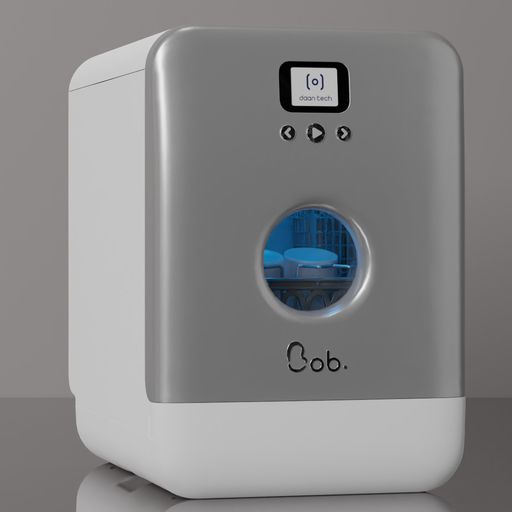 Image unavailable
Bob Mini, 3 place settings, 34 cm
This countertop model is worth considering if your usual loads fit within its 3-place-setting capacity. The product specifications state 0.39 kWh per cycle. Check which programme this figure applies to before comparing it with other dishwashers’ kWh per 100 Eco programme cycles.
View on Joybuy
 Image unavailable
Samsung DW80H72YBB0U1, 60 cm, 13 place settings, Class B
Worth considering if your usual loads suit a 13-place-setting capacity and your kitchen unit can accommodate a fully integrated installation. To assess energy use, check the kWh per 100 Eco programme cycles and water use per cycle, as well as the required dimensions and connections.
View on Joybuy
Frequently asked questions
Which kitchen appliance should I check first?
Start by checking the annual energy use of your fridge or freezer, which runs continuously, then look at appliances you use frequently. ADEME’s guidance can help you understand these patterns, but your priorities depend on how much energy your current appliances use and how often you use them.
Is the letter on the energy label enough to help me choose?
No. The European Commission also shows kWh/year and capacity for fridges and freezers, and kWh per 100 Eco programme cycles for dishwashers. Compare these figures between appliances with a capacity suited to your needs.
Does an induction hob have an energy label?
No. The European Commission says there is no requirement for hobs to carry an energy label. If you’re considering a replacement, look at your current hob, how you use it and any installation requirements rather than searching for an A to G rating.
What should I check before replacing a broken appliance?
Check whether the warranty applies, whether parts are available and whether you can get a repair quote. In France, the ministry responsible for the economy says the legal guarantee of conformity applies to new, second-hand and refurbished goods sold by a trader. Contact the retailer to discuss your situation.
Where can I compare the details of a model covered by energy labelling?
Check the model’s energy label and the European EPREL register. The European Commission says EPREL lets you compare the specifications of relevant models. Look in particular at energy use and capacity for your needs.


