What should you compare?
First decide how much space you need for fresh and frozen food. Then check that the appliance will fit in your kitchen and that its operating specifications suit your needs. Que Choisir’s guidelines — 100 to 150 litres for one person, plus 50 litres for each additional person — are a useful starting point, which you can adjust to suit your food shop.
Fridge only
Worth considering: if your food shop is mostly fresh and you rarely need to freeze food, or you already have a freezer.
Bear in mind: Que Choisir says a small freezer compartment isn’t enough for regularly storing large amounts of frozen food.
Fridge-freezer
Worth considering: if you regularly buy fresh and frozen food and want to store it all in one appliance.
Bear in mind: the two compartments share the available capacity, so their proportions need to suit your food shop.
Separate freezer
Worth considering: if you need to store a lot of frozen food and already have a fridge for fresh produce.
Bear in mind: you’ll need extra space for an appliance that runs continuously, as ADEME points out.
| Criteria |
What to check |
Who is it for? |
| Capacity split |
The usable capacity of the fridge compartment and, if there is one, the freezer compartment; don’t rely on the total alone. |
If most of my food shop goes in the fridge, I want enough space for fresh food without giving too much capacity to frozen food. Around 40% of consumers are said to prioritise this split. |
| Space and installation |
Height, width, depth and door opening; for a built-in appliance, check the housing and fixing type. |
If my kitchen is narrow or already has a housing, an appliance with the right capacity also needs to fit and open easily. This is said to be the top priority for around 30% of consumers. |
| Day-to-day operation |
kWh/year for appliances of a similar size and capacity, as well as the stated noise level in dB. |
In an open-plan kitchen, I pay attention to noise and the electricity used by an appliance that stays on all the time. Around 30% of consumers are said to put these operating factors first. |
Brands to consider
These ranges and models are examples to help you compare specific configurations. They don’t imply that every appliance from each brand has the same features.
Bosch
The range includes freestanding and built-in fridge-freezers to consider based on the space available and the balance you want between fridge and freezer capacity.
- Bosch lists 237 l of fridge capacity, 89 l of freezer capacity, a noise level of 39 dB and dimensions of 1860 × 600 × 660 mm for its KGN36VLED.
- These measurements and the No Frost function listed for the KGN36VLED shouldn’t be assumed to apply to other Bosch models.
Liebherr
Some fridge-freezers in the range offer large capacities and dedicated compartments. Check that their width will suit your kitchen.
- Liebherr lists a total capacity of 423 l, a noise level of 34 dB, and BioFresh and NoFrost functions for the CBNsdc 765i.
- This model is 74.7 cm wide, so check the space available. The food-preservation benefits described for BioFresh are manufacturer claims, not conclusions that apply to the entire range.
Beko
Beko’s built-in fridge-freezers are worth considering if you need to keep your fitted kitchen layout as it is.
- Beko’s specifications for the BCNA275E4ZSN describe an integrated model with a sliding hinge system, a reversible door and an open-door alarm.
- Check the housing and fixings before choosing this model. The food-preservation benefits associated with its technologies are Beko’s claims and don’t prove that it outperforms other appliances.
Whirlpool
The range includes fridges and fridge-freezers to compare, particularly if a built-in appliance needs to fit a specific housing.
- Whirlpool lists a 54 cm-wide housing and a total capacity of 250 l for its WHC18T132FR built-in fridge-freezer, including 182 l for fresh food and 68 l for frozen food.
- The listed figures of 224 kWh/year and 32 dB also apply to this specific model. Check the installation requirements and specifications of any other model separately.
Fridge-freezers for different needs
These Joybuy appliances combine refrigeration and freezing. Compare their capacity, size and listed specifications to find a fridge-freezer that suits your food shop and kitchen.
 Image unavailable
Samsung RF50C530EB1 Multi-Door, 495 L
Worth considering if you’re looking for one appliance for fresh and frozen food, with a stated total capacity of 495 L. The title lists an E energy rating; check the capacity split, dimensions and exact door configuration before deciding where to put it.
View on Joybuy
 Image unavailable
Bosch KGN33NLEB, bottom freezer, 282 L
Worth considering if you want to store fresh and frozen food in one appliance with the freezer at the bottom. The title lists a total capacity of 282 L and an E energy rating; compare the capacity of each compartment and the noise level of the exact model to suit your needs.
View on Joybuy
 Image unavailable
CHiQ JR227LSE, 227 L, Low Frost
Worth considering if kitchen width is a constraint and you buy both fresh and frozen food. The title lists 153 L for the fridge, 74 L for the freezer, a width of 54 cm, a reversible door and an E energy rating. Check the other dimensions and annual energy consumption; Low Frost may not remove the need to defrost manually.
View on Joybuy
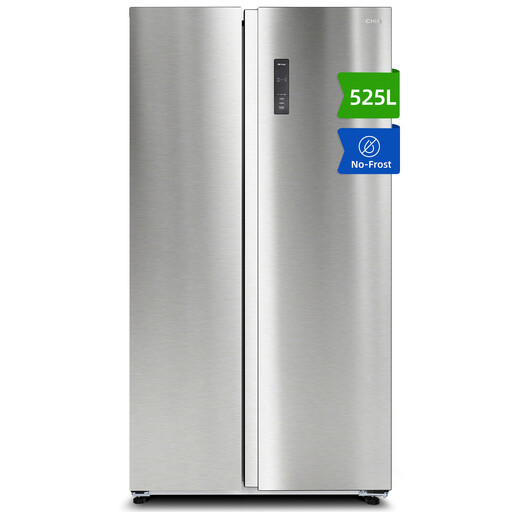 Image unavailable
CHiQ JR525WSE side-by-side, 525 L
Worth comparing if you regularly store large amounts of fresh and frozen food in one appliance. The title lists 333 L for the fridge and 192 L for the freezer, as well as No Frost, 37 dB and an E energy rating. Check its full dimensions and annual energy consumption; this capacity is only useful if it suits your food shop.
View on Joybuy
 Image unavailable
AEG NSC6M18FES built-in, TwinTech No Frost
Worth considering if you’re looking for a fridge-freezer to fit into a fitted kitchen. The title lists a total capacity of 249 L, TwinTech No Frost and an E energy rating. Check the housing dimensions, annual energy consumption and exact usable capacities: the stated total doesn’t match the combined capacity of the two listed compartments.
View on Joybuy
Frequently asked questions
Is total capacity enough to choose a fridge-freezer?
No. Compare the fridge and freezer capacities separately, as a suitable total may hide a compartment that’s too small for your food shop. Que Choisir recommends considering household size, how often you shop and how much frozen food you use.
Which figures should I compare between two refrigeration appliances?
Compare the usable capacity of each compartment, dimensions, kWh/year and the stated noise level in dB. For applicable appliances, the energy label and EPREL provide access to this information; above all, compare models with a similar size and capacity.
Does No Frost always remove the need to defrost manually?
According to manufacturers, No Frost is designed to reduce or eliminate manual defrosting in the compartment it applies to. Check which compartments are covered for the exact model: not all fridges and fridge-freezers have this feature.
How can I check energy use and prepare for installation?
Start with the kWh/year listed for the exact model, then check its dimensions and the clearances it needs. ADEME points out that refrigeration appliances run continuously. Before ordering, also check the delivery and installation options available for your chosen appliance.


