Households doing a big weekly shop
If you store several days’ worth of fresh food alongside frozen food, check the available space in each compartment separately. UFC-Que Choisir’s testing protocol includes simulating a full weekly shop.


If your weekly shop regularly includes fresh and frozen food, start by comparing fridge freezers: the usable capacity of each compartment will help you work out how much space you have for each type of food. A small freezer compartment is better suited to the occasional frozen item. Consider a separate freezer if your stocks regularly exceed the capacity of a fridge freezer, bearing in mind the space it will take up and the energy used by a second appliance.
If you store several days’ worth of fresh food alongside frozen food, check the available space in each compartment separately. UFC-Que Choisir’s testing protocol includes simulating a full weekly shop.
A narrower appliance could still work, but compare its freezer capacity with what you usually buy. UFC-Que Choisir says that a small freezer compartment alone is not enough if you eat a lot of frozen food.
If you regularly buy or freeze large quantities, compare a higher-capacity fridge freezer with a separate freezer. UFC-Que Choisir highlights the benefits of conventional freezers for larger families; a second appliance also needs space and runs continuously.
Start with how much fresh and frozen food you keep between shops, then check the installation requirements and compare the features of models with similar capacities.
Worth considering: if your weekly shop regularly includes fresh and frozen food.
The trade-off: its total capacity may hide a freezer compartment that’s too small for your stocks.
Worth considering: if you mainly buy fresh food and very little frozen food.
The trade-off: according to UFC-Que Choisir, a small freezer compartment alone is not enough if you eat a lot of frozen food.
Worth considering: if your stocks regularly exceed the practical storage space offered by a fridge freezer.
The trade-off: you’ll need to allow space for it and factor in the energy used by an additional appliance.
| Factor | What to check | Think about your needs |
|---|---|---|
| Capacity split | Compare the usable litres of the fridge and freezer separately, as well as access to drawers and shelves. UFC-Que Choisir gives an average guide of 100 to 150 litres for one person, plus 50 litres for each additional person; this doesn’t specify how much space to allow for frozen food. | I keep fresh food for several days, as well as frozen food, so the total capacity doesn’t tell me how much I can store in each compartment. |
| Weekly shop loading | Check the available information on how quickly the temperature returns to normal after loading and, if you freeze fresh food, the freezing capacity in kg/24 h. UFC-Que Choisir’s testing protocol takes a full weekly shop into account. | After a shop, I fill several compartments at once, so I want to choose based on this habit, not just the stated capacity. |
| Energy use | Compare the current energy rating and stated kWh/year for appliances of a similar size and capacity. If you’re considering a separate freezer, check its annual energy use too: it’s an additional appliance that runs continuously. | I want to know the stated energy use of every appliance I plan to use. |
| Space and storage | Measure the space, delivery access and, if necessary, the packaged appliance. Check the layout of the drawers, shelves and bins to make sure they suit the food you store; Samsung recommends measuring doors, corridors and lifts before delivery. | A larger capacity is only useful if the appliance can be brought into the kitchen and I can store my shopping easily. |
| Noise and maintenance | Compare the stated noise level in dB(A), particularly for an open-plan kitchen, and check the defrosting method for the exact model. These details don’t replace checking capacity and energy use. | If my kitchen opens onto the living area, I pay attention to noise. I also want to know what maintenance the freezer needs. |
A large capacity figure could still mean there’s too little space for your frozen food.
Compare the usable litres in each compartment with what you usually buy in a week. If frozen food takes up a lot of space, rule out a small freezer compartment: UFC-Que Choisir considers it inadequate for this purpose.
A separate appliance gives you more storage, but takes up extra space and runs continuously.
First work out what you’d need to store that wouldn’t fit in a fridge freezer, then compare the space required and the stated kWh/year for the appliances you’re considering.
According to the European Your Europe portal, the old ratings with a “+” are no longer used for fridges since 2021. So you can’t read an old label in the same way as the current scale.
For models with the current label, compare the A to G rating and kWh/year figures for appliances of a similar capacity and size.
The appliance’s dimensions alone don’t guarantee that its packaging will fit through doors, corridors or a lift. Samsung highlights this point for its fridges.
Measure the space and access route, then check them against the packaged dimensions of your chosen model.
These examples show features to look for in specific models; a brand doesn’t offer the same features across its entire range.
Compare freestanding fridge freezers where capacity split and noise levels matter.
Explore how a fridge freezer divides space between fresh and frozen food.
Compare integrated fridge freezers in particular, along with model-specific maintenance information.
Check the installation requirements for a high-capacity fridge freezer.
These appliances have a fridge section and a freezer section, making them suitable for shops that include fresh and frozen food. This selection includes fridge freezers and a side-by-side model: compare the internal layout before choosing.
 Image unavailable
Worth considering if you’re looking for separate zones for your weekly shop. The product listing states 360 L, three doors, Total No Frost, an E rating and Wi-Fi; compare the capacity split, dimensions and space needed for installation.
 Image unavailable
Compare this model if you want separate storage for fresh and frozen food. The product listing states 333 L and a C rating; check the capacity of each section and the freezing capacity if you often freeze fresh food.
 Image unavailable
Worth considering if the available width limits your choice of fridge freezer for a weekly shop. The product listing states a width of 54 cm, a height of 176 cm, a 70/30 split and Low Frost; compare the actual space for frozen food and the defrosting requirements.
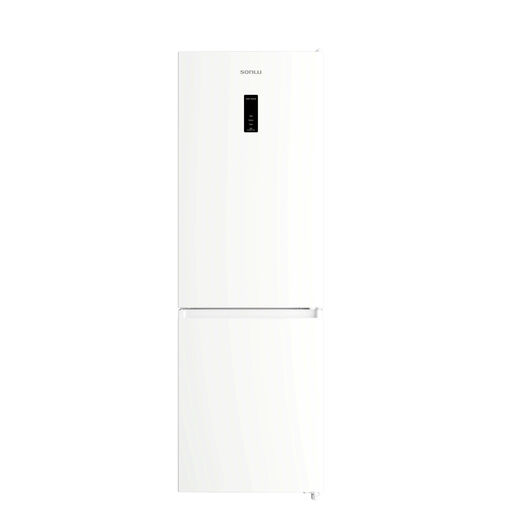 Image unavailable
Compare this model if you need space for fresh and frozen food between shops. The product listing gives 211 L of fridge capacity and 99 L of freezer capacity, with a width of 60 cm and an E rating; check the full dimensions, kWh/year and freezing capacity for your needs.
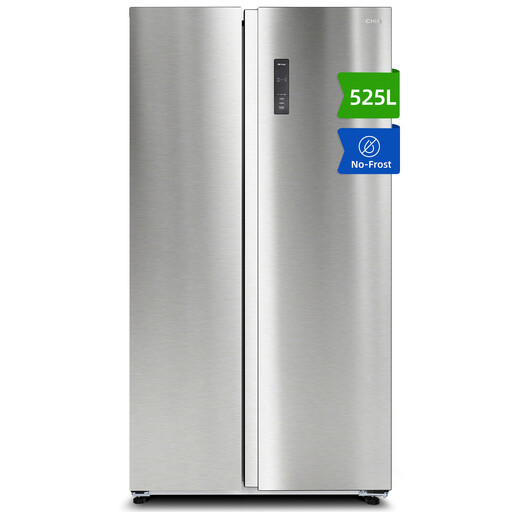 Image unavailable
Worth considering if a large proportion of your shopping needs to go in the freezer. The product listing states 333 L of fridge capacity, 192 L of freezer capacity, No Frost and an E rating; measure the space and delivery route, then compare the kWh/year and freezing capacity.
Start by checking the usable capacity of each compartment, then adjust for the size of your household and how much frozen food you buy. UFC-Que Choisir recommends an average of 100 to 150 litres for one person, plus 50 litres for each additional person. Treat this as a starting point, not a set split between fresh and frozen food.
A small freezer compartment is better suited to the occasional frozen item. If you eat a lot of frozen food, UFC-Que Choisir considers it inadequate. Compare the freezer capacity of a fridge freezer with your usual stocks, then consider a separate appliance if it isn’t enough.
Check the current energy rating and stated kWh/year for appliances of a similar capacity and size. The European Your Europe portal notes that the old A+, A++ and A+++ ratings have not been used for fridges since 2021, so don’t compare them directly with the current scale.
No. First check the space available for fresh and frozen food, energy use and installation requirements. If freezer maintenance is important to you, then compare the defrosting method stated for each model. The No Frost label alone doesn’t tell you how the appliance will perform after a large shop.
Measure the space where it will go and the entire delivery route, including doors, corridors and the lift if you’ll be using one. Compare these measurements with the packaged dimensions of your chosen model, not just the dimensions of the unwrapped appliance, as Samsung advises.