Households that shop for several days at a time
If you need fresh and frozen food to last until your next shop, check how much space is available in each compartment. The total capacity doesn’t show you how that space is divided.


To store several days’ worth of shopping and a regular supply of frozen food in one appliance, start by comparing the net capacity of the fridge and freezer compartments separately. A fridge-freezer could suit your needs if both compartments are large enough for your usual supplies. If the freezer compartment is small, check its capacity particularly carefully. If you need more space for frozen food and have room for two suitable appliances, a separate fridge and freezer are another option. Then check the installed dimensions, ventilation requirements, permitted ambient temperature and noise level.
If you need fresh and frozen food to last until your next shop, check how much space is available in each compartment. The total capacity doesn’t show you how that space is divided.
Compare the net freezer capacity with the amount you usually store, then check how the drawers are arranged. If you also freeze large quantities of fresh food, check the model’s freezing capacity, stated in kg/24 h.
Measure the space and access routes, allowing for the doors to open and the clearances specified in the manual. If your kitchen is open-plan or close to a living area, compare the stated noise levels in dB(A) too.
Worth considering if: you want to keep fresh food and a regular supply of frozen food in one appliance.
What to weigh up: the amount of space allocated to the freezer varies by model, even when total capacities are similar.
Worth considering if: your stocktake shows that a smaller freezer compartment will be enough for the food you buy.
What to weigh up: check there’s room for bulky items before choosing this format if you regularly buy frozen food.
Worth considering if: you want to choose the capacity for fresh and frozen food independently.
What to weigh up: you’ll need two suitable spaces, and each appliance will have its own installation requirements and noise level.
Once you’ve chosen a possible format, compare its features with your usual stock and the space available.
| What to check | Points to consider | What you need |
|---|---|---|
| Capacity split | Check the net capacity in litres of the fridge and freezer separately. Look at the drawers and, if you freeze fresh food, the freezing capacity in kg/24 h. | I want to store several days’ worth of shopping without running out of space for the frozen food I usually keep. |
| Keeping fresh food | Check the temperature settings and the model’s storage guidance. Anses recommends keeping food between 0 and +4 °C at the coldest point in the fridge. | After putting away a new shop, I need to be able to check the temperature and store food according to the manual. |
| Installation and noise | Compare the height, width and depth with the space and access routes. Check the manual for ventilation requirements, the climate class for the room temperature, and the product information for the noise level in dB(A). | Is there enough room in my kitchen to install the appliance and open its doors? If the kitchen opens onto a living area, the stated noise level is also important. |
| Energy consumption | Compare the stated annual energy consumption in kWh/year for appliances with formats and capacities that suit you. The DGCCRF describes the energy label as a summary of the features of new appliances; the European EPREL database gives details including energy consumption and compartment capacities. | I want to compare appliances that can hold my shopping, rather than choosing based on the energy label letter alone. |
Beko’s product information lists freezer capacities of 46 L for the RDSA280K40SN and 120 L for the RCSA366K40SN. It’s the capacity of each compartment, not just the total, that shows how much space you’ll have for frozen food.
Note down the net capacity of each compartment and compare it with the food in your shopping and your current freezer.
The depth, door clearance and ventilation requirements could all make the space unsuitable for the appliance you choose.
Measure the space and the delivery route, then allow for the clearances specified in the manual for that exact model.
Bosch lists No Frost for the KGN36VLED, while Beko lists MinFrost for the RCSA366K40SN. So check the cooling technology for each individual model.
Before choosing, check the care and defrosting instructions for the freezer compartment.
Depending on the system, defrosting can also take time and temporarily prevent you from using the compartment.
The permitted ambient temperature depends on the appliance. A very cold or hot room may not be suitable for installation.
Compare the actual room temperature with the range specified by the model’s climate class and manual.
These models show different capacity splits and installation options. Their features aren’t necessarily representative of every appliance from the same brand.
Bosch Home France’s product information lets you compare a freestanding fridge-freezer with a separate upright freezer.
Beko France’s product information shows a range of possible capacity splits between fresh and frozen food.
Whirlpool France’s built-in fridge-freezers are worth considering if you need an appliance to fit into a kitchen cabinet.
These five appliances combine fridge and freezer compartments in a single unit, in a range of formats. If you do a weekly shop and regularly buy frozen food, pay particular attention to the capacity of each compartment and the space needed for installation.
 Image unavailable
To divide your shopping between fresh and frozen food, check the capacity of each compartment before deciding. The product title gives a total capacity of 360 L, Total No Frost, an E energy rating, Wi-Fi and My Zone. Check the manual for the required dimensions and ventilation clearances.
 Image unavailable
If space is tight, compare the stated width of 54 cm with the space needed for installation and to open the door. The product title gives a capacity of 262 L, a 70/30 split, a height of 176 cm and Low Frost. Check the manual for clearances and freezer defrosting instructions.
 Image unavailable
This model lets you assess the space available for each type of food: the product title gives a fridge capacity of 153 L and a freezer capacity of 74 L. It also lists Low Frost, a width of 54 cm, a reversible door and an E energy rating. Check the height, clearances and permitted ambient temperature range before installation.
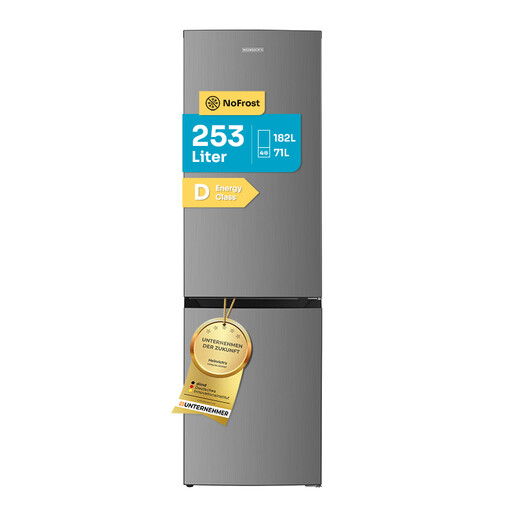 Image unavailable
To compare fresh and frozen food storage, the product title gives a fridge capacity of 182 L and a freezer capacity of 71 L. It also lists LED lighting, a noise level of 39 dB and No Frost. If you often freeze fresh food, check the model’s freezing capacity. Also check its full dimensions and installation requirements.
 Image unavailable
To find out whether this appliance can hold your frozen food, check the net capacity of each compartment separately: the 444 L stated in the product title is the total capacity. The title also lists a frost-free system, a noise level of 40 dB and an E energy rating. Check the dimensions and clearances needed for installation.
Compare its net capacity with the amount you usually store, including bags and bulky items. Beko France lists a freezer capacity of 46 L for the RDSA280K40SN, compared with 120 L for the RCSA366K40SN fridge-freezer. These figures show how much capacities can vary between formats, but they don’t replace taking stock of what you need to store.
Anses recommends keeping food between 0 and +4 °C at the coldest point in the fridge. After installation, set the appliance and store food according to the instructions in its manual.
First, check the requirements for your specific model. Beko’s support guide recommends leaving at least 5 cm on each side and at the back for ventilation, but you should follow the manual for your chosen appliance when installing it. If you’re considering a garage or another room that can get very hot or cold, check that the ambient temperature is within the range permitted for the model.
They can help you compare the declared features of specific models, but you should still check their capacities. The DGCCRF says that the energy label summarises the features of new appliances. For registered fridges, the European EPREL database includes details such as annual energy consumption and compartment capacities.
In France, the Ministry for the Ecological Transition describes the ‘one-for-one’ take-back scheme as handing over an old product when buying another of the same type. Ask the retailer about the practical arrangements for your purchase and for taking away the bulky appliance.