Households preparing several meals in advance
If you store fresh ingredients, prepared meals and frozen portions, check how much space is available in each compartment and how easily you can keep these foods separate.


If your fresh groceries and frozen portions fit into suitable compartments, a fridge freezer keeps everything in one appliance. If batch-cooked meals and bulk buys regularly take up too much room, consider a separate freezer. If the main problem is finding and protecting your food, start by reorganising the cold storage you already have. In each case, compare the capacity of each compartment with the space available, how easily you can reach your food and the food’s use-by dates.
If you store fresh ingredients, prepared meals and frozen portions, check how much space is available in each compartment and how easily you can keep these foods separate.
When storing bulk buys for the freezer, usable capacity matters just as much as how easily you can reach your food. The choice between drawers and a chest freezer depends, among other things, on how often you take food out.
In a small kitchen, measure the space available and allow room for the door to open. If the appliance will be near a living area, check its stated noise level and energy consumption too.
Work out whether you need more space for fresh food, frozen food or simply storage that’s easier to access. The EU energy label lists the capacity of each compartment and shows details such as annual energy consumption and noise level. Use it to compare appliances that meet the same needs.
Consider this if: you want to store fresh groceries and frozen portions in a single kitchen appliance.
Check: a large total capacity doesn’t guarantee enough freezer space for your batch-cooked meals.
Consider this if: you need little freezer space and prefer to prioritise fresh groceries.
Limitation: check the stated capacity of the freezer compartment before relying on it for several portions.
Consider this if: you want extra freezer storage and would like to organise portions in drawers.
Allow for: the space needed to open the door and pull out the drawers.
Consider this if: your priority is plenty of freezer storage and you have enough floor space.
Limitation: food at the bottom takes some organising, and you’ll need to reach in from above.
As an extra: if you have enough capacity but find it hard to identify or protect your portions.
Limitation: containers don’t add cooling capacity or replace temperature checks.
| What matters to you | What to check | Who is it for? |
|---|---|---|
| Balance of fresh and frozen storage | Compare the usable capacity in litres of the fridge and freezer separately, then check how each compartment is laid out. | I keep fresh ingredients and freeze some of my meals, so I need space for both. Around 33% of consumers prioritise this balance. |
| Freezer storage | Work out how much usable capacity you need and choose a storage layout that suits you: drawers, baskets or a chest freezer. | When bulk buys and batch-cooked portions take up too much room, I first look for somewhere to freeze them. This is the priority for around 27% of consumers. |
| Space and access | Measure the appliance, the route to its location and the clearance needed for the door or lid. | In a narrow kitchen or utility room, I need to be able to fit the appliance and reach my portions easily. Space and access come first for around 20% of consumers. |
| Everyday use and maintenance | Check annual energy consumption in kWh, noise level and the type of defrosting. | If the appliance runs constantly near the rooms I use, I pay particular attention to its energy use, noise and maintenance. Around 20% of consumers put these factors first. |
Two fridge freezers with a similar total capacity may allocate space differently between the fridge and freezer. If you’re already struggling to fit in frozen portions, the overall figure won’t answer your question.
Compare the usable capacity in litres for each compartment on the energy label and product details, then consider it alongside your usual groceries.
A large capacity can come with a considerable floor footprint and make food at the bottom harder to reach. For example, the Liebherr CFd 2505 Plus chest freezer is 167 cm wide, according to Liebherr.
Measure the space, the delivery route and the clearance needed to open the lid. If you store several types of food in it, plan to organise them in baskets or boxes.
A feature related to frost tells you about the model’s stated maintenance requirements, but not how much space it offers for your portions, how noisy it is or how much energy it uses each year.
Check capacity, dimensions and the details on the energy label first, then look at the exact defrosting feature for the model you’re considering.
A larger appliance won’t fix an unsuitable temperature or an overfilled fridge. Anses recommends monitoring the temperature in the coldest area and leaving room for air to circulate.
Check the temperature and organise your food before deciding you need more capacity.
These examples highlight features to check on a specific model; they don’t represent every range from each brand.
The range includes freestanding fridge freezers that keep fresh and frozen food together.
The range of upright and chest freezers is worth considering if you’re looking for separate freezer storage.
The range includes freestanding and built-in fridge freezers, with Total No Frost available on some models.
The fridge freezer range includes built-in models with a variety of ways to organise chilled and frozen food.
These five fridge freezers offer a range of capacities for keeping fresh and frozen food in one appliance. Compare the actual capacity of each compartment before choosing. If you mainly need extra freezer storage, consider a separate freezer too.
 Image unavailable
Worth considering if you want to store fresh groceries and frozen portions in a four-door appliance. The stated total capacity is 467 l, with Total No Frost and an E energy rating. Check how much of that capacity is in the freezer, as well as the space needed to open the doors.
 Image unavailable
An option to consider if you want to store fresh and frozen food in a three-door appliance. The title states a capacity of 360 l, with Total No Frost, an E energy rating, Wi-Fi and My Zone. Check the capacity of each compartment and make sure the temperature controls meet your needs.
 Image unavailable
This bottom-freezer model may suit you if you want to keep fresh and frozen food in the same appliance. Its stated total capacity is 282 l and it has an E energy rating. Check the freezer capacity and noise level for your installation.
 Image unavailable
Worth considering if width is an important factor: the title states that it is 54 cm wide, with 153 l for the fridge and 74 l for the freezer. This E-rated model is listed with Low Frost and a reversible door. Check its height before planning the installation; Low Frost doesn’t mean you’ll never need to defrost it manually.
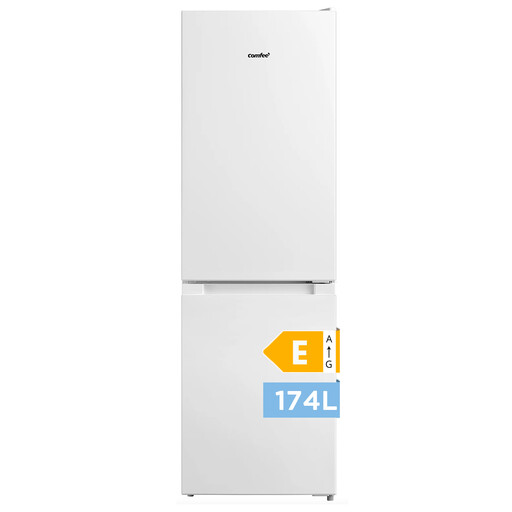 Image unavailable
Consider this model if a total capacity of 174 l is enough for your groceries and batch-cooked portions. It’s listed with Low Frost, an adjustable thermostat, a reversible door and an E energy rating. Check the exact dimensions before installation, as the measurements given in the product descriptions differ.
Anses recommends keeping an eye on the temperature in the coldest part of the fridge, where it should be 4 °C. Check your appliance manual to find this area. Choosing a larger fridge doesn’t replace checking the temperature.
No. Anses recommends freezing food as soon as you buy or prepare it, rather than waiting until its use-by date is approaching. Extra capacity makes it easier to store portions, but it doesn’t replace good food-storage practices.
The EU energy label shows details including the energy rating, annual consumption in kWh, storage capacity and noise emissions. Compare these details across models with a capacity that meets your needs, rather than relying on the total capacity alone.
Not if your main problem is a lack of space for frozen portions. First choose a suitable balance of capacity between the compartments, then look at the model’s defrosting feature, annual energy consumption and noise level.
If your current capacity is enough, protect and label portions in suitable containers while keeping food easy to reach. Anses also advises against overfilling the fridge, so air can circulate. Containers won’t make up for a genuine lack of capacity.