Households of two to four people
If you do a big weekly shop and cook regularly, consider how much room you need for fresh food, prepared meals and frozen food. The total capacity alone doesn’t tell you how that space is divided.


If your weekly shop includes fresh food, meals to keep and frozen food on a regular basis, start by comparing fridge-freezers with a separate freezer compartment. To work out the right capacity, UFC-Que Choisir suggests allowing 100 to 150 L for one person, plus 50 L for each additional person. Adjust this to suit your habits, and check the available space, freezer capacity, annual energy consumption and noise level separately. A more compact model may be enough if you don’t store much, while a multi-door fridge-freezer needs both plenty of storage space and a kitchen that can accommodate its size.
If you do a big weekly shop and cook regularly, consider how much room you need for fresh food, prepared meals and frozen food. The total capacity alone doesn’t tell you how that space is divided.
If space is tight and you don’t keep much frozen food, compare the usable capacity with the appliance’s external dimensions. A compact model should still have enough room for your shopping without being packed to the brim all the time.
A large fridge-freezer or multi-door model may suit your needs if you store a lot of fresh food, prepared meals and frozen food. Measure the space and access routes too, then compare the noise levels and energy consumption of the models you’re considering.
Start with how much food you need to store after your shop, then compare the capacity you need with the space available and each model’s features.
| What to check | Points to consider | Your needs |
|---|---|---|
| Capacity and compartments | As a guide, UFC-Que Choisir recommends 100 to 150 L for one person, plus 50 L for each additional person. Check the fridge and freezer capacities separately, as well as the layout inside. | I want room for my shopping, prepared meals and usual amount of frozen food, rather than choosing based on the total capacity alone. |
| Keeping food cold | Check the temperature in the coldest part of the fridge and leave room for air to circulate after putting your shopping away. Anses recommends 4 °C in this area; UFC-Que Choisir’s testing also looks at how appliances cope with a weekly shop. | After my shop, I need enough room to store perishable food without overfilling the fridge. |
| Installation and noise | Compare the height, width and depth with the space available and your access routes. Check that the doors can open fully, allow for the clearances specified by the manufacturer and look at the stated noise level in dB. | The appliance needs to be delivered and used in my kitchen without getting in the way. If the kitchen is open-plan, noise matters too. |
| Energy consumption | For appliances of a similar size and capacity, compare the energy rating with the kWh/year, capacities and noise levels. ADEME describes the energy label as information for shoppers; the rating letter alone doesn’t tell you the annual energy consumption. | I want to compare the energy consumption of models that meet my storage needs, while taking their differences in size into account. |
Two models with similar total capacities may have different amounts of space for fresh and frozen food. This matters if you freeze portions of meals or regularly buy frozen food.
Compare the usable capacity of each compartment on the product page for the exact model, then check whether the shelves, drawers and bins suit your shopping.
An appliance that’s regularly overfilled leaves less room for air to circulate. Anses recommends not overfilling the fridge.
Allow enough room for your biggest shop, rather than choosing a model based on how full it is at the end of the week.
If the depth or height isn’t right, you may not be able to install the appliance, even if it fits across. UFC-Que Choisir points out that very large models need a sufficiently spacious kitchen.
Measure the space, doors, corridors and stairs, then check that the doors can open fully and allow for the clearances specified for your chosen model.
The rating letter doesn’t replace the annual energy consumption figure in kWh. On its own, it’s less useful when the appliances you’re comparing have different capacities or sizes.
Compare the kWh/year figures for models that suit your household, along with their capacity and noise levels. You can also look up the model in EPREL, the European Commission’s database for products covered by energy labelling.
The specifications below apply to the models listed, not to every appliance from each brand.
On its product page for the KGN39AIAU fridge-freezer, Bosch lists an A energy rating and an A noise rating, with a noise level below 29 dB.
LG France lists the GBB72BM9CQ1 fridge-freezer as having a total capacity of 387 L, consuming 174 kWh/year and producing 35 dB of noise.
Samsung France lists the RB38T602CSA fridge-freezer as having a capacity of 385 L, a depth of 600 mm and a stated noise level of 35 dB.
Beko’s HarvestFresh range includes fridges designed to store fresh food, vegetables and prepared meals.
This selection includes fridge-freezers for storing fresh and frozen food, plus a multi-door model for those who need more storage space. Start by choosing according to the capacity you need and the space in your kitchen.
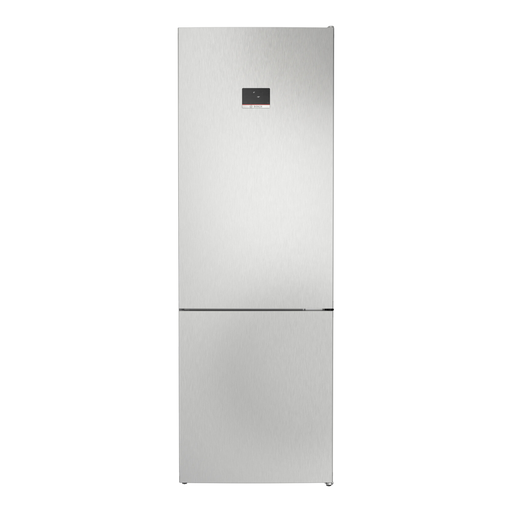 Image unavailable
If you do a large shop that includes plenty of frozen food, compare how much space you need in each of the two compartments. Also check that this fridge-freezer’s dimensions suit your space and access routes.
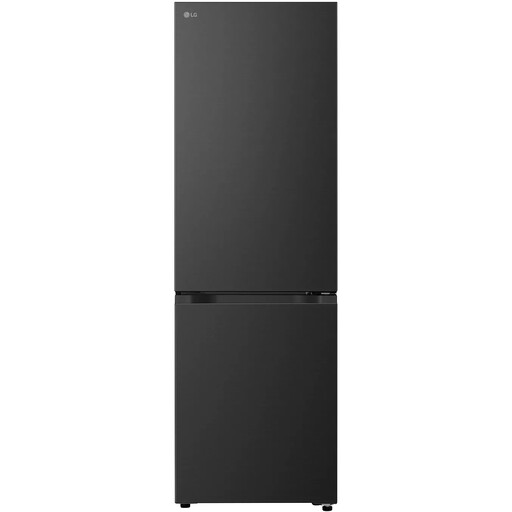 Image unavailable
If you’re looking for a fridge-freezer for several days’ worth of shopping, compare its 333 L capacity with the amount of fresh and frozen food you store. Check the separate compartment capacities, dimensions and noise level for this model.
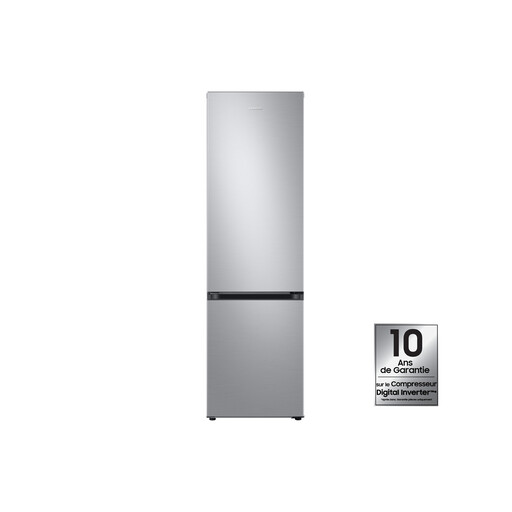 Image unavailable
If you want to store prepared meals and frozen food, check how the 390 L capacity is divided between the compartments. Measure the space available too before choosing this model.
 Image unavailable
This four-door model offers plenty of storage, provided your kitchen has room for it. Check the width, door clearance and annual energy consumption before choosing an appliance of this size.
 Image unavailable
Its stated width of 54 cm could be useful in a narrow kitchen, but check its height of 176 cm and the clearances required too. If you store lots of frozen food, check the freezer capacity before choosing this 70/30 model. The freezer needs manual defrosting.
As a starting point, UFC-Que Choisir recommends 100 to 150 L for one person, plus 50 L for each additional person. Adjust this guide to suit the prepared meals you store and the size of your shop, then work out separately how much space you need for frozen food.
It may be suitable if you only need to store a small amount of frozen food. If you regularly buy frozen food or freeze portions of meals, check the type and capacity of the compartment. UFC-Que Choisir notes that a simple ice box isn’t enough if you eat a lot of frozen food.
Avoid overfilling it and check the temperature in the coldest part of the fridge. Anses recommends 4 °C in this area, where you should store perishable foods. Leave space between products so air can circulate too.
Compare the energy rating, kWh/year, capacities and noise levels, ideally between models of a similar size and capacity that suit your needs. ADEME describes the label as a tool to inform shoppers; the European Commission’s EPREL database lets you look up information for the models it covers.