Households that shop less often
If you stock up for a week or longer, compare the usable capacity of both compartments with the amount of fresh and frozen food you need to store between shopping trips.


Start by choosing the usable capacity you need based on the number of people in your household and how often you shop, then check how much room you’ll need for frozen food. A fridge-freezer combines both compartments in one appliance; a tabletop or larder fridge is better suited to more limited storage needs, while a multi-door model calls for careful checks of the available space and access to your home. Whatever you choose, compare the dimensions, door clearance and ventilation requirements for the specific model.
How often you shop, the space in your kitchen and how much frozen food you store all influence your choice of format, as highlighted in Que Choisir’s fridge guide.
If you stock up for a week or longer, compare the usable capacity of both compartments with the amount of fresh and frozen food you need to store between shopping trips.
A tabletop or larder fridge can free up space, as long as its capacity meets your needs. Also measure the space available, door clearance and the gaps required by the installation instructions.
Compare the freezer capacity separately from the fridge capacity. A fridge-freezer or a larger format may be worth considering, depending on how much space you need and what’s actually available.
Start with the amount of food you need to store, decide how much room you need for fresh and frozen food, then check that the appliance will fit and work properly in its intended position.
| Criteria | What to check | Based on my needs |
|---|---|---|
| Usable capacity | Compare the usable litres with the number of people in your household and how often you shop. Que Choisir suggests 100 to 150 L as a starting point for one person, plus 50 L for each additional person; adjust this to suit your habits. | If I do a big shop less often, I need enough room between shopping trips, rather than choosing based solely on the appliance’s external size. |
| Compact format | For a tabletop fridge, check its usable capacity and whether it has a freezer compartment. For a larder fridge, check whether it includes a freezer section and how much space it offers. | In a small kitchen, I can prioritise a compact design if I store little food or have another way to keep frozen food. |
| Fresh and frozen food | For a fridge-freezer or multi-door model, compare the fridge and freezer capacities separately. Que Choisir recommends considering how much frozen food you store and how often you shop, rather than looking at the total capacity alone. | For weekly shops that include frozen food, I’m looking for a separate freezer compartment with enough capacity for what I actually store. |
| Location | Measure the recess or available space, as well as the doors, hallways and stairs along the delivery route. Check the door clearance and ventilation gaps specified in the model’s instructions. | If my kitchen or access routes are narrow, I need to be able to install the appliance and open its doors—not just fit it into the floor space. |
| Energy and noise | Compare appliances with similar capacities and layouts. According to the European Commission, fridge energy labels show details including the A to G energy rating, energy consumption, storage volumes and airborne noise emissions. | In an open-plan kitchen, noise matters to me just as much as the energy consumption shown on the model’s label. |
Two appliances with a similar total capacity may offer different amounts of space for fresh and frozen food.
Estimate what you store between shopping trips, then compare the capacity of each compartment separately.
An appliance that fits in a recess may not necessarily be suitable for installation there: there must also be room for air to circulate and for the doors to open. Bosch and Beko both highlight the importance of ventilation in their installation guidance.
Check the required clearances and installation conditions in the instructions for your chosen model, then measure the space around nearby units.
Delivery can be difficult even if your kitchen has enough room. For the American-style fridge-freezers covered in its guide, Que Choisir notes that widths can approach 1 m and weights can exceed 100 kg; these measurements don’t apply to every multi-door model.
Check the dimensions and weight of the model you’re considering, as well as every access point along the route to its intended position. Then compare its capacity and energy label with those of a fridge-freezer that meets your needs.
A water or ice dispenser, or a connected feature, won’t solve a lack of storage space or make an unsuitable installation work.
First check the compartments, location and installation requirements; then consider which features you’ll actually use.
Brand ranges offer a choice of different layouts, but dimensions and installation requirements vary from model to model.
Bosch France’s range includes larder fridges, fridge-freezers and multi-door models.
Beko offers integrated fridge-freezers that may be worth considering if your appliance needs to fit into your kitchen units.
Samsung France’s range includes larder fridges, fridge-freezers, American-style models, multi-door models and integrated options.
These two-, three- and four-door models let you compare different capacities if you want to store fresh and frozen food in the same appliance. Check the full dimensions and installation instructions before choosing.
 Image unavailable
Worth considering if you want to combine fresh food storage and freezing in a three-door appliance. The model name indicates Total No Frost, an E energy rating, Wi-Fi and My Zone. Compare the capacity of each compartment and the installation requirements before deciding.
 Image unavailable
Worth comparing if you need plenty of capacity for fresh and frozen food. This silver multi-door model is listed with Total No Frost, Smart Inverter and an E energy rating. Check how the capacity is divided, as well as the width and delivery access.
 Image unavailable
The stated width of 54 cm may help you compare this black fridge-freezer with the space you have available. The model name indicates a height of 176 cm and a 70/30 split; check which compartments this refers to, as well as the clearances specified in the instructions.
 Image unavailable
This silver fridge-freezer lets you compare a stated width of 54 cm with the convenience of an integrated freezer: its name specifies 153 L for the fridge and 74 L for the freezer. It also lists Low Frost, a 4-star freezer rating, a reversible door and an E energy rating. Check the other dimensions and the model’s energy label for its consumption.
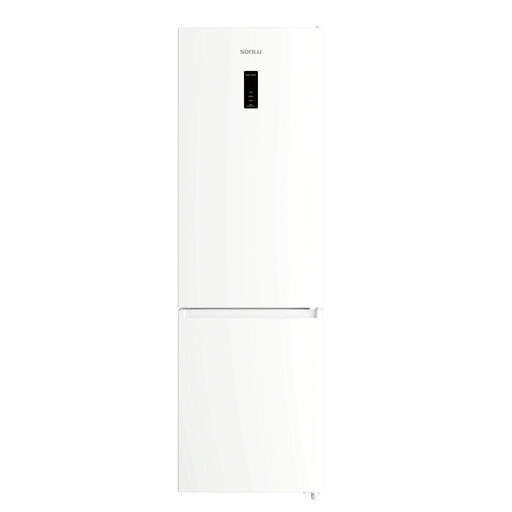 Image unavailable
If you’re looking for more space in a fridge-freezer, compare the stated 252 L fridge capacity and 103 L freezer capacity with what you usually buy. The model name indicates a reversible door, an inverter compressor and an E energy rating. Check the full dimensions, ventilation requirements and energy consumption in the model documentation.
Que Choisir suggests 100 to 150 L as a rough guide for one person, then around 50 L for each additional person. Adjust this starting point to how often you shop and how much frozen food you store, comparing the capacity of the two compartments separately.
A small freezer compartment may not be enough if you buy a lot of frozen food, as Que Choisir points out. If you store frozen food regularly, consider an appliance with a separate freezer compartment and check its capacity in litres.
Measure the space where the appliance will go and the entire access route, including doors, hallways and stairs. Also check the fridge-freezer’s door clearance and the ventilation gaps required by its instructions; for larger models, check the weight too.
Start by comparing fridge-freezers with similar capacities and layouts. The European Commission says their energy labels show details including the A to G energy rating, energy consumption, storage volumes and airborne noise emissions. Consider all these details together, especially if the appliance will be in an open-plan kitchen.