Households that often prepare and freeze meals
Compare the space you need for fresh food with the room required for frozen meals at the same time. If a fridge freezer can’t accommodate both, consider whether you could install a separate freezer.


First, work out how much space you need for fresh food and frozen meals, comparing the two capacities separately. A fridge freezer combines both in one appliance. A small freezer compartment may be enough if you don’t freeze much, while two separate appliances could suit a long-term need for greater freezer capacity, provided you have the space and compare their energy use.
Compare the space you need for fresh food with the room required for frozen meals at the same time. If a fridge freezer can’t accommodate both, consider whether you could install a separate freezer.
Choose a fridge capacity that suits your needs, then check whether the freezer compartment is big enough for the occasional frozen item. The European Commission says the energy label shows these capacities separately.
Check the description of the appliance being sold and, if it’s described as refurbished, find out what tests have been carried out. Also check whether the seller is a business or a private individual before reviewing the terms of sale.
Start by working out how much you need to store in the fridge and freezer. Then compare appliances that can meet both needs and fit in your available space.
Consider this if: you need to store fresh food and frozen meals in one appliance.
Bear in mind: a large total capacity doesn’t guarantee the right balance between the two compartments.
Consider this if: you mainly store fresh food and only a few frozen items.
Bear in mind: make sure there’s enough room for all the meals you want to freeze.
Consider this if: you regularly need more freezer capacity than a fridge freezer that suits your home can provide.
Bear in mind: you’ll need space to install and run two appliances; this setup won’t automatically use less energy.
| Feature | What to check | Think about your needs |
|---|---|---|
| Capacity | Compare the fridge and freezer capacities in litres shown on the energy label, then check how the compartments are laid out. | I want enough room for my fresh groceries and the prepared meals I freeze at the same time, rather than relying on the total capacity alone. |
| Energy use | Check the kWh/year and energy rating of models with capacities that suit your needs. If you’re considering two appliances, check both. | As ADEME points out, refrigeration appliances run continuously. I’d rather compare their energy use once I know what capacity I need. |
| Space and noise | Measure the available space and check the appliance dimensions and installation clearances. Compare the noise emissions shown on the energy label. | If my kitchen is open-plan or close to a room that’s often occupied, the stated noise level matters just as much as the space available. |
| Second life | For a second-hand or refurbished appliance, check the condition of the actual item, the tests carried out and the seller’s status. Find out which spare parts are available for the model you’re considering. | I want to know what checks have been carried out on the appliance being sold and who to contact if a problem arises. |
This figure doesn’t tell you how much room there is for fresh groceries or frozen meals. The European Commission says the energy label shows these capacities separately.
Work out what you’ll store in each compartment at the same time, then compare the relevant capacities in litres.
According to ADEME, refrigeration appliances run continuously, and a larger size or extra features can increase your electricity bill.
Compare the annual energy use of appliances with a suitable capacity, and choose features that fit your habits.
A separate fridge and freezer both run continuously. You can’t work out their energy use just from the type of setup.
If a separate freezer would meet a long-term need, compare the kWh/year, capacities, noise levels and space required for the models you’re considering.
The Ministry of the Economy distinguishes between a simply second-hand item and a refurbished product, which has undergone functionality tests.
Ask for a description of the item being sold, the checks carried out and any repairs made. Also check who’s selling it.
These appliances combine refrigeration and freezing for groceries and prepared meals. Before choosing a total capacity, compare the internal layout with what you usually store.
 Image unavailable
A four-door appliance for storing fresh groceries and frozen meals together. The title lists a total capacity of 467 L, Total No Frost and an E energy rating. Compare the capacity of each compartment and check how much installation space you’ll need.
 Image unavailable
If width is a key consideration, the title lists this model as 54 cm wide and 176 cm tall. It has a total capacity of 262 L and a 70/30 split. Check how much freezer space is available for your prepared meals and what maintenance the Low Frost system requires.
 Image unavailable
This three-door fridge freezer is worth considering if you want to store groceries and frozen meals together. The title lists a total capacity of 360 L, Total No Frost and an E energy rating. Compare the separate compartment capacities and dimensions with your needs.
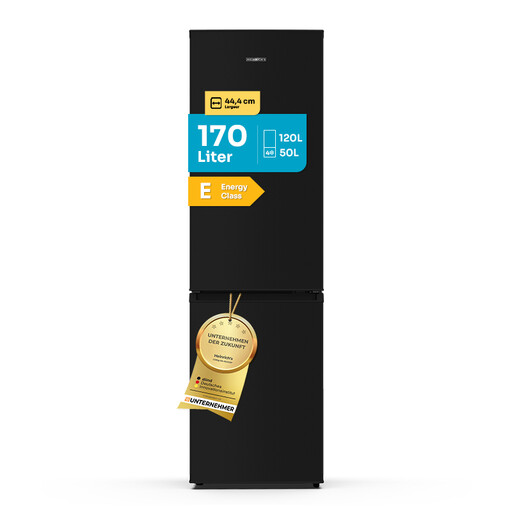 Image unavailable
The listed capacities of 120 L for the fridge and 50 L for the freezer make it easy to compare each compartment with the groceries and meals you need to store at the same time. The title lists an E energy rating and 40 dB. Also check the annual energy use and dimensions to see how it would fit in your home and suit continuous use.
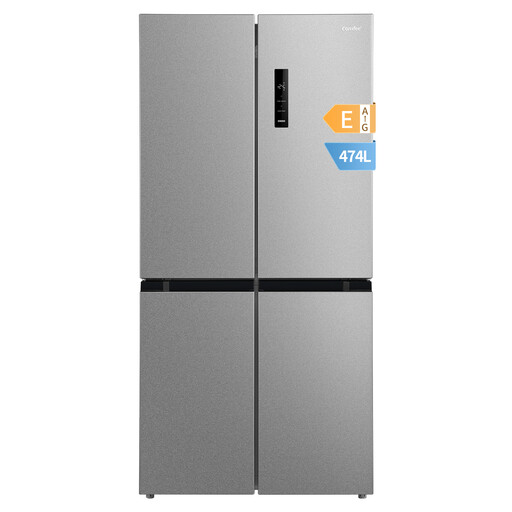 Image unavailable
The title lists a four-door appliance with a capacity of 474 L and an E energy rating. If you plan to store frozen meals regularly, check the separate fridge and freezer capacities, then compare the model’s annual energy use and noise level.
Compare the energy rating, energy use, fridge and freezer capacities, and stated noise levels of the models you’re considering. The European Commission says the label shows this information. Look at it all together rather than choosing based on the energy rating alone.
No. You need to check the freezer compartment’s capacity. The European Commission says the label shows this separately from the fridge capacity. Compare it with the amount of food and meals you keep frozen at the same time.
Check that it’s been tested, whether any repairs have been carried out and how the item being sold is described. According to the Ministry of the Economy and the DGCCRF, a refurbished product is a second-hand item that has undergone functionality checks. A simple second-hand listing doesn’t mean those checks have been done.
EU ecodesign requirements provide for certain spare parts to be available for an extended period, but this doesn’t mean that every part or repair will be available on the same terms. Before deciding, check which parts are available for the appliance you’re considering and what repair options there are.