Who is this option for?
The space you need depends as much on how many portions you freeze as on the food you keep in the fridge.
Single person or couple preparing several meals
If you cook meals for the days ahead, work out which portions need to be chilled and which need to be frozen. Then check that your containers will fit in the drawers, rather than choosing based on total capacity alone.
Household that regularly freezes portions
If you prepare several batches of meals or buy frozen food, check the freezer capacity and how easy it is to access the drawers. If your current fridge already meets your needs for fresh food, you could also consider a separate freezer, provided you have room for a second appliance.
Someone living in a small home or with an open-plan kitchen
Width isn’t everything: check the depth, door clearance and noise level. Que Choisir rates the quietest fridges in its guide at under 40 dBA; always check the stated figure for the model you’re considering.
Which criteria should you check first?
First, decide what you’ll keep chilled and what you’ll freeze. This will help you choose between a fridge freezer, a fridge with a small freezer compartment, and a separate appliance.
Fridge freezer
Consider this if: you store fresh ingredients and frozen portions every week but don’t have space for two appliances.
The trade-off: two fridge freezers with similar total capacities can have very different amounts of space for the fridge and freezer compartments.
Fridge with a small freezer compartment
Consider this if: most of your prepared meals stay in the fridge and you only freeze the occasional portion.
The limitation: Que Choisir notes that a small freezer compartment isn’t enough if you eat a lot of frozen food.
Separate freezer
Consider this if: your fridge already meets your everyday needs and you only need more space for frozen food.
Bear in mind: you’ll need space for a second appliance, which will use energy continuously, as ADEME points out.
| Priority |
What to check |
What I need |
| Capacity and storage |
Compare the fridge and freezer capacities separately, then check the number of drawers and whether there’s room for your containers. For the fridge compartment alone, Que Choisir suggests using 100 to 150 L for one person and around 50 L for each additional person as a starting point. |
I want enough room for my fresh meals without running out of space for the portions I regularly freeze. |
| Energy consumption |
Look at the energy efficiency class, kWh/year and storage capacities together on the EU energy label. If you’re considering a separate freezer, factor in the kWh/year for both appliances; ADEME points out that they run continuously. |
Extra capacity is only useful if it suits the portions I plan to store and how long I intend to keep them. |
| Space and noise |
Measure the height, width and depth, as well as the delivery route. Check the door clearance and ventilation gaps in the manual for the exact model, and look at its stated noise level in dBA. |
In a narrow or open-plan kitchen, the appliance needs to fit in the space and be quiet enough for the living area. |
| Loading prepared meals |
Check how easy it is to access the drawers and whether there’s room for your containers. If you freeze several portions at once, freezing and cooling performance after loading will tell you more than a general claim: Que Choisir’s testing protocol measures these situations. |
After a cooking session or a big shop, I need to be able to store everything and close the doors without difficulty. |
Which brands and ranges should you consider?
These examples show different formats and features to compare model by model; the specifications listed don’t apply to every product from a brand.
Bosch
The freestanding fridge freezer range includes wider formats for households that need more room in both compartments.
- According to Bosch’s specifications for the KGN492IAF, this model offers 311 L of fridge space, 129 L of freezer space and a stated noise level of 29 dB(A).
- Its stated dimensions of 2030 × 700 × 667 mm mean you’ll need to check the available space and delivery route; these figures don’t describe other Bosch models.
Beko
The range includes fridge freezers with different compartments and storage features, depending on the model.
- Beko describes Multizone as a feature that lets you convert the freezer compartment into fridge space on selected models.
- Beko’s claim that eligible Freezer Guard models can operate in an unheated room at temperatures as low as −5 °C only applies to certain models: check the model and its installation conditions.
Liebherr
The refrigeration range also includes compact fridge freezers.
- Liebherr lists the CUele281-26 with a total capacity of 265 L, a width of 55 cm and a noise level of 38 dB.
- Check the freezer capacity and internal layout of the model you choose; these figures don’t apply to the whole range.
Samsung
The fridge freezer range covers several capacities, with connected features available on selected models.
- Samsung lists the RB38C7B6AS9 with a capacity of 387 L, an A energy efficiency class, No Frost cooling and Wi-Fi compatibility.
- According to Samsung, SmartThings features require an eligible model, a Wi-Fi connection and an account; they don’t replace checking the kWh/year on the energy label.
Fridge freezers to compare on Joybuy
These five fridge freezers offer two compartments for storing prepared meals. Compare their capacities with the portions you plan to store, and check the installation requirements for each model before choosing.
 Image unavailable
Haier HTW5618ENMG, 3-door fridge freezer, 360 L
Separate fridge and freezer spaces make it possible to store fresh meals and frozen portions apart. The model name lists a capacity of 360 L, an E energy efficiency class, Total No Frost, Wi-Fi and My Zone. Compare the space in each compartment with your containers, and check the delivery route, door clearance and ventilation requirements in the manual.
View on Joybuy
 Image unavailable
Candy CFQQ5T817EPS, 4-door fridge freezer, 467 L
This multi-door format is worth considering if you plan to store lots of prepared meals and fresh food, as long as each compartment meets your actual needs. The model name lists a capacity of 467 L, four doors, an E energy efficiency class and Total No Frost. Measure the space and delivery route, then check the door clearance in the model’s manual.
View on Joybuy
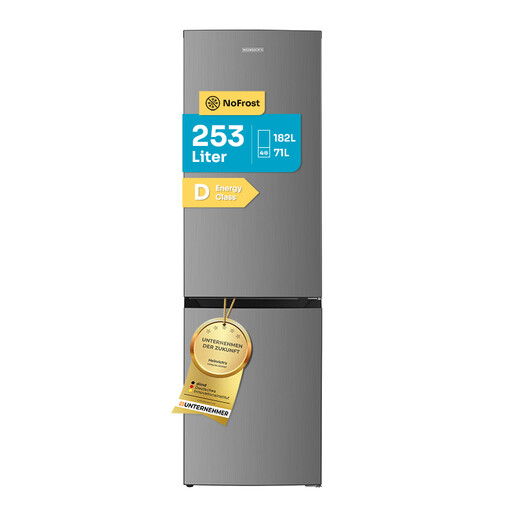 Image unavailable
Heinrich´s, 253 L fridge freezer, 182 L + 71 L
The stated split of 182 L for the fridge and 71 L for the freezer makes it easy to compare this model with the amount of fresh and frozen food you plan to store. The model name also lists 39 dB, No Frost and a reversible door. Before comparing its energy consumption or confirming it will fit, check the energy label and full dimensions.
View on Joybuy
 Image unavailable
CHiQ JR227LSE, 227 L fridge freezer, 54 cm wide
The stated width of 54 cm offers an initial guide for a narrow kitchen, but it isn’t enough to confirm that the appliance will fit. The model name lists a total capacity of 227 L, split between 153 L for the fridge and 74 L for the freezer; it also states that the model has a reversible door, Low Frost and an E energy efficiency class. Check the height, depth, ventilation gaps and kWh/year for the exact model.
View on Joybuy
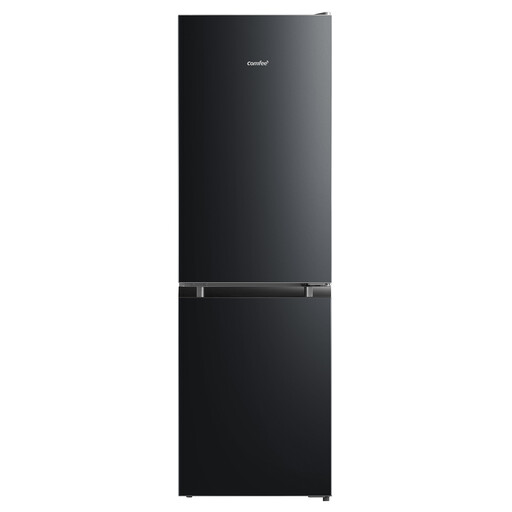 Image unavailable
Comfee' by Midea RCB230BL2EU(E), 174 L fridge freezer
Its stated total capacity of 174 L could suit smaller quantities of prepared meals, but check how much room is available for frozen portions. The model name lists Low Frost and a reversible door. Check the energy label for kWh/year and noise level, and the manual for the order of the dimensions and installation clearances.
View on Joybuy
Frequently asked questions
How do you work out the capacity you need for meal prep?
First, work out how much fridge space you need, then choose the freezer capacity based on how many portions you plan to store. Que Choisir suggests using 100 to 150 L of fridge space for one person, then around 50 L for each additional person as a starting point; after that, check how your containers will fit in the freezer drawers and available space.
Is the energy efficiency class enough to compare two fridge freezers?
No: the EU energy label also shows kWh/year, storage capacities and noise levels. Compare these figures between appliances with a balance of fridge and freezer space that suits your needs; ADEME points out that a larger size or unnecessary features can increase energy consumption.
How do you estimate the annual cost of electricity?
Multiply the kWh/year shown on the energy label by the price per kWh, including tax, on your electricity tariff. This gives you an estimate to compare appliances with a suitable capacity, rather than a guaranteed figure for your usage.
What noise level should you look for in an open-plan kitchen?
Check the stated noise level for the exact model. Que Choisir rates the quietest fridges in its guide at under 40 dBA; this can help you narrow down your options, but you should still check the appliance’s energy label.
What should you measure before your fridge freezer is delivered?
Measure the route to the kitchen, the available height, width and depth, and the space needed to open the doors. The manual for your chosen model sets out the ventilation and installation requirements you’ll need to check before confirming where it will go.


