Which features should you compare?
First decide whether you need separate capacities for fresh and frozen food. Only compare annual energy use once you’ve settled on your needs and the type of appliance.
Fridge
Consider this if: you store little or no frozen food.
Bear in mind: check whether it has a freezer compartment and how much it holds before relying on it for your regular shopping.
Fridge-freezer
Consider this if: you store fresh food every day and also keep frozen food, but don’t need a large separate freezer.
Bear in mind: the total capacity doesn’t tell you how much space each compartment has.
Separate fridge and freezer
Consider this if: your frozen food regularly exceeds the capacity of a fridge-freezer that otherwise suits your household.
Bear in mind: this option takes up space for two appliances, both of which run continuously and use energy, as ADEME points out.
| Factor |
What to check |
Who it matters to |
| Annual energy use |
The kWh/year shown on the label, compared across appliances of a similar size and capacity. |
If my fridge runs all the time, I want to avoid paying to power capacity I don’t use. Around 37% of consumers put this need first. |
| Fridge capacity |
The litres available for fresh food, based on household size and how often you shop. |
To fit in my usual shopping without running short of space, I prioritise the fridge compartment’s capacity. This is the main consideration for around 36% of consumers. |
| Freezer space |
The freezer capacity in a fridge-freezer, followed by the space needed for a separate appliance. |
If I keep a large amount of frozen food, I need to know whether a fridge-freezer can really hold it all. A separate freezer is the top priority for around 18% of consumers. |
| Size and noise |
The full dimensions and stated noise level, especially if it will be near a living area. |
In a small or open-plan kitchen, I want an appliance that fits without getting in the way of everyday life. Around 9% of consumers prioritise these considerations. |
Brands to know
There are no brands to feature in this section.
Fridge-freezers on Joybuy
These models keep fresh and frozen food in one appliance. Compare their capacities with your needs, then check the annual energy use for the exact model before making your choice.
 Image unavailable
Haier HTW5618ENMG, three-door fridge-freezer, 360 L
Worth considering if you need to store both fresh and frozen food in a 360 L fridge-freezer.
The model name indicates an E rating and Total No Frost, Wi-Fi and My Zone features. Check the capacity of each compartment and the kWh/year on the label for this model.
View on Joybuy
 Image unavailable
Candy CFQQ5T817EPS, four-door fridge-freezer, 467 L
Worth considering if you need plenty of space for fresh and frozen food, once you’ve checked that you have room for it.
The model name states an E rating and Total No Frost. Check the capacity of each compartment and the kWh/year to see whether this model is right for you.
View on Joybuy
 Image unavailable
Sonlu CC-520WE, fridge-freezer, 444 L
Its total capacity may suit a household that needs plenty of storage, provided the balance between fresh and frozen food is right.
The product name states an E rating and 40 dB. Check the separate compartment capacities, dimensions and kWh/year for this model.
View on Joybuy
 Image unavailable
CHiQ JR227LSE, fridge-freezer, 227 L, 54 cm wide
Worth considering for a kitchen with limited width, if both compartments have enough room for your usual shopping.
The model name specifies 153 L of fridge space and 74 L of freezer space. It also states an E rating, Low Frost and a reversible door. Check the full dimensions and kWh/year.
View on Joybuy
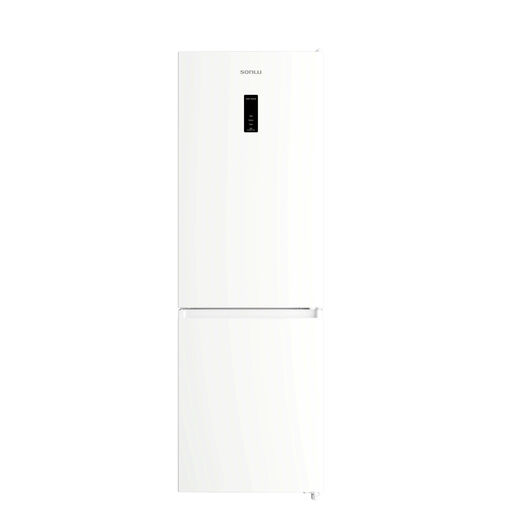 Image unavailable
Sonlu CD‑350RW, fridge-freezer, 310 L, 60 cm wide
Worth considering if you want separate capacities for fresh and frozen food in a fridge-freezer.
The model name specifies 211 L of fridge space and 99 L of freezer space, an E rating and a reversible door. Check the installation dimensions and kWh/year before comparing its energy use.
View on Joybuy
Frequently asked questions
Which figures should I check before choosing a fridge?
Check the kWh per year, then the capacity for fresh and frozen food, the dimensions and the noise level. The DGCCRF says that a new fridge sold in France must display an energy label. Compare energy use between models with similar capacity to make sure you’re comparing like with like.
Is a better energy rating enough to choose between two models?
No. Compare their annual energy use and capacity too. ADEME points out that a larger appliance or one with more capacity than you need can increase energy use, so the ratings alone don’t tell you which model best suits your needs.
When should I choose a separate freezer rather than a fridge-freezer?
Choose a separate freezer if your usual stock of frozen food won’t fit in the freezer compartment of a fridge-freezer that suits your household. Check that you have enough space, that the freezer’s climate class is suitable and what both appliances use each year. UFC-Que Choisir points out that a chest freezer may need more floor space.
What should I do if the fridge delivered doesn’t match its description?
Keep a copy of the product listing, proof of purchase and any messages you’ve exchanged with the seller, then let them know what doesn’t match. According to the Ministry of the Economy, the legal guarantee of conformity applies to new goods sold by a business to an individual in France.


