Households that do a weekly shop
A fridge freezer keeps fresh and frozen food in one appliance, as long as each compartment has room for your usual shopping. UFC-Que Choisir’s testing protocol, for example, takes a full weekly shop into account.


To store your weekly shop and prepared meals, start by working out how much space you need for fresh and frozen food, rather than relying on the total capacity alone. A fridge freezer is a good starting point if both compartments are large enough. Consider a larger model if you have the space, or a separate freezer if you need to store more frozen portions over the longer term. Then compare the dimensions, kWh/year and noise levels of models with a similar capacity.
A fridge freezer keeps fresh and frozen food in one appliance, as long as each compartment has room for your usual shopping. UFC-Que Choisir’s testing protocol, for example, takes a full weekly shop into account.
Count the containers and frozen foods you need to store at the same time. The freezer’s capacity in litres and the layout of its drawers matter more than the appliance’s total capacity alone.
A large-capacity appliance can make it easier to organise your shopping, but it needs to fit in your kitchen and along the delivery route. For American-style models, UFC-Que Choisir gives a guide of around 1 m wide and 75 to 80 cm deep.
Consider it if: you want to keep fresh food and a regular amount of frozen food in one appliance.
The trade-off: a fixed split between compartments may leave too little room for prepared meals. Check the freezer compartment before you choose.
Consider it if: you have a very small kitchen and don’t need much space for frozen food.
The trade-off: check the capacity and type of compartment before planning to freeze several meals.
Consider it if: you need a large capacity and easy access to the compartments, and your kitchen has room for it.
The trade-off: measure the delivery route too, and compare energy use with appliances that meet the same needs.
Consider it if: you need to choose the capacity for fresh food and frozen portions independently.
The trade-off: you’ll need space for two appliances and should check the energy use of each one.
| Priority | What to check | What you need |
|---|---|---|
| Separate capacities | Compare the fridge and freezer capacities in litres on the energy label, then check how much usable space the drawers offer. UFC-Que Choisir suggests a total usable capacity of 100 to 150 L for one person, then around 50 L for each additional person. | I want to store my shopping and prepared portions at the same time, without the total capacity hiding a freezer that’s too small. |
| Cooling and freezing | If available, look for tests of the model’s cooling performance after adding food, freezing performance and temperature stability. UFC-Que Choisir’s testing protocol, for example, simulates a full weekly shop. | After doing the shopping, I want to assess how the model performs when it’s full, rather than relying on its cooling technology alone. |
| Space and access | Measure the space for the appliance, door clearance, room to open the drawers and the whole delivery route. According to UFC-Que Choisir, the American-style models described in its guide need around 1 m of width and 75 to 80 cm of depth. | The appliance needs to fit all the way into my kitchen and be easy to open once it’s in place. |
| Energy and noise | For models with a similar capacity, compare the A to G energy rating, kWh/year and noise level in dB. The European Commission says this information appears on the energy label for fridges and freezers. | In an open-plan kitchen, noise matters as much as day-to-day energy use. |
A total capacity that looks sufficient may hide a freezer compartment that’s too small for several prepared portions.
Count the containers and frozen foods you need to store at once, then compare the freezer capacity in litres and the layout of its drawers.
A large appliance may fit in its intended spot but not through a doorway, along a corridor or into a lift. Samsung recommends measuring these access points before delivery.
Check the clearance, including with the appliance in its packaging, as well as the space needed to open the doors and pull out the drawers.
The A to G rating alone doesn’t tell you the annual energy use or how much usable space you’ll have.
Compare the kWh/year, fresh and frozen capacities, and noise levels shown on the energy labels of models with a similar capacity to suit your needs, as set out in the European Commission’s energy labelling guidance.
Having this feature isn’t enough to judge how well a model cools after a shop or freezes a new load of food.
If these performance measures are important to your choice, look for tests of the model that assess how it handles added food and temperature stability. These are among the criteria in UFC-Que Choisir’s testing protocol.
Bosch offers fridge freezers and single-door appliances, among other options, to compare based on the space available and the layout you want.
Samsung’s fridge freezers and larger models offer configurations to consider when comparing capacity and overall size.
Liebherr is a brand worth considering for fridge freezers with dedicated fresh-food compartments.
This Joybuy selection includes fridge freezers, a four-door model and a side-by-side appliance. Compare the space allocated to the freezer and the overall size to suit your shopping and the meals you prepare.
 Image unavailable
Worth considering if your shopping needs a large-capacity appliance with separate fresh and frozen food compartments. The model name indicates Total No Frost and an E energy rating. Check how the capacity is divided and how much space you’ll need to open the doors.
 Image unavailable
Compare this model if you’d like to organise fresh and frozen food in a three-door appliance. It’s listed with Total No Frost, an E energy rating, Wi-Fi and My Zone. Check the capacity of each compartment and the clearance you’ll need at home.
 Image unavailable
Its listed width of 54 cm is worth considering for a narrow space. The model name specifies a 153 L fridge and a 74 L freezer, with Low Frost and an E energy rating. Compare the 74 L capacity with the number of portions you plan to freeze.
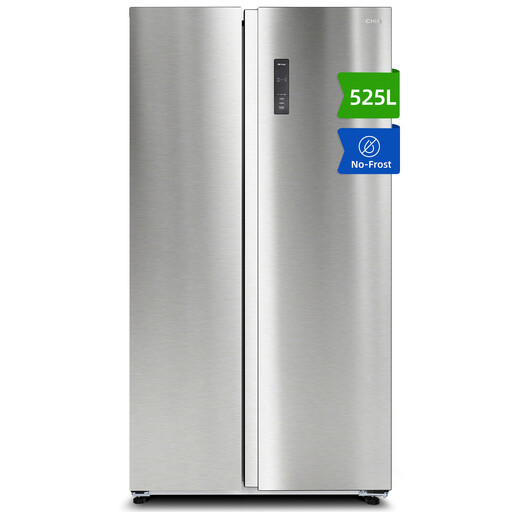 Image unavailable
Consider this model if you want plenty of room for frozen food without adding a second appliance. The model name lists 333 L for the fridge and 192 L for the freezer, as well as No Frost, an E energy rating and a noise level of 37 dB. Measure the space and delivery access points.
UFC-Que Choisir suggests a total usable capacity of 100 to 150 L for one person, then around 50 L for each additional person. If you batch-cook meals to freeze, check the freezer capacity in litres separately and see how much room its drawers offer.
Not necessarily. A fridge freezer may be suitable if its freezer compartment can fit your portions and other frozen food. If you consistently need more freezer space, two appliances let you choose each capacity independently, as long as you have room for both.
Compare the A to G rating, kWh/year, fresh and frozen capacities, and noise level rather than looking at the rating alone. The European Commission says this information appears on fridge and freezer labels in the European Union. Focus on comparing appliances with a capacity that suits your needs.
No. It depends on how much capacity you need and how much space you have. For the American-style models described in its guide, UFC-Que Choisir gives a guide of around 1 m wide and 75 to 80 cm deep. Measure the installation space and access points, then compare the compartment capacities and kWh/year of the models you’re considering.