Households that regularly stock up on frozen food
If your weekly shop includes plenty of frozen food, check the freezer capacity separately. Que Choisir distinguishes this need from occasional use of a small freezer compartment.


To keep fresh and frozen food in stock between shops, a fridge freezer lets you compare the space available for each separately. A compact model may suit you if you have limited supplies; a multi-door model offers more capacity, provided you check that it will fit in your kitchen, pass through on delivery and meet your energy needs.
If your weekly shop includes plenty of frozen food, check the freezer capacity separately. Que Choisir distinguishes this need from occasional use of a small freezer compartment.
You need to be able to install the appliance without obstructing the doors or airflow. Electrolux France highlights the importance of ventilation, while Samsung France also recommends measuring the route a large packaged appliance will take.
ADEME points out that an appliance’s size and features can affect its energy consumption. Compare the kWh/year figures for models with a capacity that suits the amount you usually store.
First decide how much space you need for fresh and frozen food, then check that the appliance will fit, open properly and work where you plan to put it. Que Choisir links the choice of format to how often you shop, how much frozen food you buy and the size of your kitchen.
Consider this if: your weekly shop regularly includes frozen food and you want two separate compartments.
Bear in mind: the available capacity is split between the fridge and freezer, so the total alone is not enough to help you choose.
Consider this if: you have a small kitchen and keep a limited amount of food for the week.
Bear in mind: its compact size leaves less room for storing plenty of fresh or frozen food.
Consider this if: you mainly store fresh food and only occasionally buy frozen food.
Bear in mind: according to Que Choisir, a small freezer compartment is not enough if you eat a lot of frozen food.
Consider this if: a larger capacity suits the amount you actually store and your kitchen can accommodate this format.
Bear in mind: check the width, delivery access and energy consumption for the model you choose.
| Criteria | What to check | Who is it for? |
|---|---|---|
| Storage capacity | Usable fridge and freezer capacity, checked separately against the amount you usually store. | If I fill the appliance with food for the whole week, I need enough room for fresh and frozen food. Around 42% of consumers put this capacity first. |
| Installation and access | The appliance and access-route dimensions, door opening space and clearances specified in the manual. | In a small kitchen or where access is difficult, I need to be able to get the appliance in and install it. This is the top priority for around 33% of consumers. |
| Energy consumption | Energy rating and kWh/year figures for appliances of comparable capacity. | If I can manage without extra capacity or features, I want to keep an eye on the energy use of the appliance I choose. This is a priority for around 25% of consumers. |
Two appliances with a similar total capacity may offer different amounts of space for frozen food. This split matters especially when your shopping needs to last until your next shop.
Compare the usable capacity of each compartment separately with the amount you usually store.
An appliance may fit in its intended spot but still not get through a doorway, along a corridor or round a corner. Once installed, air must also be able to circulate around it, as Electrolux France points out.
Measure the route and check the packaged dimensions where available, then follow the clearances specified in the model’s manual.
If the appliance cannot get through or there is not enough clearance, you may need to rethink where you plan to put it.
Extra space is only useful if the amount you store calls for it. ADEME notes that an appliance’s size and features can increase its electricity consumption.
Choose a capacity that suits your shopping habits, then compare the kWh/year figures for appliances of similar capacity.
The TSE1284N is an example of a compact model worth considering when space is limited.
The freestanding KGV58VLEAS fridge freezer is an example of a model whose fridge and freezer capacities should be compared separately.
The RM70F63NER is an example of a multi-door model designed for households that need plenty of capacity.
These fridge freezers and multi-door models offer different ways to divide space between fresh and frozen food for less frequent shopping trips. Check their dimensions, energy consumption and installation requirements against your kitchen.
 Image unavailable
Worth considering if you’re looking for a three-door appliance to store fresh and frozen food between less frequent shopping trips.
The model name indicates a capacity of 360 L, Total No Frost technology and an energy rating of E. Before choosing, compare the space in each compartment with the amount you store, and check the delivery route and required clearances.
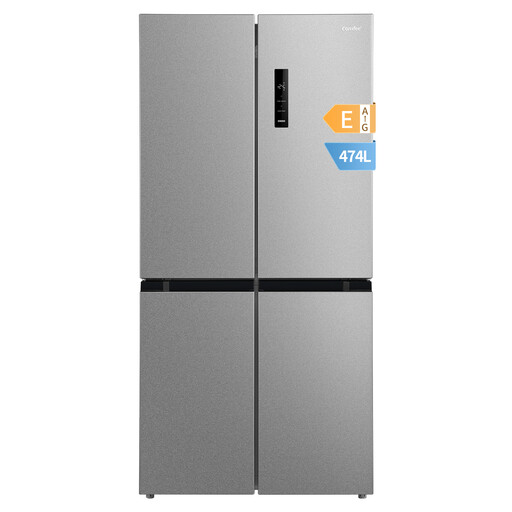 Image unavailable
This four-door format is for those looking for a large capacity for their weekly shop.
The product name indicates a capacity of 474 L and an energy rating of E. Check how the compartments are divided, how much space is needed to open the doors and whether the appliance will fit along the route to your kitchen.
 Image unavailable
Worth considering when the amount of fresh and frozen food you store calls for a multi-door model.
The product name indicates a capacity of 495 L and an energy rating of E. Measure the access route and the space needed to open the doors. If you plan to use the dispenser, check the connection requirements for this variant.
 Image unavailable
At a stated width of 54 cm, it’s worth considering if your kitchen is narrow but you still need a separate freezer compartment.
The product name splits the 227 L capacity into 153 L for refrigeration and 74 L for freezing. It also indicates a reversible door, Low Frost technology and an E rating. Check that this capacity suits the amount you store, and read the care and installation instructions.
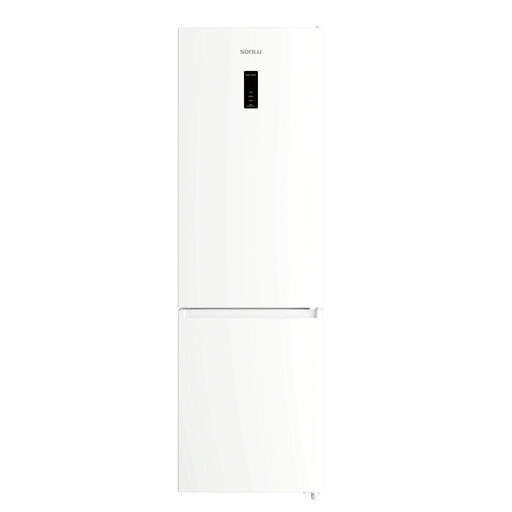 Image unavailable
This fridge freezer lets you assess separately how much space is available for fresh food and frozen food.
The product name indicates 252 L of fridge capacity, 103 L of freezer capacity, a width of 60 cm, reversible doors and an E rating. Check the dimensions needed for installation and compare the kWh/year figures before choosing.
Que Choisir suggests starting with 100 to 150 L for one person, then adding around 50 L for each additional person. Adjust this guide to suit your habits, and check the freezer capacity separately if you store a lot of frozen food.
Measure the space where it will go and the entire delivery route, including doors, corridors, lifts and corners. Samsung France recommends checking that the packaged appliance will fit. Also allow enough room to open the doors on the model you choose.
Yes, air needs to circulate around the appliance. Electrolux France advises following the installation instructions, allowing for heat sources and checking the climate class. Find the specific clearance requirements in the model’s manual.
Compare their energy ratings and stated consumption in kWh/year, preferably for appliances with a similar capacity. ADEME notes that an appliance’s size and features can affect its energy use, so extra capacity should suit your needs.