Households that shop once a week
If you store several days’ worth of fresh food as well as frozen items, compare the usable capacity of each compartment. A large total capacity doesn’t guarantee enough freezer space.


If your weekly shop includes fresh food and frozen items, a fridge freezer is a good place to start: it combines both compartments in one appliance. Then choose based on the usable capacity you need in each compartment and the space available. A more compact model may be enough if you don’t freeze much, while a larger one means checking access, dimensions and the model’s annual energy consumption.
If you store several days’ worth of fresh food as well as frozen items, compare the usable capacity of each compartment. A large total capacity doesn’t guarantee enough freezer space.
A fridge freezer lets you store fresh and frozen food in one appliance. Check its internal layout and dimensions before considering a wider model.
A table-top fridge or a single-door fridge is worth considering if you don’t freeze much, or if you already have a separate freezer. Remember to measure the space needed to open the door, too.
Start by working out how much space you need for fresh and frozen food, then compare each format with your kitchen and the specifications of the model you’re considering.
| Priority | What to check | Think about your needs |
|---|---|---|
| Usable capacity | Compare the fridge and freezer capacities in litres separately, then look at the layout of the shelves and drawers. UFC-Que Choisir suggests an average guide of 100 to 150 L for one person, plus 50 L for each additional person. | I do a big shop to last several days: I need room for fresh food without choosing a freezer that’s too small for my frozen items. |
| Format and dimensions | Measure the height, width and depth, as well as the delivery route and door clearance. A table-top fridge can suit limited space; a fridge freezer combines fresh and frozen storage; a multi-door or side-by-side model means paying particular attention to its width. | In a small kitchen, I’d first check what will fit and open properly. If I’m looking for more storage, I also need to make sure the appliance can be delivered and installed. |
| Energy use and noise | The European Commission’s energy label runs from A to G and shows the model’s energy consumption and noise level. Compare annual kWh figures for appliances with similar capacities and uses. You can also look up information registered for a particular model in EPREL. | My kitchen opens onto the living area, so noise matters just as much as annual energy consumption. |
| Freezing and maintenance | Check the usable capacity of the freezer compartment and the features listed for the exact model. A single-door fridge may need a separate freezer solution; don’t assume every fridge freezer has No Frost. | I regularly buy frozen food, so I want to know the freezer’s actual capacity and what maintenance the model I choose will need. |
Two appliances with a similar total capacity may allocate the space differently between fresh and frozen food. The compartment you rely on most could end up being too small.
Work out what you store in each compartment, then check the individual capacities on the model’s product page or in EPREL.
A large appliance may fit in the space you’ve set aside but be difficult to get through a doorway, corridor or lift. Once it’s installed, its doors could also get in the way.
Before ordering, measure the appliance, the delivery route and the space needed to open the doors.
The rating alone doesn’t tell you a model’s annual energy consumption or how much storage space it offers.
Compare the annual kWh figures of appliances suited to similar storage needs, then check their dimensions and noise levels.
These are general pointers about each brand’s range, not claims about every model or the products featured below.
Bosch’s range in France includes fridge freezers that combine fresh and frozen food storage.
Samsung’s French catalogue includes multi-door, fridge-freezer and side-by-side models.
Whirlpool’s range in France includes fridge freezers with compartments for fresh and frozen food.
This selection includes fridge freezers, a multi-door model and a side-by-side model for storing fresh and frozen food. Compare their stated capacities with the space you have at home.
 Image unavailable
For a weekly shop with fresh and frozen food, this model brings both storage spaces together. The product name lists a 360 L capacity, Total No Frost, an E energy rating, Wi-Fi and My Zone. Check the capacity of each compartment and the full dimensions to make sure it suits your kitchen.
 Image unavailable
Worth considering if you need plenty of room for fresh and frozen food. The product name lists a 467 L capacity, Total No Frost and an E energy rating. Measure the space, allow for all four doors to open and check the delivery route before choosing this format.
 Image unavailable
If you’re comparing fresh and frozen storage for a narrow kitchen, the product name lists 153 L of fridge capacity and 74 L of freezer capacity, with a width of 54 cm. It also lists a reversible door and an E energy rating. Low Frost is not the same as No Frost: check the maintenance requirements and any other dimensions needed for installation.
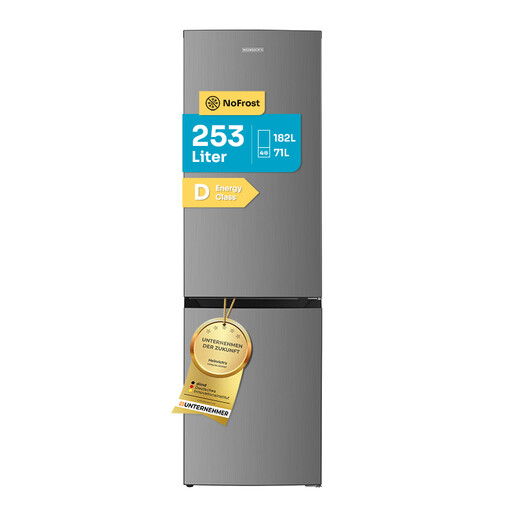 Image unavailable
This fridge freezer lets you assess the 182 L of fridge space and 71 L of freezer space separately. The product name lists No Frost, LED lighting and 39 dB. Check the full dimensions and annual kWh figures to compare it with other appliances suited to your kitchen.
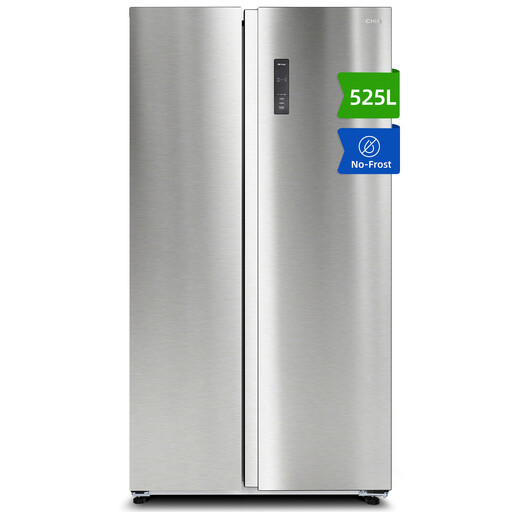 Image unavailable
If you need plenty of storage, the product name lists 333 L of fridge capacity and 192 L of freezer capacity, as well as No Frost, 37 dB and an E energy rating. Before choosing this larger model, check the full dimensions, door clearance, delivery access and annual energy consumption.
UFC-Que Choisir suggests an average guide of 100 to 150 L for one person, plus 50 L for each additional person. Use this as a starting point and adjust it to your shopping habits. Compare the space set aside for frozen food separately.
For fridges covered by the EU energy label, check the A to G rating, annual energy consumption, capacity and noise level. The European Commission says you can also use EPREL to view information registered for the model, including its dimensions and compartment capacities.
No. It depends on how much you need to store and how much space you have. Before choosing a multi-door model, measure your kitchen and delivery access, then compare the fridge and freezer capacities as well as the annual kWh figures for the model you’re considering.
No Frost may be useful if you want to reduce the need for defrosting, but it doesn’t replace checking the freezer capacity, dimensions, noise level and energy consumption. Check that the specific model has this feature and read its maintenance instructions.