What should you compare?
First choose a format that gives you the space you need for fresh and frozen food, then compare the features of appliances that can accommodate your usual stock.
Fridge-freezer
Consider this if: you regularly use both compartments and want them in one appliance.
Keep in mind: a large total capacity doesn’t guarantee enough room in the freezer drawers.
Fridge with a small freezer compartment
Consider this if: you mainly store fresh food and only occasionally keep frozen food.
Keep in mind: UFC-Que Choisir says a small freezer compartment won’t be enough if you eat a lot of frozen food.
Separate freezer
Consider this if: you mainly need extra space for frozen portions and shopping.
Plan for: a dedicated space and the electricity consumption of a second appliance, which runs continuously according to ADEME.
| What to compare | What to check | Your needs |
|---|
| Capacity and storage |
Compare the usable capacity of the fridge and freezer separately, then check drawer sizes and the space between shelves. UFC-Que Choisir gives a general guide of 100 to 150 L for one person, plus 50 L for each additional person; this alone doesn’t determine how much freezer space you need. |
My meal containers need to fit alongside fresh food, and my frozen portions alongside the frozen food I buy. |
| Cooling and adding food |
Check how evenly the appliance cools and how much room is available when you add shopping or several prepared meals. UFC-Que Choisir assesses temperature and freezing performance when food is added; ANSES recommends not overfilling the fridge. |
After cooking or doing the shopping, I want to be able to put food away without blocking the airflow. |
| Energy use |
Check the annual consumption in kWh alongside the energy rating from A to G, then compare appliances of a similar size and capacity. If you’re buying a separate freezer, also consider its energy consumption on top of that of the fridge you’re keeping. |
If I add a second appliance, the extra freezer space needs to justify its additional energy use in my eyes. |
| Installation and noise |
Measure the appliance and check it will fit through doors, corridors and lifts; make sure the doors and drawers can open fully. The European energy label also shows noise emissions. |
In an open-plan kitchen or a narrow space, I need to be able to install the appliance and access its storage easily. |
Which branded models can you use as a guide?
These features apply to the models listed, not to every appliance made by each brand.
Bosch
The KGN493WDA fridge-freezer is a useful example for comparing the stated fresh and frozen storage capacities.
- Bosch lists a 330 L fridge, a 108 L freezer and a noise level of 38 dB(A) for this model.
- Check that its 108 L freezer capacity and dimensions suit your containers and the space you have in mind.
Samsung
The RB38T602CSA fridge-freezer is a useful reference for comparing total capacity and dimensions.
- Samsung lists a total capacity of 385 L and dimensions of 595 × 2 030 × 658 mm for this model.
- Total capacity alone won’t tell you how much room there is for frozen food: check the freezer capacity of the version you choose.
Whirlpool
The WB70E973W is an example of a large-capacity fridge-freezer whose dimensions need careful consideration.
- Whirlpool lists a total capacity of 462 L for this model.
- At 70 cm wide and 75,5 cm deep, you’ll need to measure the space and the route to it.
Which fridge-freezers should you look at on Joybuy?
These five fridge-freezers combine fresh and frozen storage in one appliance. Compare their internal layouts before choosing a model for your prepared meals.
 Image unavailable
Haier HTW5618ENMG, 3 doors, 360 L
Its three doors let you separate storage for fresh and frozen food; check how much room each compartment offers for your containers.
The product name lists Total No Frost, an E rating, Wi-Fi and My Zone. Measure the route and the space before ordering.
View on Joybuy
 Image unavailable
Candy CFQQ5T817EPS, 4 doors, 467 L
This four-door design is worth considering if you need to divide a large amount of food between fresh and frozen storage; check the capacity and access for each area.
The product name lists Total No Frost, an E rating and Smart Inverter. Check that there’s enough room to open the doors where you plan to put it.
View on Joybuy
 Image unavailable
CHiQ JR263LGE, 262 L, Low Frost, 70/30
With a stated 70/30 split, check that the freezer section can hold your usual portions as well as the frozen food you buy.
This model is listed as 54 cm wide and 176 cm high. Low Frost doesn’t mean you’ll never need to defrost it manually.
View on Joybuy
 Image unavailable
Bosch KGN33NLEB, bottom freezer, 282 L
A bottom freezer is worth considering if you often separate frozen portions from fresh food.
The product name lists an E rating. To decide whether it suits your kitchen and the amount you store, check the capacity of each compartment, the noise level and the freezing features of this specific model.
View on Joybuy
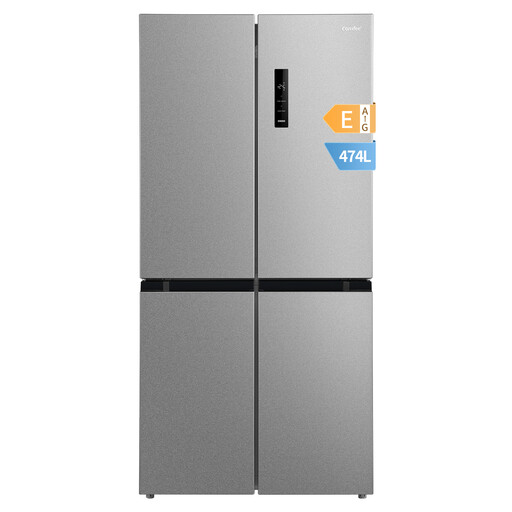 Image unavailable
COMFEE' RCF470LS2EU(E), 4 doors, 474 L
If you store containers of different sizes, take a look at the Flip Tray layout listed for this model rather than relying on its total capacity of 474 L alone.
The product name also mentions Vario Box and an E rating. Check the usable fresh and frozen capacities, kWh/year and noise level for the exact model.
View on Joybuy
Frequently asked questions
How much space do you need for prepared meals?
Separate the containers you’ll keep chilled from those you’ll freeze, then add the frozen food you usually buy before comparing the capacity of each compartment. UFC-Que Choisir gives a general guide of 100 to 150 L for one person, plus 50 L for each additional person; adjust this to account for how much of your food you keep frozen.
When should you consider a separate freezer?
Consider one if you’re consistently short of freezer space, while your fridge still meets your needs for fresh food. Check where it will go, how the drawers are arranged and the second appliance’s annual energy consumption; ADEME notes that fridges and freezers run continuously.
What should you look for on a fridge-freezer’s energy label?
According to the European Commission, the EU energy label for household refrigeration appliances shows the A to G rating, annual energy consumption, storage capacities and noise level. Compare the kWh/year figures in light of each model’s capacity and format, rather than looking at the rating alone.
How can you avoid overfilling the fridge with prepared meals?
Leave enough space between containers for air to circulate. ANSES recommends not overfilling the fridge and advises keeping food at between 0 and +4 °C in its coldest area; it also recommends not putting hot food straight into the fridge.
What should you measure before ordering a large appliance?
Measure the space where it will go, as well as the doors, corridors and any lift on the delivery route, taking the packaging dimensions into account. Then check there’s enough clearance to open the doors and pull out the drawers in your kitchen.


