Which households is it for?

Households that cook and freeze food every week

Two genuinely usable compartments make weekly shopping, storing leftovers and keeping frozen food much easier. Focus your comparisons on the proportion of space allocated to the freezer, how quickly the appliance cools down after a large shop, temperature stability and how long it stays cold during a power cut.

Small households or kitchens with limited space

Start with usable capacity, the external or built-in dimensions and your actual need for freezer space. An appliance category alone does not guarantee that a model will suit your kitchen or your lifestyle.

Shoppers who care about noise and service life

For an appliance that runs continuously, check its kWh/year, noise level in dB(A), stability test results and access to spare parts. In France, the repairability index does not currently cover refrigerators, according to the ministry responsible for ecological transition.

What to look for

Fridge-only

Consider it: if you mainly store fresh food and rarely use frozen products.

Check: a small freezer compartment is not a substitute for a proper freezer if you regularly store frozen food.

Freestanding fridge freezer

Consider it: if you use both the fridge and freezer every week and do not need the appliance integrated behind a kitchen door.

Check: compare energy consumption, noise and test results rather than capacity alone.

Built-in fridge freezer

Consider it: if the appliance needs to fit into a tall housing unit or behind a matching kitchen door.

Check: the housing dimensions, ventilation, door-fixing system and opening direction are all crucial.

Priority What to check Your needs
Capacity and format Compare the total usable capacity and the split between fridge and freezer space. Check the external or housing dimensions, door opening and ventilation requirements. I want enough room for my shopping and frozen food without powering space I do not need. UFC-Que Choisir suggests 100 to 150 L as a guide for one person, then around 50 L extra per additional person.
Continuous energy use Compare kWh/year between appliances with a similar format and capacity. Assess features according to how useful they really are. As the appliance runs day and night, I want energy consumption that is appropriate for the capacity I genuinely need. ADEME points out that refrigerators and freezers operate continuously.
Temperature stability Look for tests covering temperature settings, cold-air distribution, cooling after loading and performance in hot conditions. I want food to remain at a consistent temperature after shopping and repeated door openings. UFC-Que Choisir’s independent laboratory tests cover these conditions.
Noise Compare dB(A) levels between models of the same format and consult an independent acoustic assessment where available. In an open-plan kitchen, studio flat or location close to a bedroom, I prefer an appliance whose stated noise level is suitable for where it will be installed.
Parts and servicing Make a note of the full model reference, check the manual and after-sales service details, and find out how spare parts can be ordered. I want to be able to replace a door seal, drawer or hinge if necessary. European regulations provide, among other things, for a minimum availability period of seven years for certain commonly replaced parts and ten years for door seals on the appliances covered.

Mistakes to avoid before buying

  • Relying solely on the energy class or purchase price

    Energy consumption recurs every year, while excessive capacity or features you rarely use can make everyday running costs higher.

    Compare kWh/year between appliances with a similar capacity and format, then choose the features that genuinely match your habits.

  • Buying a built-in model without measuring the housing and door installation

    A model may be incompatible with the height, width, depth, ventilation or door-fixing system, even if its capacity appears suitable.

    Measure the internal housing dimensions, door type and opening direction, and check the manufacturer’s installation requirements before choosing.

  • Treating No Frost or a fresh-food compartment as proof of food preservation

    These features describe equipment or manufacturer specifications, but they do not by themselves establish temperature accuracy, cooling after shopping or how long the appliance stays cold during a power cut.

    To separate your shortlisted models, look for an independent test covering these measurements and use the manufacturer’s specifications as supplementary information.

  • Looking for a French repairability index without checking the parts

    Refrigerators are not currently covered by the repairability index in France, so the absence of a score does not allow you to assess a model’s repairability.

    Keep the full model reference, check access to the manual and after-sales service, then ask how spare parts can be obtained.

Brand guide

LG

A useful option for a large-capacity freestanding fridge freezer in a 60 cm footprint. LG presents the GBV3100EPY as a 344 L fridge freezer with a 35 dB noise level and E energy class.

  • The stated capacities and noise level can help you shortlist a model suitable for a freestanding kitchen.
  • Check the exact reference in an independent test to compare stability, real-world energy consumption, autonomy and acoustic performance.

Bosch

A useful option for standard-width freestanding fridge freezers. Bosch lists the KGN36NLEA with 216 L of fridge space and 89 L of freezer space, No Frost and a stated noise level of 42 dB(A).

  • The official product information provides clear details about the format, capacities and features.
  • No Frost or an alarm alone is not enough to distinguish models by noise, energy consumption or temperature stability.

Liebherr

A useful option for shoppers looking for a freestanding or built-in fridge freezer with dedicated food-preservation features. The CBNc 5223 is listed at 320 L and 35 dB, while the ICBNc 5623 is designed for a housing measuring 194 to 195 × 56 to 57 × 55 cm.

  • The housing references and stated capacities make it easier to check whether a model suits your installation plans.
  • BioFresh compartments and NoFrost features are manufacturer specifications that should be considered alongside your eating habits and independent results for the exact model.

Beko

A useful reference among fridge freezers tested in France: the B5RCNA346HG appears on UFC-Que Choisir’s list of tested models, while Beko publishes an environmental information sheet for this reference.

  • The full reference makes it easier to find product information and, where applicable, the corresponding test results.
  • A manufacturer’s environmental information sheet is not a substitute for an independent test of food preservation, noise or energy consumption.

Joybuy products

Joybuy options for replacing a fridge freezer used every day, including freestanding fridge freezers and one built-in model.

Samsung RB33B612EBN 344 L black fridge freezer

Samsung RB33B612EBN 344 L black, class E

For a household that regularly uses both the fridge and freezer, with 230 L of fridge space and 114 L of freezer space.

Freestanding format measuring 59.5 × 185.3 × 65.8 cm, with stated energy consumption of 254 kWh/year, a stated noise level of 35 dB and stated autonomy of 9 hours. Compare this energy use with similar-capacity fridge freezers and allow for the specified ventilation clearances.

View on Joybuy

CHiQ JR263LGE 262 L black fridge freezer

CHiQ JR263LGE 262 L Low Frost black

A 54 cm-wide option for a narrow kitchen and regular shopping, with 187 L of fridge space and 75 L of freezer space.

Dimensions of 176 × 54 × 55 cm, with stated energy consumption of 215 kWh/year, a stated noise level of 39 dB and stated autonomy of 10 hours. It is specified for an ambient temperature of 16 to 38 °C; the Low Frost system requires periodic manual defrosting.

View on Joybuy
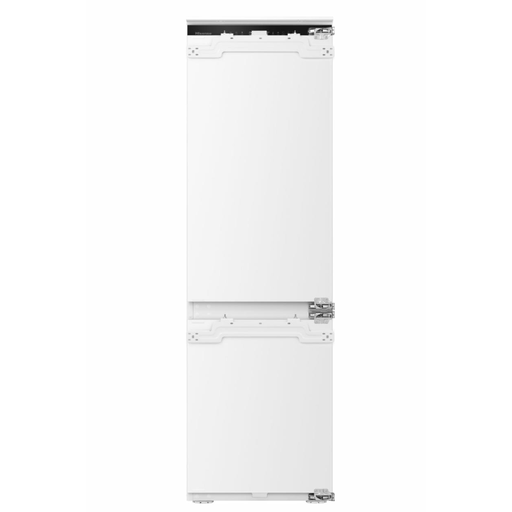
Hisense RB3B250SAWC 252 L built-in fridge freezer

Hisense RB3B250SAWC built-in 252 L, class C

For a fitted kitchen requiring two compartments, with 176 L of fridge space and 76 L of freezer space.

Stated energy consumption of 150 kWh/year, a stated noise level of 34 dB and stated holdover time of 14 hours without power. Before ordering, check the housing dimensions, ventilation and door installation compatibility against your kitchen plans.

View on Joybuy
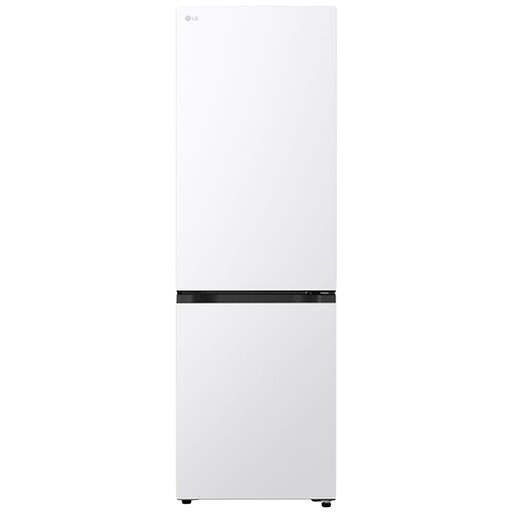
LG GBBSJ1CCSW 333 L white fridge freezer

LG GBBSJ1CCSW 333 L white, class C

A freestanding fridge freezer for a household that makes extensive use of fresh and frozen food, with 183 L of fridge space, 113 L of freezer space and a 37 L compartment.

Dimensions of 59.7 × 186 × 67.4 cm, with stated energy consumption of 169 kWh/year and a stated noise level of 34 dB. Opening to 110° against a wall is specified, with at least 5 cm of clearance required around the appliance.

View on Joybuy

Bosch KGN33NLEB 282 L stainless steel fridge freezer

Bosch KGN33NLEB 282 L, class E

A medium-sized fridge freezer for a 60 cm freestanding installation, with 193 L of fridge space and 89 L of freezer space.

Dimensions of 176 × 60 × 66 cm, with stated energy consumption of 228 kWh/year, a NoFrost freezer and three transparent drawers. Allow at least 5 cm behind, 2 cm at the sides and 10 cm above the appliance for installation.

View on Joybuy

Frequently asked questions

What capacity should you choose for a household?

UFC-Que Choisir suggests 100 to 150 L as a starting point for one person, followed by around 50 L for each additional person. Adjust this guide according to how often you shop, how much freezer space you need and how you organise your meals.

Which indicators should you compare on the label and product information?

Prioritise usable capacity for each compartment, annual energy consumption in kWh/year, noise level in dB(A), climate class, dimensions and stated autonomy. kWh/year figures are most useful when comparing appliances with a similar type and capacity.

Which independent tests can help distinguish between two fridge freezers?

Look for tests that measure temperature accuracy, cold-air distribution, cooling after adding food, stability in hot conditions, energy consumption, noise and freezer autonomy. UFC-Que Choisir’s testing protocol measures, among other things, how long the freezer stays cold without electricity.

Is a repairability index compulsory for refrigerators in France?

No. Refrigerators are not among the categories currently covered by the French repairability index, according to the ministry responsible for ecological transition. Instead, check the exact reference, manuals, available parts and service network.

Which parts must remain available for a refrigerator?

For the appliances covered, European regulations provide for the availability of handles, hinges, trays and baskets for at least seven years after the last unit of the model is placed on the market, and door seals for at least ten years. Check that the reference being sold is covered and ask where spare parts can be ordered.