What should you look for?
The right format depends first on how much space you need for frozen food. A fridge freezer suits regular freezing needs; a compact model or a fridge with a small freezer compartment may be enough if you only store a little, while a multi-door model calls for more capacity and plenty of kitchen space.
Fridge freezer
Worth considering: if your weekly shop regularly includes both fresh and frozen food.
Consider: whether the balance of fridge and freezer space suits what you buy.
Fridge with a freezer compartment
Worth considering: if you mainly buy fresh food and store few frozen items, or keep them elsewhere.
Limitation: a small freezer compartment may not offer the same functionality as a separate freezer. Check the details of the model’s compartment.
Table-top or under-counter
Worth considering: if space is your priority and you only need to store a modest amount of food.
Limitation: check the capacity and whether it can freeze food before choosing this format for your weekly shop.
Multi-door
Worth considering: if your household needs more storage space and your kitchen can accommodate a large appliance.
Consider: the extra capacity comes with a larger footprint to measure and energy consumption to compare from model to model.
| Criteria | What to check | Who is it for? |
|---|
| Space for fresh and frozen food |
The usable capacity of each compartment and the type of freezer compartment. |
When my shopping needs to last until the following week, I want to store frozen food without sacrificing space for fresh produce. Around 36 % of shoppers prioritise this balance. |
| Temperature recovery after loading |
Test results after a full weekly shop and, if you freeze fresh food, after freezing food. |
After putting away a large amount of food at once, I want to know how quickly the appliance returns to temperature. For around 29 % of shoppers, maintaining a consistent temperature is the main priority. |
| Fitting it in your kitchen |
The dimensions, access routes, door clearance and specified ventilation. |
If space is tight, I need to make sure the appliance will fit through the door and that I can open it before benefiting from its capacity. Around 21 % of shoppers prioritise how well it fits their kitchen. |
| Noise and energy use |
The stated noise level and kWh/year, compared across models with similar capacities. |
Noise matters day to day if the appliance is near a living area; I also want to know how much energy an appliance that’s always on will use. Around 14 % of shoppers prioritise these factors. |
Fridge freezers selected on Joybuy
This selection includes fridge freezers, including an integrated model, as well as multi-door appliances for storing fresh and frozen food. Compare their compartments and overall dimensions to suit your shopping habits and kitchen.
 Image unavailable
Candy CFQQ5T817EPS, 4-door multi-door fridge freezer, 467 L
Worth considering if your weekly shop calls for plenty of space for fresh and frozen food, and your kitchen can accommodate a multi-door model.
The model name indicates 467 L, four doors, Total No Frost and an E energy rating. Check the capacity of each compartment, the dimensions and door clearance before choosing.
View on Joybuy
 Image unavailable
Haier HTW5618ENMG, 3-door, 360 L
This three-door fridge freezer is worth comparing if you want separate spaces for fresh and frozen food.
The model name indicates 360 L, Total No Frost and an E energy rating. Check how the capacity is divided, the installation space required and the door clearance.
View on Joybuy
 Image unavailable
Bosch KGN33NLEB, bottom freezer, 282 L
This fridge freezer is worth comparing if you want a separate freezer for a weekly shop that includes both fresh and frozen food.
The product name indicates 282 L and an E energy rating. Check the space allocated to the freezer, the noise level if your kitchen is near a living area, and the installation instructions.
View on Joybuy
 Image unavailable
AEG NSC6M18FES, integrated fridge freezer, 249 L
Consider this model if your kitchen has space for an integrated appliance and you need two separate compartments.
The model name indicates 249 L, TwinTech No Frost and an E energy rating. Before ordering, check that the cabinet dimensions, door system and ventilation requirements are compatible with your kitchen. Also check the detailed compartment capacities in the model specifications.
View on Joybuy
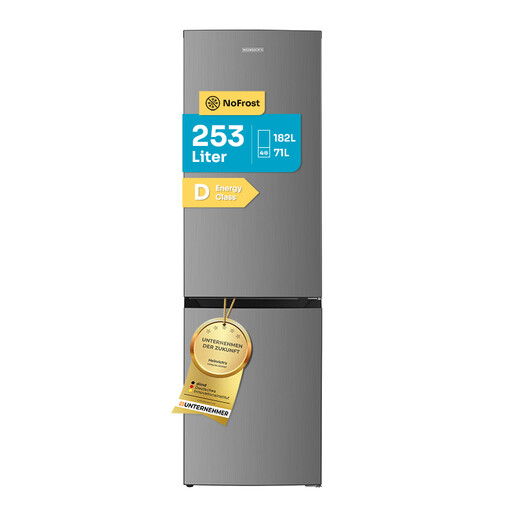 Image unavailable
Heinrich´s, 253 L fridge freezer, including 71 L freezer
This fridge freezer makes it easy to assess how much space is set aside for frozen food in your weekly shop.
The model name indicates a 182 L fridge, a 71 L freezer, No Frost and a stated noise level of 39 dB. Check its full dimensions and annual energy consumption to compare it with other models.
View on Joybuy
Frequently asked questions
What capacity do you need for a weekly shop?
UFC-Que Choisir’s guide suggests 100 to 150 L of usable capacity for one person, then around 50 L for each additional person. Use this as a starting point and adjust it to suit what you buy. Check the fridge and freezer capacities separately, especially if you store a lot of frozen food.
How can you tell how well it maintains its temperature after a full shop?
Look for tests carried out on the specific model after loading. UFC-Que Choisir’s testing protocol includes adding food daily and loading the appliance with a full weekly shop. A feature mentioned in the product name is no substitute for these results.
What should you compare on the energy label?
Compare annual consumption in kWh across appliances with similar capacities and configurations. According to the Ministry for the Ecological Transition, fridges sold in France are among the appliances covered by the energy label. The stated consumption isn’t a guarantee of how much energy your own appliance will use.
How should you arrange for your old fridge to be taken away?
Before placing your order, confirm the arrangements for taking away your old appliance, including the collection point and access requirements at your home. In a report published in 2017, the DGCCRF highlighted problems with information and the practical arrangements for taking back appliances bought online.
How much space should you leave for ventilation?
Follow the clearances specified in the instructions for your model and suited to its installation type. Bosch recommends leaving at least 200 cm² of clear space behind and beneath certain appliances. Don’t automatically apply this figure to other models.


