If your regular food shop includes a mix of fresh and frozen food, start by comparing the two compartment capacities of a fridge-freezer. A small appliance with a freezer compartment is better suited to occasional frozen food, while separate appliances are worth considering if frozen storage is a priority and you have enough space. Then compare annual energy consumption between appliances with similar configurations and capacities, and check the location and door opening requirements.
Who are these configurations suited to?
Households with a weekly mix of fresh and frozen food
If you put away fresh food and a regular supply of frozen food each week, look at the litres allocated to each compartment rather than the total capacity alone. A fridge-freezer lets you assess both needs in a single appliance.
Households stocking up on frozen food
If freezing is a priority, compare the freezer capacity of a fridge-freezer with that of a separate freezer. If you opt for two appliances, also consider how much space they take up and their respective annual energy consumption: ADEME points out that they run continuously.
Kitchens with limited space
An alcove, narrow access or a wall close to the door may rule out a model that otherwise offers the right capacity. Measure the space and delivery route, then check the hinges and ventilation requirements in the manual for your chosen model.
How do you compare appliances?
First decide how much space you need for frozen food, then compare appliances that meet this need with the space you have available. The European Commission says that the energy label for refrigerating appliances shows, among other things, compartment capacities, annual energy consumption and noise levels.
Appliance with a freezer compartment
Consider this if: you store little frozen food and want a single, compact appliance.
Bear in mind: the model’s freezer capacity needs to suit your needs; you can’t work it out from the total capacity.
Fridge-freezer
Consider this if: you regularly shop for fresh and frozen food and want both compartments in one appliance.
Bear in mind: two fridge-freezers with the same total capacity may allocate space differently between fresh and frozen food.
Separate fridge and freezer
Consider this if: ample frozen storage is a priority and your home has room for two appliances.
Bear in mind: two appliances need two spaces, and you should consider their combined annual energy consumption.
| What matters |
What to check |
Who is this for? |
| Fresh and frozen storage |
Compare the stated litres for the fridge and freezer compartments separately, then match them to your usual food shop. |
If your weekly shop regularly includes fresh and frozen food, you need enough room in both compartments, not just a large total capacity. Around 40 % of consumers would put this balance first. |
| Continuous energy use |
Compare the energy class and kWh/an on the label for appliances with similar configurations and capacities. |
If an appliance runs day and night, I want to avoid paying for capacity or features my household doesn’t need; energy efficiency would be the top priority for around 30 % of consumers. |
| Installation and access |
Measure the appliance, the space and the delivery route; check how the doors open and what ventilation the manual requires. |
In a narrow kitchen, being able to fit the appliance and open its doors fully matters more than extra features. Around 30 % of consumers would put this compatibility first. |
Mistakes to avoid before ordering
-
Choosing based on total capacity alone
This figure doesn’t show how much space is set aside for frozen food. For the relevant refrigerating appliances, the European Commission lists each compartment’s capacity on the energy label.
Compare the fridge and freezer capacities separately, taking into account how much space your usual food shop needs.
-
Going bigger without needing the extra storage
ADEME points out that refrigerating appliances run continuously, and that choosing an unnecessarily large model or too many features can push up your electricity bill.
Once you’ve chosen a configuration, compare kWh/an across similar capacities before opting for extra features.
-
Ordering before checking the door clearance and depth
An appliance may fit in the space but still not leave enough room to open the doors or meet the manufacturer’s installation requirements.
Measure the delivery route too. Check the manual for your chosen model and, if needed, the terms for installation or door-reversal services offered when you order.
Brands to consider for each configuration
Bosch
Bosch’s product details for the KIV875SE0 show what an integrated fridge-freezer can offer. This model measures 1 772 × 541 × 548 mm, with 200 L of fridge capacity and 70 L of freezer capacity.
- For this model, Bosch lists LowFrost and a noise level of 35 dB.
- Before choosing an integrated model, check the installation manual against your cabinet space and hinges. These features don’t apply to every Bosch model.
LG
The freestanding GBV22NCDEP fridge-freezer featured by LG France is an example of the stated compartment split: 277 L for refrigeration and 110 L for freezing.
- For this model, LG lists a reversible door, 35 dB and 217 kWh/an.
- Its stated dimensions of 595 × 2 030 × 682 mm should be checked against the available height and depth; they don’t apply to other LG models.
Whirlpool
The range featured by Whirlpool France includes integrated and freestanding fridge-freezers, with cooling technologies that vary by model.
- It gives you a choice of different installation types within the same brand.
- Check the capacity, energy consumption and dimensions for each model: no single figure represents the entire range.
Fridge-freezers for different spaces and storage needs
These Joybuy appliances combine refrigeration and freezing in one unit, with both freestanding and integrated options. To compare them, start with the stated capacity and installation type, then check the compartment split, energy label and manual for the model you choose.
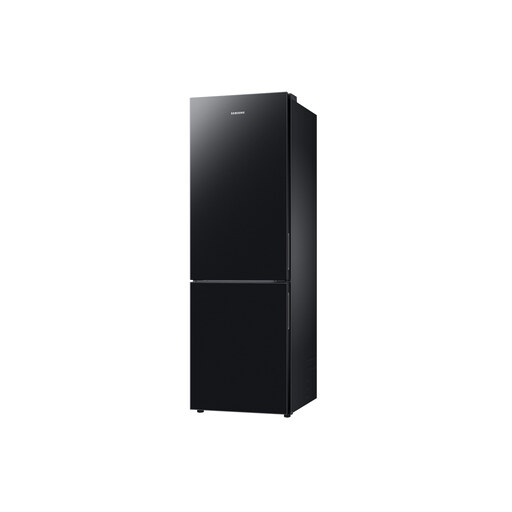 Image unavailable
Samsung RB33B612EBN, 344 L black fridge-freezer
Worth considering if you want one appliance for a mix of fresh and frozen food. Check that the space allocated to each compartment suits your habits.
The title states a total capacity of 344 L and energy class E. Check the dimensions, door opening and clearances specified in the manual for your space.
View on Joybuy
 Image unavailable
Candy CFQQ5T817EPS, 467 L four-door fridge-freezer
Consider this if you want more capacity in an appliance that combines both functions; compare the space actually allocated to frozen food with your needs.
The title lists 467 L, four doors, Total No Frost and energy class E. The product details say the doors aren’t reversible, so check that they can open fully in your kitchen.
View on Joybuy
 Image unavailable
Haier HTW5618ENMG, 360 L three-door fridge-freezer
If your food shop includes both fresh and frozen food, compare this model’s compartment capacities with those of other fridge-freezers you’re considering.
The title lists 360 L, three doors, Total No Frost and energy class E. Before ordering, measure the delivery route and check the installation clearances in the manual.
View on Joybuy
 Image unavailable
LG GBBSJ1CCSW, 333 L white fridge-freezer
Worth considering if you want to compare exactly how much space a fridge-freezer gives you for fresh and frozen food.
The title states 333 L and energy class C. If you plan to place the appliance near a wall, check the door opening direction and the clearance needed to access the drawers in the manual.
View on Joybuy
 Image unavailable
AEG NSC6M18FES, 249 L integrated fridge-freezer
Consider this if your kitchen needs an integrated fridge-freezer rather than a freestanding appliance. A good fit for the cabinet space and hinges is essential.
The title lists 249 L, TwinTech No Frost and energy class E. Check the label for kWh/an and the individual compartment capacities, then consult the manual for cabinet dimensions and ventilation requirements.
View on Joybuy
Frequently asked questions
What should I compare on a fridge-freezer’s energy label?
For the relevant domestic refrigerating appliances, the European Commission says the label shows the A to G energy class, annual consumption in kWh, compartment capacities and noise levels. Compare appliances with similar capacities and configurations in particular; the QR code links to detailed information about the model in EPREL.
Is it enough to measure the space for the appliance?
No: also measure the delivery route, the available depth and the space needed to open the doors. Then check the dimensions and installation instructions for the exact model in its manual, especially if it’s an integrated appliance.
Can you change the way every door opens?
No, door reversibility depends on the model. LG lists this feature for its GBV22NCDEP, for example, but it isn’t available on every fridge-freezer. Check the product details for your chosen appliance and find out how to change the door opening direction.


