Households preparing several meals for the week
You mainly want to keep meals fresh for the next few days, with a few frozen portions: the split between the fridge and freezer net capacities is more useful than the total capacity alone.


For meals intended mainly for the next few days, a fridge freezer offers a balance between fresh storage and frozen portions. A separate freezer becomes more suitable when your stock of portions builds up over several weeks, provided you have a suitable space; first compare the net capacities of each compartment, the dimensions and the installation requirements of the exact model.
You mainly want to keep meals fresh for the next few days, with a few frozen portions: the split between the fridge and freezer net capacities is more useful than the total capacity alone.
You regularly prepare or buy enough portions for several weeks: a separate freezer could be a good fit if its location, climate class and net capacity are suitable for your home.
First check the housing unit, external dimensions, ventilation and installation requirements. The model’s measurements and the instructions in its manual take precedence over the advertised capacity.
Consider it: if meals are mainly kept refrigerated and only a few portions are frozen.
Bear in mind: freezing capacity depends entirely on the model and must be read separately from the total capacity.
Choose it: to alternate between fresh meals and frozen portions without installing a second appliance.
Check: the space allocated to the freezer may limit a sizeable weekly stock, particularly with an integrated appliance.
Choose it: if you regularly store portions for several weeks in a dedicated space.
Plan for: its footprint, everyday access and installation requirements.
| Priority | What to check | Your needs |
|---|---|---|
| Usable capacity | Compare the fridge and freezer net capacities separately. Also look at the drawers, shelves and available height for your containers. | I want to know how many portions can genuinely be stored, rather than relying on the appliance’s total capacity. |
| Installation | Take the external dimensions or those of the housing unit. Consult the manual for ventilation, clearance from heat sources and climate class. | My appliance must fit in my kitchen, fitted unit or designated room without compromising the installation requirements. |
| Defrosting and access | Check whether the model specifies NoFrost and which compartment it applies to. Compare the door opening, drawers and access to portions according to your containers. | I want accessible storage when I take out portions frequently, with fewer issues caused by frost. |
| Comparing energy consumption | Use the energy label and product information sheet to compare models on the same basis. Also check the stated noise level. | I want to compare appliances using regulated information, rather than a general promise of savings. ADEME states that the energy label provides a useful guide when making a choice. |
A fridge freezer may allocate most of its capacity to the fridge, while prepared portions need to fit in the freezer compartment.
Note the fridge and freezer net capacities separately, then compare them with the number and size of your portions.
A model may offer the right capacity but still be incompatible with your kitchen’s height, width, depth, door mounting or airflow requirements.
Measure the housing unit and consult the diagram or manual for the exact model before ordering.
The permitted ambient temperature range depends on the climate class or on a feature explicitly stated for the model concerned.
Check the climate class in the documentation or on the rating plate, then compare it with the intended location.
Refrigeration appliances must be sent through an appropriate collection system because of the fluids they contain.
ADEME states that, when replacing an appliance, the old one can be handed to the retailer or delivery driver; a recycling centre equipped for waste electrical and electronic equipment is another option.
Worth considering for upright or integrated freezers, particularly when you want to compare capacity, dimensions, noise level and defrosting features on a specific model.
A brand worth comparing for fitted kitchens and fridge freezers, where housing-unit dimensions and the split between compartments are key considerations.
Worth looking at if you are seeking an upright freezer or fridge freezer and want to filter models by capacity, NoFrost and internal layout.
A brand to compare for No Frost fridge freezers, freestanding or integrated, when you want to combine fresh and frozen storage in one appliance.
This selection brings together fridge freezers for combining fresh meals and frozen portions, as well as dedicated freezers for increasing your storage capacity over several weeks.
 Image unavailable
For a kitchen without a second appliance, with fresh meals for several days and a few frozen portions.
187 L fridge capacity and 75 L freezer capacity; 540 mm wide, with three freezer drawers and a reversible door. The freezer requires manual defrosting; check the ventilation clearances and suitability of the intended room.
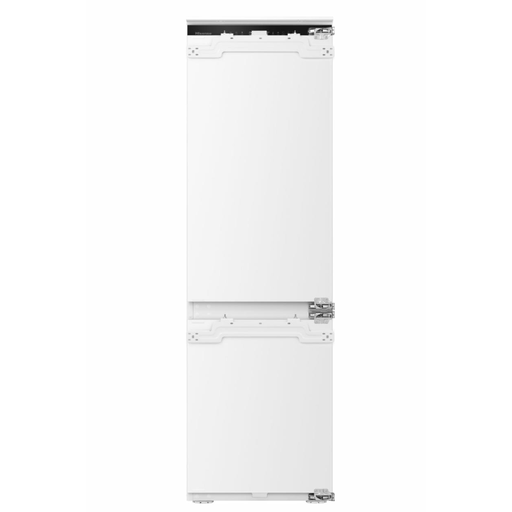 Image unavailable
An integrated option for alternating between fresh food and frozen portions in a fitted kitchen.
176 L fridge capacity, 76 L freezer capacity, three drawers and a No Frost system; C energy rating and stated annual consumption of 150 kWh. Check the housing unit, door system and ventilation requirements before installation.
 Image unavailable
For meals to be eaten over the next few days, complemented by a few portions to freeze.
186 L fridge capacity, 62 L freezer capacity and three drawers; TwinTech Total No Frost and a stated freezing capacity of 5 kg/24 h. Check the housing-unit dimensions, door-panel fitting and ventilation.
 Image unavailable
Capacity dedicated entirely to frozen portions stored over several weeks.
161 L, three drawers, two shelves, Fast Freeze function down to -22 °C and C energy rating. Allow space for a dedicated location and consult the technical specifications for the dimensions, ventilation and climate class.
 Image unavailable
Additional freezer capacity without adding a second fridge freezer.
140 L, storage basket, castors and stated dimensions of 637 × 556 × 846 mm; E energy rating. Check that top access suits your containers, as well as the installation and defrosting requirements.
Compare the freezer compartment’s net capacity separately from the fridge compartment’s net capacity and the total capacity. Also measure your containers and check the internal layout before deciding that the space will be usable.
It is mainly useful if you want to reduce manual defrosting. Liebherr and Bosch feature this technology on certain models; check that it applies to the compartment you want, as it does not replace comparing net capacity.
Only if the model’s climate class and installation requirements allow it. Electrolux recommends checking the ambient temperature stated on the rating plate; Liebherr states compatibility down to -15 °C for the FNd 7026, but this feature does not apply to other appliances.
First follow the model’s manual. Electrolux support recommends allowing air to circulate around the appliance, keeping it away from heat sources and waiting at least four hours before plugging it in after transport; the manufacturer’s own instructions always take priority.
ADEME states that, when replacing an appliance, you can hand the old one to the retailer or delivery driver. It can also be taken to the dedicated electrical and electronic equipment area of a recycling centre.