What should you compare?
Start with the food you usually keep in stock, then rule out any configurations that can’t be installed and used in the room you have in mind.
| Criteria |
What to check |
For my needs |
| Fresh and frozen capacity |
Check the capacity in litres of each compartment separately, and compare it with the number of people in your household and the contents of your shop. UFC-Que Choisir suggests allowing 100 to 150 L of fridge space for one person, plus 50 L for each additional person. Assess freezer capacity separately. |
After the weekly shop, I need to put away fresh food without sacrificing space for frozen food and pre-prepared portions. |
| Freezer configuration |
Compare the freezer compartment in a fridge-freezer with the capacity of a separate appliance. According to Electro Dépôt’s guide, an upright freezer makes it easier to find what you need day to day, while a chest freezer offers space worth considering for bulky items. Check the layout inside the model you choose. |
If I often freeze portions, I want to be able to organise them and find them easily. For large packs, I mainly need to check they’ll fit in the space available. |
| Energy use |
For appliances with similar storage capacity, check the energy rating and kWh/year shown on the label described by the European Commission. If you’re considering two appliances, check the annual energy use of each one. ADEME points out that fridges and freezers run continuously. |
I want enough space for my usual stock without choosing extra capacity I won’t use. |
| Installation and noise |
Measure the height, width and depth, as well as the access route and door clearance. Check the clearances in the manual, the climate class for the room and the noise emissions stated on the energy label, especially for an open-plan kitchen. |
The appliance needs to fit in the room, its doors and drawers need to open, and its stated noise level needs to suit the location. |
| Adding food |
For the models you’re considering, look for data or test results on how quickly they return to temperature after being loaded and, if you freeze a lot at once, on their freezing capacity. UFC-Que Choisir’s test protocol includes a full weekly shop; you can’t infer this result from the appliance format alone. |
When I get home with several bags of shopping or prepare portions to freeze, I want to know how the model performs in that specific situation. |
Brands to consider
The features below apply to specific models, not every appliance made by each brand.
Bosch
Worth considering if you’re looking for a freestanding fridge-freezer with separate controls for each compartment.
- Bosch lists Total NoFrost, VitaFresh and individual temperature controls among the features of the KGN36VLED.
- These features are stated for the KGN36VLED. Check the capacity, dimensions, kWh/year and noise level of the model you’re considering.
Liebherr
Worth comparing if you want a fridge-freezer with stated capacity and dimensions for a specific model.
- Liebherr lists a total capacity of 320 L and a noise level of 35 dB for the CBNsfc 5223, along with BioFresh and NoFrost.
- These details don’t apply to other Liebherr models. Check the compartments and dimensions of the model you choose against the space available.
Beko
Worth considering if you need a chest freezer for separate storage, with particular attention to where it will be installed.
- Beko states that its HSM14540 chest freezer can operate in an unheated room at temperatures as low as -15 °C.
- Don’t assume the same temperature range applies to other Beko chest freezers. Check the ambient temperature range in the relevant model’s manual.
Models available on Joybuy
This selection includes fridge-freezers for storing fresh and frozen food in one appliance, as well as a 95 L convertible chest freezer to consider as a separate reserve.
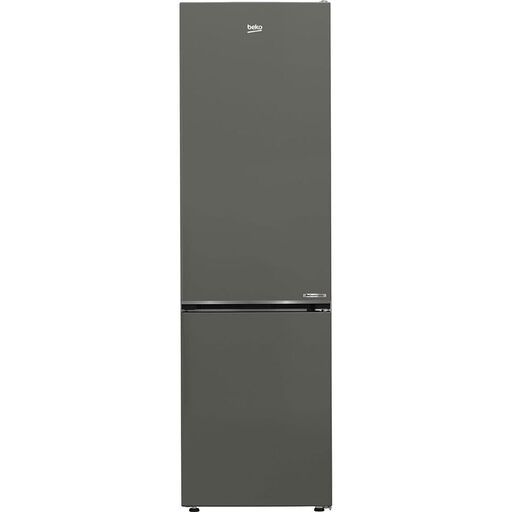 Image unavailable
Beko B5RCNE406HG — 355 L Total No Frost fridge-freezer
To store fresh and frozen food in one appliance, compare its 355 L capacity with your household’s usual stock. The title lists Total No Frost and an energy rating of C. Check how the capacity is split between compartments and the dimensions needed for installation.
View on Joybuy
 Image unavailable
Candy CFQQ5T817EPS — 467 L 4-door fridge-freezer
Its 467 L capacity is worth considering if you regularly need to store a lot of food, rather than choosing it based on the occasional big shop alone. The title lists Total No Frost and an energy rating of E. Measure the access route and installation space for this four-door model.
View on Joybuy
 Image unavailable
CHiQ JR263LGE — 262 L Low Frost fridge-freezer
Its stated width of 54 cm makes this fridge-freezer worth considering for a narrow kitchen. The title specifies a height of 176 cm and a 70/30 split. Check the capacity of each compartment and the clearance needed to open the doors. For a garage or cold outbuilding, check the permitted ambient temperature range.
View on Joybuy
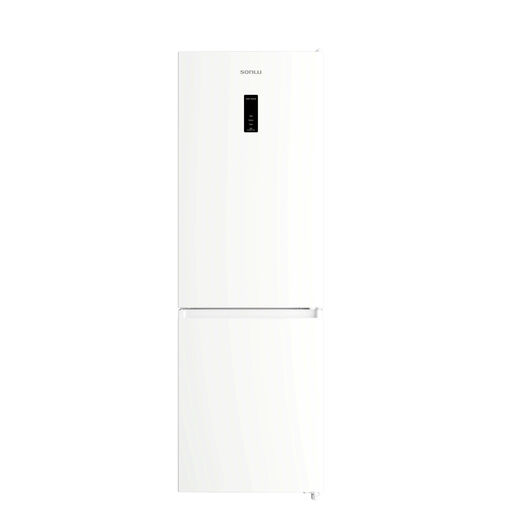 Image unavailable
Sonlu CD‑350RW — 310 L fridge-freezer
The split listed in the title — 211 L for the fridge and 99 L for the freezer — helps you work out whether your shopping and pre-prepared portions will fit in each compartment. The stated width is 60 cm and the energy rating is E. Also check the full dimensions and kWh/year before comparing installation requirements and energy use.
View on Joybuy
 Image unavailable
AUCMA — 95 L convertible chest freezer
This 95 L chest freezer can provide separate storage. It’s advertised as switchable between refrigeration and freezing, so it can’t provide both spaces at the same time. The title mentions a removable basket and an energy rating of E. If you plan to install it in a cellar or garage, check the permitted ambient temperature range.
View on Joybuy
Frequently asked questions
Which figures should I compare on the energy label?
Compare kWh/year, the capacity of the fresh and frozen compartments, and the stated noise level across appliances that meet the same needs. The European Commission says these details appear on fridge and freezer labels. The energy rating alone won’t tell you whether the capacity is right for your household.
What capacity do I need for my weekly shop?
Start with the amount of fresh and frozen food you usually store, then check the two compartments separately. For the fridge, UFC-Que Choisir suggests allowing 100 to 150 L for one person and 50 L for each additional person. Work out separately how much space you need for portions you plan to freeze.
Can I install a freezer in a garage or cellar?
Yes, provided the room temperature is within the range allowed for the specific model and you meet the installation requirements in its manual. UFC-Que Choisir recommends checking the climate class. The operation down to -15 °C stated by Beko for its HSM14540 does not automatically apply to other freezers.
What temperature should the coldest part of my fridge be?
Anses recommends keeping the coldest part of your fridge between 0 °C and +4 °C to store food safely. When choosing an appliance, check its temperature settings and, if test results are available for the specific model, how consistently it maintains its temperature.


