Buying priorities
Start by dividing your needs between fresh food and frozen portions, then check the available space and annual energy consumption across appliances of a similar size.
| Priority |
What to check |
Your needs |
| Fresh and frozen storage balance |
Compare the fridge and freezer litres separately. Also check the drawers, shelves and baskets against the sizes of your food containers. |
I want to store my portions without reducing the space needed for fresh groceries. UFC-Que Choisir suggests 100 to 150 L of refrigeration capacity for one person, followed by an additional 50 L per person; frozen storage should be chosen separately. |
| Suitable energy consumption |
Compare kWh/year between appliances with similar capacities and formats. Read the A to G rating alongside the separate capacities and dimensions. |
I want enough capacity without running an oversized appliance. ADEME states that size and unnecessary features can increase the consumption of equipment that operates continuously. |
| Size and access |
Note the height, width, depth, door-opening clearance and delivery access. An upright format makes drawer access easier; a chest freezer holds more large containers but requires internal organisation. |
I want to add space for portions without overcrowding the kitchen or making food difficult to reach. Chest freezers can hold up to 600 L, while upright models are often around 200 L according to UFC-Que Choisir. |
| Noise and installation |
Check the model’s noise level in dB, noise class and climate class. Choose No Frost for easier maintenance, but do not use it as your only criterion. |
In an open-plan kitchen, I want to keep noise to a minimum. For a garage, cellar or utility room, I will check that the appliance’s specified ambient temperature range is suitable for the room. |
Joybuy products
These Joybuy options include fridge-freezers, a compact chest freezer and an upright freezer, helping you tailor your frozen storage to your prepared meals.
 Image unavailable
CHiQ JR263LGE 262 L black Low Frost
A fridge-freezer for keeping fresh food and a moderate reserve of frozen portions in a narrow kitchen.
187 L of refrigeration capacity, 75 L of freezer capacity, three drawers, 215 kWh/year, 39 dB(A) and dimensions of 1760 × 540 × 550 mm. Its stated climate range is 16 to 38 °C.
The 75 L freezer capacity may become restrictive if portions continue to build up over time.
Joybuy
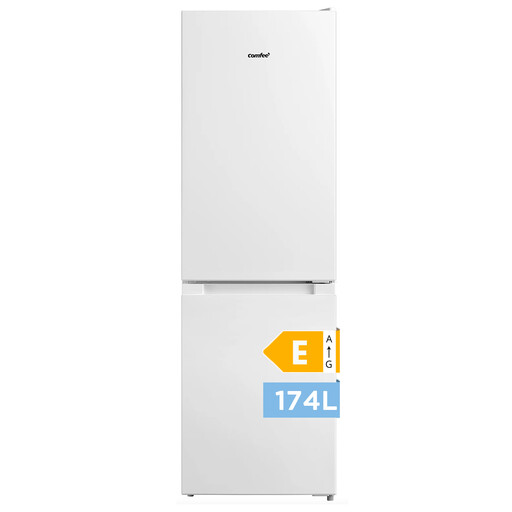 Image unavailable
Comfee' RCB169WH2(E) 174 L Low Frost
A compact format for a small household that freezes a few portions while keeping just one appliance.
115 L of refrigeration capacity, 59 L of freezer capacity, three drawers, 39 dB, reversible door and dimensions of 50 × 55 × 150 cm; energy rating E.
Check the kWh/year and climate class on the label before comparing its running costs or installing it in an unheated room.
Joybuy
 Image unavailable
CHiQ JR227LSE 227 L silver Low Frost
A slim fridge-freezer for balancing fresh food and frozen portions in a compact kitchen.
153 L of refrigeration capacity, 74 L of freezer capacity, 54 cm width, reversible door, adjustable feet, Low Frost and a stated noise level of 39 dB; energy rating E.
Note the full dimensions, kWh/year and climate class before finalising the installation and comparing it with appliances of a similar capacity.
Joybuy
 Image unavailable
CHiQ JR99DWE 99 L chest freezer
A compact extra freezer for prepared portions, to use alongside an existing fridge.
99 L, four-star freezing, stated capacity of 4.5 kg/24 h, removable basket, adjustable thermostat, castors and dimensions of 54.5 × 47.6 × 83.5 cm.
A chest freezer does not add any refrigerated storage; organise food by basket or date so you can find items stored at the bottom.
Joybuy
 Image unavailable
Heinrich's 161 L No Frost upright freezer
Dedicated capacity for frozen portions in a household whose fridge-freezer compartment regularly overflows.
161 L, three drawers, two shelves, No Frost, display, alarm, reversible door and a stated setting range of −14 °C to −22 °C; energy rating C.
It should be paired with a fridge that is suitable for your fresh groceries. Check the dimensions, noise level, kWh/year and climate class before installation.
Joybuy
Frequently asked questions
Which parts of the energy label should you compare for a refrigeration appliance in France?
Compare the separate refrigeration and freezer capacities, followed by the kWh/year and noise level. The European Commission states that the A to G label also displays this information; for meals prepared in advance, the litres in each compartment are the starting point.
Does a better energy rating guarantee lower running costs?
No, not if the appliances do not have comparable capacities or formats. ADEME highlights that fridges and freezers run continuously, and that size or unnecessary features can increase consumption; therefore, read the rating alongside the kWh/year and usable litres.
Can I install a freezer in a garage or cellar?
This depends on the model and the room temperature. Check its climate class and specified ambient temperature range; UFC-Que Choisir recommends carrying out this check for chest freezers installed in a cellar or utility room, and EPREL may provide this information for some models.
Is No Frost essential when preparing meals in advance?
No. According to manufacturers’ information, it is primarily a convenience feature related to frost and defrosting. Also check the freezer capacity, drawer layout, kWh/year, noise level and dimensions of your chosen model.


