If your regular shop includes fresh food and a moderate amount of frozen food, choose a fridge-freezer with compartment capacities that suit what you store. A small freezer compartment is better for occasional use. If your frozen stocks consistently outgrow the space in a fridge-freezer, compare it with buying a separate freezer, taking its location and energy consumption into account.
Which households are these options suited to?
Households that plan meals around fresh and frozen food
If you check what you have in stock before shopping, the usable space in each compartment matters more than the total capacity. A fridge-freezer keeps fresh and frozen food in one appliance, as long as its layout suits what you store. ADEME recommends taking stock regularly to avoid buying duplicates and forgetting about food.
Households with large frozen food stocks
If you often freeze meals or buy in bulk, check how much the freezer compartment in a fridge-freezer can hold when your stocks are at their fullest. A separate freezer is worth comparing if you also have a suitable space for it. Its design will affect how easy it is to access and organise your food.
Small kitchens where frozen food is an occasional purchase
If you mainly store fresh food and freeze very little, a fridge with a small freezer compartment may be enough. Still, check how many litres are allocated to this section: a generous total capacity does not necessarily mean there is enough room for your frozen food.
What are the key differences between the options?
Fridge-freezer
Choose this if: you regularly store fresh food and a moderate amount of frozen food in one appliance.
Bear in mind: the freezer space depends on the layout of the model, even if its total capacity seems sufficient.
Small freezer compartment
Choose this if: most of your food is fresh and you only occasionally store frozen food.
Bear in mind: bulk buys or meals you plan to freeze can quickly outgrow the available space.
Separate freezer
Consider this if: your frozen food stocks regularly exceed the capacity you need in a fridge-freezer and you have extra space.
Bear in mind: a second appliance takes up space and adds to your electricity consumption.
| Criteria |
What to check |
Consumers concerned |
| Fresh and frozen food capacity |
Compare the capacity in litres of each compartment with your usual stocks after a shop. |
When my shopping includes fresh and frozen food, I want both to have an accessible place, rather than relying on the total capacity alone. Around 33% of consumers would prioritise this balance. |
| Frozen food stocks |
Assess the maximum amount of frozen food you keep, how easy it is to access and whether you have room for a separate appliance. |
If I regularly freeze meals or buy in bulk, I need to be able to store my supplies without overfilling the fridge-freezer compartment. This would be the top priority for around 25% of consumers. |
| Controls and temperature |
Look at the controls and cooling system for each compartment, and check how you can monitor the temperature. |
To keep an eye on sensitive fresh food, I want to be able to read and adjust the settings rather than relying on the name of a technology. Around 25% of consumers would put this control over cooling first. |
| Energy and power cuts |
Compare kWh/year for appliances with the same purpose, and look separately for stated or measured storage time during a power cut. |
If an appliance runs continuously and contains frozen food stocks, I want to check its energy consumption without assuming that this indicates how long it will keep food frozen during a power cut. Around 17% of consumers would prioritise these two criteria. |
Buying mistakes to avoid
-
Choosing based on total capacity alone
Two appliances with similar total capacities may allocate space differently between fresh and frozen food. You could end up short of room in the section you use most.
Note the capacity in litres of each compartment and compare it with your stocks once you have put away your shopping. The European EPREL database lists these capacities separately.
-
Assuming No Frost or a fresh food zone guarantees food will keep
These labels describe features that vary by model; they do not replace the need for suitable settings or temperature checks. Anses recommends keeping the coldest part of the fridge between 0 °C and 4 °C.
Check the manual to see which compartments are covered, how to adjust them and how to monitor the temperature. If test results are available for the specific models you are considering, compare them.
-
Treating a separate freezer as just an add-on
If your frozen food stocks regularly exceed the space in your fridge-freezer, a dedicated appliance deserves its own comparison. On the other hand, extra capacity may not be much use if you rarely freeze food.
Start with the maximum amount you store, then compare capacity, access to food, location, energy consumption and storage time during a power cut.
A second appliance also takes up space and runs alongside your fridge.
-
Assuming energy rating tells you how long food will stay frozen
Annual energy consumption and how well food stays frozen during a power cut are two different characteristics. UFC-Que Choisir measures the latter by simulating a power cut as part of its freezer testing process.
Look for a stated storage time for the model you are considering or a comparable test result. Do not infer it from the capacity or energy rating.
Brands to consider, model by model
Bosch
Fridge-freezers to consider if fresh food organisation and the type of cooling matter to you.
- Bosch lists the KGN39AIAU with Total NoFrost, a VitaFresh XXL zone and Multi Airflow.
- These features apply to this model. Check the capacity and dimensions of the model you are considering.
Liebherr
Models with specialised fresh food compartments, including BioFresh, to compare according to the space you need.
- Liebherr describes the BioFresh compartment on some models as operating at close to 0 °C.
- Liebherr’s claim of longer-lasting freshness does not prove that all foods or models deliver the same results. Check the settings, capacities and conditions for the specific model.
Samsung
Fridge-freezers, including built-in models, whose compartment layout and installation requirements should be compared model by model.
- Samsung describes the BRB30600EWW as a 298 L built-in fridge-freezer with No Frost and two independent cooling systems.
- For a built-in model, check the housing unit and door fitting, as well as the respective capacities for fresh and frozen food.
Whirlpool
Fridge-freezers to compare by size and defrosting technology, which vary from one model to another.
- Whirlpool lists the built-in WHC18T132FR as having 182 L of fridge space and 68 L of freezer space.
- Check the cooling system, installation requirements and capacity split for the model you choose, rather than assuming they are the same across the brand.
Electrolux
Built-in fridge-freezers to consider when capacity and compatibility with your kitchen are key.
- Electrolux lists the ENS3LE18S as having a total capacity of 271 L, including 73 L for freezing.
- Specifications vary by model. Check the housing unit, doors and door fitting before you choose.
Appliances to organise fresh and frozen food
This Joybuy selection includes a fridge with a small freezer compartment and several fridge-freezers. Compare their capacity split and installation requirements with your stocks. If you need to freeze a lot of food, it may also be worth looking at a separate freezer.
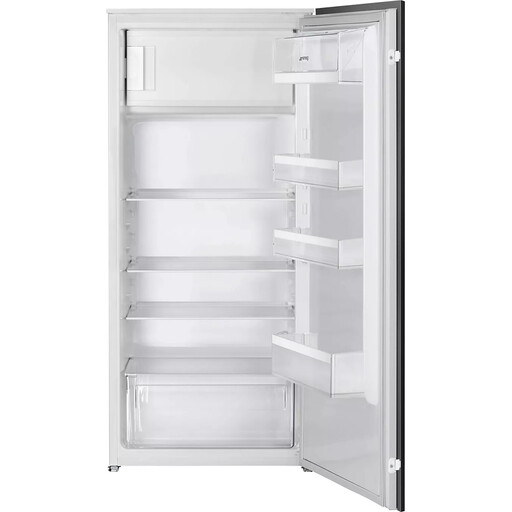 Image unavailable
SMEG S4C122E, built-in, 188 L
Worth considering if fresh food takes up most of your storage space and you freeze very little. As it is built in, check the housing unit dimensions and the parts required for installation before you buy.
Stated total capacity: 188 L. Energy rating: E.
View on Joybuy
 Image unavailable
AEG NSC6M18FES, built-in fridge-freezer, 249 L
A fridge-freezer to consider if you want to store fresh and frozen food in your fitted kitchen. Before choosing, confirm the capacity of each compartment and check that it will fit the housing unit and door front.
Stated total capacity: 249 L. TwinTech No Frost. Energy rating: E.
View on Joybuy
 Image unavailable
Samsung RF50C530EB1, multi-door, 495 L
Worth comparing if your fresh and frozen food regularly takes up a lot of space. Check how the 495 L is split between compartments, along with the dimensions and clearance required. Also consult the manual for the water dispenser installation requirements.
Stated total capacity: 495 L. Energy rating: E.
View on Joybuy
 Image unavailable
Bosch KGN33NLEB, bottom freezer, 282 L
A fridge-freezer to consider if you want to keep fresh food and frozen supplies in one appliance. Compare the space allocated to each section and check the clearance required for your chosen location.
Stated total capacity: 282 L. Energy rating: E.
View on Joybuy
 Image unavailable
CHiQ JR227LSE, 227 L fridge-freezer
Worth considering for a kitchen with limited width, while still giving you a separate freezer compartment. Also check the depth, height and space needed to open the door.
153 L fridge capacity and 74 L freezer capacity; stated width: 54 cm. Low Frost, reversible door and energy rating E.
View on Joybuy
Frequently asked questions
How should I compare two fridge-freezers of different sizes?
First, compare the fridge and freezer capacities in litres separately: the total capacity does not show which of your food stocks will fit. Then look at the dimensions, noise level and annual energy consumption of appliances suited to your installation. The European EPREL database lists these details for each model.
What temperature should I be able to check in the fridge?
Anses recommends keeping the coldest part of the fridge between 0 °C and 4 °C. Check how the model can be adjusted and how you can monitor this area, rather than assuming that a marketing feature will maintain the temperature you want by itself.
Does No Frost guarantee better food storage?
No. The presence of No Frost alone does not guarantee this. Check which compartment it applies to, along with the settings and temperatures, and look for comparable tests of the specific model if food storage is a key factor in your choice.
How can I compare how long freezers keep food frozen during a power cut?
Look for a stated storage time for each model or a measurement from comparable tests; do not infer it from the energy rating. UFC-Que Choisir simulates a power cut in its freezer testing process and measures how long food stays below −9 °C. Bear this condition in mind when comparing results.


