A fridge-freezer is a good choice if its fridge and freezer compartments each have enough room for your usual supplies, without taking up space for two appliances. If you regularly stock up on frozen food or ready meals, it may be worth considering a separate freezer, provided you have a suitable place for it. Compare the capacity of both compartments, then check the dimensions, ventilation requirements, kWh/year and noise levels listed for the models you’re considering.
Who are these options for?
Households of four or more
Work out how much fridge and freezer space you need separately. Gifam recommends more than 330 L of fridge space as a general guide for a household of at least four people; the amount of freezer space you need also depends on your shopping habits.
Households that freeze meals or buy in bulk
Compare the usable space in a fridge-freezer’s compartment with the amount you usually keep in stock. A separate appliance can make storage easier: an upright freezer organises food into compartments, while a chest freezer offers more room for bulky items.
People in smaller homes or with limited kitchen space
Measure the space, access route and door opening before choosing a compact model. Also check the ventilation clearances, noise level and freezer capacity: a space-saving appliance won’t necessarily be suitable for storing large quantities.
What should you compare?
Start by working out how much fresh and frozen food you need to store, then check which type of appliance will fit in your home. Once you’ve decided, compare the features of models with a suitable capacity.
| Priority | What to check | My needs |
|---|
| Separate capacities |
Compare the fridge and freezer capacities in litres separately, rather than looking at the total capacity alone. Gifam recommends more than 330 L of fridge space as a general guide for households of four or more; choose freezer capacity to suit the amount you keep in stock. |
I need enough room for fresh groceries without reducing the space available for frozen food and ready meals. |
| Freezer type |
Look at the drawers and shelves in an upright freezer, or the space available for bulky items in a chest freezer. Gifam notes that chest freezers can offer a large capacity, ranging from 100 L to more than 750 L, depending on the appliance. |
If I freeze individual portions, I want to be able to find them easily. For bulky food, I need to check its dimensions and how much accessible space there is. |
| Freezing food at home |
Check the compartment’s star rating and freezing capacity if you want to freeze fresh food. The Ministry of Agriculture distinguishes between a freezer and an icebox, which isn’t suitable for this purpose. |
I prepare meals in advance, so a compartment that only keeps food frozen after purchase wouldn’t meet my needs. |
| Installation |
Measure the appliance and access route, check the door opening and allow for the ventilation clearances specified for the model. Also check its permitted ambient temperature range if the room isn’t heated. |
The appliance needs to fit in my kitchen or utility room, with enough space for the door to open and heat to escape. |
| Energy use and noise |
The European Commission says the energy label provides information on capacity, energy consumption and noise emissions. Compare kWh/year for appliances with similar capacities and intended uses, and check the noise level if the appliance will be near a living area. |
In an open-plan kitchen, noise matters just as much as the space available. I also want to compare energy use across appliances with a suitable capacity. |
| Maintenance |
Check the cooling system and the model’s care instructions. Gifam describes fan-assisted cooling, or No Frost, as a way to prevent ice from building up; protect any food that could dry out. |
I want to know what maintenance is required, without overlooking how to store and protect food. |
Which mistakes should you avoid?
-
Looking only at a fridge-freezer’s total capacity
A large total capacity doesn’t guarantee enough freezer space for your frozen food or ready meals.
Estimate how much fresh and frozen food you keep separately, then check the capacity of each compartment on the product details and energy label.
-
Confusing an icebox with a freezer
The Ministry of Agriculture explains that an icebox can’t freeze fresh food in the same way as a freezer.
If you want to freeze home-cooked meals, check the star rating and freezing capacity of the specific compartment.
-
Overlooking ventilation space around the appliance
The required clearances depend on the model and how it’s installed: the requirements for a freestanding appliance don’t automatically apply to a built-in model.
Measure the space and follow the instructions. For example, Whirlpool recommends 5 cm above and 10 cm behind its freestanding fridges.
-
Assuming every freezer will work in a cold garage
The permitted ambient temperature depends on the model. Beko says its B1RFNE314W works in temperatures as low as -15 °C, but this doesn’t apply to other models.
Before installing an appliance somewhere without heating, check the permitted ambient temperature range and the conditions listed in the instructions for your chosen model.
Which brands should you consider?
These ranges give you examples of different formats and features to compare; their inclusion here doesn’t mean that the models below are part of the product selection.
Bosch
Bosch offers freezers and refrigeration appliances with layouts that vary across its ranges.
- The brand highlights No Frost and storage features designed to help you organise food on selected models.
- Check the dimensions, storage options and ventilation requirements for the specific model and installation.
Whirlpool
Whirlpool France’s range includes fridge-freezers, chest freezers and upright freezers.
- The choice of formats lets you consider either one appliance or a separate freezer.
- For its freestanding fridges, Whirlpool recommends 5 cm of clearance above and 10 cm behind the appliance. Built-in models should be installed according to the specifications for the individual model.
Beko
Beko France offers chest and upright freezers to suit different storage needs and installation spaces.
- Beko lists a net capacity of 284 L for its HSM27050 chest freezer and says its B1RFNE314W upright freezer works in ambient temperatures as low as -15 °C.
- These features apply to the models named here. Check the details for the model you’re considering before choosing an unheated location.
Fridge-freezers to consider on Joybuy
These five models combine fridge and freezer storage in one appliance. They give you a way to consider this option based on the space available and the capacity you need. If your frozen food takes up more room than the freezer compartment offers, compare it with a separate freezer too.
 Image unavailable
Haier HTW5618ENMG, 360 L three-door fridge-freezer
Consider this model if you want to store fresh and frozen food in one appliance. The model title lists Total No Frost, an E energy rating, Wi-Fi and My Zone. Compare the capacity of each compartment with the amount you usually keep in stock, and check the dimensions and clearances in the instructions.
View on Joybuy
 Image unavailable
CHiQ JR263LGE, 262 L Low Frost fridge-freezer, black
Its listed width of 54 cm may suit a narrow kitchen, but remember to measure the door opening and required clearances too. The title gives a height of 176 cm and a 70/30 split; check that the freezer section has enough room for the amount you store.
View on Joybuy
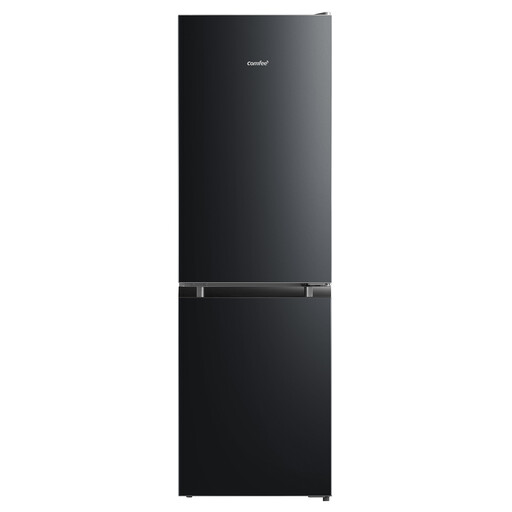 Image unavailable
Comfee' by Midea RCB230BL2EU(E), 174 L fridge-freezer, black
This freestanding model is worth considering if you have limited space and don’t need to store large quantities. The title mentions Low Frost, an adjustable thermostat and a reversible door. Check the capacity of each compartment, then look at the kWh/year and noise level on the energy label.
View on Joybuy
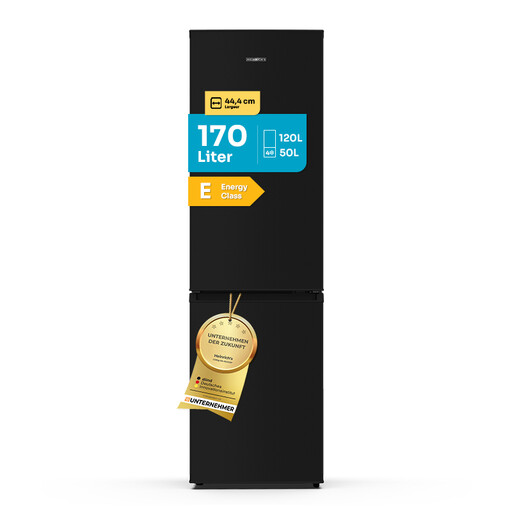 Image unavailable
Heinrich´s, 170 L fridge-freezer, black
The stated capacities of 120 L for the fridge and 50 L for the freezer should be compared separately with your household’s shopping needs. The title lists an E energy rating and a noise level of 40 dB. Check the dimensions and permitted ambient temperature range for your chosen location.
View on Joybuy
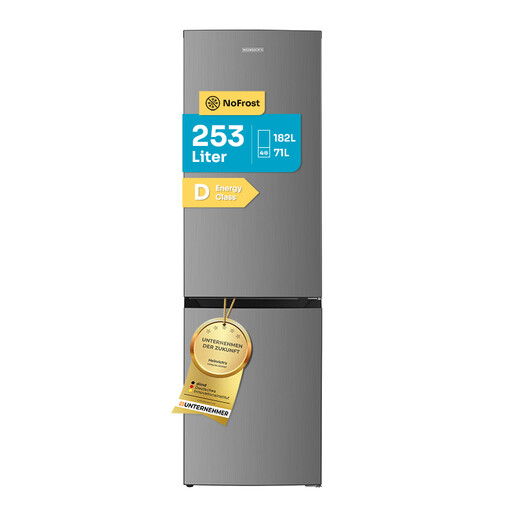 Image unavailable
Heinrich´s, 253 L No Frost fridge-freezer, stainless steel finish
The title lists 182 L of fridge space and 71 L of freezer space. Compare both capacities with your needs rather than focusing on the total of 253 L. It also lists a noise level of 39 dB and No Frost. Check the energy label for the energy rating, and look at the star rating and freezing capacity if you plan to freeze food yourself.
View on Joybuy
Frequently asked questions
What temperature should I set my fridge and freezer to?
The Ministry of Agriculture recommends setting your fridge to +4 °C and your freezer to -18 °C. Anses advises keeping the coldest part of the fridge between 0 °C and 4 °C. Check the temperature, particularly when the appliance is very full or opened frequently.
Is an icebox enough to freeze ready meals?
No. The Ministry of Agriculture distinguishes between an icebox, which can’t freeze fresh food, and a freezer. If you prepare meals to freeze, check the star rating and freezing capacity of the compartment you’re considering.
What should I compare on the energy label?
Compare energy consumption in kWh/year with storage capacity and noise emissions, rather than relying on the energy rating alone. The European Commission says this information appears on the labels of relevant fridges and freezers. Compare figures for appliances with a similar capacity and intended use.
Can I install a freezer in an unheated garage?
Only if the model’s permitted ambient temperature range is suitable for your garage. Beko says its B1RFNE314W works in temperatures as low as -15 °C, but this doesn’t apply to all freezers. Check the product details and instructions for the model you’re considering.


