Which criteria should you consider first?
First, decide whether you need to store frozen food, and how much. Then compare litres per compartment and kWh/year across appliances with a similar configuration and capacity. Check both sets of information on the energy label and in EPREL.
Fridge only
Consider this if: you store very little frozen food or already have enough freezer capacity.
Keep in mind: if your freezer needs increase, you may need another appliance.
Fridge-freezer
Consider this if: fresh and frozen foods are regular items on your shopping list and you’d prefer one appliance.
Keep in mind: the space allocated to each compartment is fixed for each model. A large total capacity in litres doesn’t guarantee enough room in the compartment that matters most to you.
Separate freezer
Consider this if: you regularly store more frozen food than a fridge-freezer can accommodate.
Keep in mind: you’ll need to allow enough space and take into account the annual energy consumption of an additional appliance that runs continuously.
| Criterion |
What to check before you buy |
Who is this important to? |
| Comparable energy use |
kWh/year and energy rating, comparing similar installation types and capacities. |
If I want to limit the energy use of an appliance that runs continuously, the annual figure matters more than looking at a rating letter in isolation. Around 36% of consumers rank this as their top priority. |
| Usable capacity |
The fridge and freezer capacities in litres, considered separately and in relation to the food you store regularly. |
When I store different amounts of fresh and frozen food, I look for enough room in the right compartment. For around 29% of consumers, this is their main concern. |
| Installation |
The appliance dimensions, access routes, installation type and ventilation requirements in the instructions. |
If my kitchen has an alcove or narrow access routes, I need to be able to install the appliance in line with the instructions. This is the top priority for around 21% of consumers. |
| Useful features |
Whether the exact model has the feature you want and its declared kWh/year figure. |
If I want to avoid manual defrosting or use a connected feature, I want to know exactly what the model offers without assuming it will use less electricity. Around 14% of consumers prioritise this kind of practical feature. |
Brands to consider, model by model
The features mentioned below relate to specific models or ranges described by their manufacturers, not to every appliance from a particular brand. They can help you decide what to compare on the product details pages for the models you’re interested in.
Bosch
Bosch offers freestanding fridge-freezers in a range of capacities, energy ratings and feature combinations, depending on the model.
- Bosch’s product information for the KGN39AIAU lists an A rating, with 260 L of fridge capacity and 103 L of freezer capacity.
- The KGN36ELEA is listed with an E rating. A model’s rating or features shouldn’t be assumed to apply to other Bosch appliances.
Whirlpool
Whirlpool offers built-in fridge-freezers, among other options, with product information showing capacity and annual energy consumption.
- Whirlpool’s product information for the WHC20D021B2 gives a total capacity of 300 L and energy consumption of 180 kWh/year, useful details when assessing this model.
- Its freezer is listed as requiring manual defrosting, so check whether this level of upkeep suits you.
Samsung
In 2024, Samsung introduced high-capacity RB6000D fridge-freezers, with energy specifications that vary by model.
- The range is worth exploring if you’re looking for a large capacity and want to compare the management features available on each model.
- A connected feature doesn’t replace checking the kWh/year figure on your chosen model’s label. Also check compatibility and activation requirements.
Fridge-freezers available on Joybuy
These fridge-freezers are for households that want to store fresh and frozen food in one appliance. Their formats and stated capacities vary, so check they suit your space and habits, then consult the energy label for the exact model to compare kWh/year.
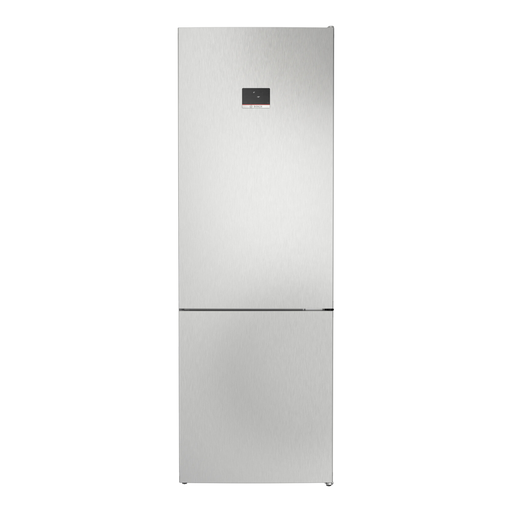 Image unavailable
Bosch KGN497LDF, 440 L grey fridge-freezer
Worth considering if you’re looking for a freestanding fridge-freezer. Check that the compartments and overall dimensions suit your household.
Stated total capacity: 440 L. Listed energy rating: D. Check the label for this model to find its annual energy consumption and the capacity of each compartment.
View on Joybuy
 Image unavailable
Hisense RB3B250SAWC, 252 L built-in fridge-freezer
For a fitted kitchen, check the cabinet dimensions, fixing and ventilation requirements for this model before making your choice.
Stated total capacity: 252 L. No Frost and a C energy rating are listed; compare its annual energy consumption with that of other built-in fridge-freezers of a similar capacity.
View on Joybuy
 Image unavailable
Haier HTW5618ENMG, 360 L three-door fridge-freezer
Consider this if a three-door layout suits the way you use your appliance. Check the space available for fresh and frozen food separately.
Total No Frost, Wi-Fi and My Zone are listed in the model name, which has an E rating. These features don’t indicate how much energy it uses: check the kWh/year figure on the label for this model.
View on Joybuy
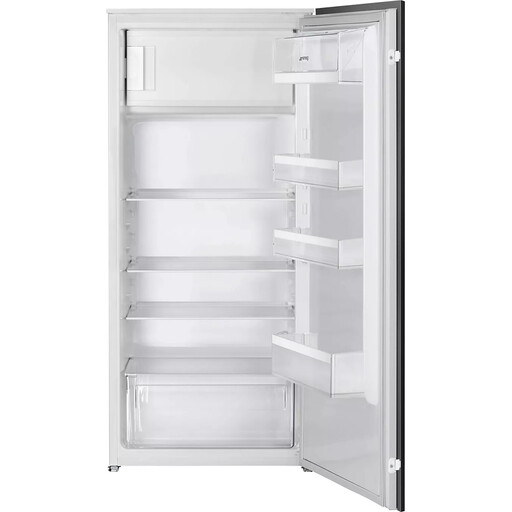 Image unavailable
SMEG S4C122E, 188 L built-in fridge-freezer
This top-freezer design may suit you if you’re looking for a built-in fridge-freezer and the freezer capacity meets your needs.
The stated total capacity is 188 L and the listed energy rating is E. Check the capacity of each compartment in litres, the kWh/year figure and the cabinet requirements for this model.
View on Joybuy
 Image unavailable
Candy CFQQ5T817EPS, 467 L four-door fridge-freezer
Worth considering if you regularly need plenty of space for fresh and frozen food, once you’ve checked how much room you have in your kitchen.
This silver model has a stated capacity of 467 L, Total No Frost and an E rating. Check its label for annual energy consumption and the capacity of each compartment; don’t assume the No Frost feature means it uses less energy.
View on Joybuy
Frequently asked questions
How do you compare two fridge-freezers using the energy label?
Compare their kWh/year figures only after checking that they have a similar installation type, usable capacity and split between compartments. The energy label and the European Commission’s EPREL database show declared annual energy consumption. Check the capacity in litres, dimensions and noise level before choosing too.
Does No Frost mean a fridge-freezer uses less energy?
No. The presence of No Frost alone doesn’t mean a fridge-freezer uses less energy than another model. If you want this feature to reduce the need for manual defrosting, check exactly what it covers on the specific model, then compare its kWh/year figure with those of appliances with a similar format and capacity.
Can a separate freezer help reduce energy use?
Not necessarily: a separate freezer adds another appliance that runs continuously. Consider one if your regular storage needs exceed the capacity of a fridge-freezer, then check its capacity, declared annual energy consumption and installation space requirements.
What should you check before installing a fridge-freezer?
Check the dimensions of the space and access routes, then follow the instructions for the model you’ve bought for installation, ventilation and connection. For the installation covered in its advice, Electrolux recommends waiting at least four hours before plugging the appliance in; always follow the instructions for your chosen model.


