Who is this choice for?

Households short on kitchen space

If your kitchen is short on space but you have a utility room or garage that could house a freezer, first check the room’s temperature and the ventilation requirements for the model you’re considering. Having a spare space doesn’t automatically make it suitable.

Households that freeze food in bulk

If you prepare meals in advance or stock a variety of frozen foods, compare the freezer capacity and the interior layout. Drawers can make it easier to organise food by category, while with a chest freezer you’ll need to consider how to reach food stored at the bottom.

Households mindful of trips and energy use

If you often use frozen food when preparing meals, consider whether it would be more convenient to keep it in the kitchen. When comparing two set-ups, ADEME points out that refrigeration appliances run continuously: check the usable capacities and annual energy consumption of the appliances you’re actually planning to install.

Which factors should you weigh up?

Fridge and separate freezer

Consider this if: you mainly need more room for frozen food and the extra room is suitable for the freezer you’ve chosen.

Bear in mind: you’ll need to make room for two appliances and may have to go to the utility room or garage.

Fridge-freezer

Consider this if: you want fresh and frozen food to be within easy reach in the kitchen.

Bear in mind: freezer capacity depends on the model you choose and can’t be increased independently of the fridge.

Factor What to check before buying Who is this important to?
Suitability of the utility room or garage Compare the room’s temperatures with the model’s climate class, and allow for the clearances specified in its instructions. If I move the freezer elsewhere, I need to know whether my utility room will be suitable in both winter and summer. Around 27% of consumers prioritise this.
Everyday access Identify the foods you use often, then check the route and how the door or lid opens. To prepare meals without regularly going to the utility room, I’d rather keep everyday frozen foods close to hand; this is a priority for around 33% of consumers.
Capacity and storage Compare the usable litres available for frozen food and the layout of the model’s drawers or baskets. When I freeze portions and a variety of foods, I mainly want to be able to store them neatly and find them again. This comes first for around 20% of consumers.
Energy use in everyday use Compare the fridge-freezer’s kWh/year and usable capacity with those of the two appliances you’re considering for a separate set-up. If I add another appliance that runs continuously, I want to check its energy use before gaining extra capacity. Around 20% of consumers put this factor first.

Pitfalls to avoid

  • Putting a freezer in the garage without checking temperatures

    According to Bosch Électroménager, the climate class defines the ambient temperature range the appliance is designed for. If the room is too cold or too warm for the model, it may not work properly.

    Before planning where to install it, compare the temperatures in the room, particularly in winter and summer, with the climate class of the model you’ve chosen.

  • Choosing based on the energy label letter alone

    The energy class on its own doesn’t tell you the annual energy consumption of a complete set-up. ADEME also highlights the importance of appliance size and over-equipping when it comes to refrigeration.

    For each set-up you’re considering, compare the kWh/year and usable capacities of the specific models. If you’re planning to have two appliances, add together their stated energy consumption.

  • Measuring the appliance but not the space around it

    An appliance may fit in its allotted space but still not have enough room for ventilation or to open its door, drawers or lid fully.

    Measure the route to its final position, then allow for the clearances specified in the instructions. The requirements for an integrated model aren’t necessarily the same as those for a freestanding appliance.

  • Choosing a chest freezer without considering access to food

    Food at the bottom of a chest freezer is less easy to reach than food stored in drawers. This matters if you open the freezer often.

    Check the interior layout and the space needed to lift the lid. If you mainly want to access food by category throughout the day, compare upright freezers with drawers too.

Brands to consider when comparing set-ups

Bosch

Bosch offers fridges, fridge-freezers and freezers: options to consider if you’re deciding whether to keep all your refrigeration in the kitchen or have separate appliances.

  • The range includes freezers with compartments designed to help you organise food.
  • Check the capacity, layout and climate class for the specific model rather than assuming these are the same across the range.

Whirlpool

The range includes fridge-freezers as well as upright and chest freezers, giving you several ways to divide up your storage.

  • Whirlpool France’s installation advice distinguishes between ventilation for freestanding appliances and checking the climate class.
  • Follow the instructions for the model you choose: an integrated fridge-freezer may not have the same clearance requirements as a freestanding one.

Electrolux

Electrolux offers fridges, fridge-freezers and freezers to compare according to the space available and where you plan to install them.

  • Electrolux France’s guidance draws attention to air circulation and the ambient temperature around the appliance.
  • Cooling technologies and installation requirements vary between ranges and models.

A fridge-freezer option on Joybuy

This integrated fridge-freezer is an option if you want to keep both fresh and frozen food in the kitchen. If your priority is to increase your frozen food storage separately in a utility room, compare the capacity and installation requirements of a separate freezer too.
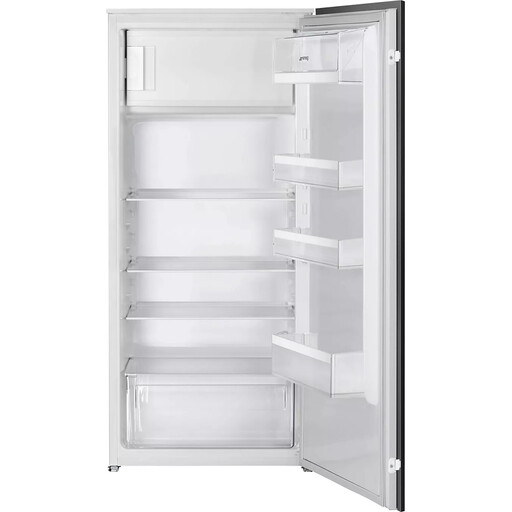
SMEG S4C122E integrated fridge-freezer, freezer on top

SMEG S4C122E, 1-door integrated fridge-freezer, freezer on top, 188 L, E energy class

This fridge-freezer keeps fresh and frozen food in the kitchen, making it a good choice if you want both close to hand in one place.

Stated total capacity: 188 L; E energy class. Before choosing this integrated model, check the niche dimensions, ventilation instructions and space needed to open the door.

View on Joybuy

Frequently asked questions

Can I install any freezer in a garage or utility room?

No: the room must stay within the ambient temperature range specified for the model. For example, Bosch Électroménager gives a range of 10 to 32 °C for climate class SN and 10 to 43 °C for class SN-T. Check the class of the appliance you’ve chosen and the temperatures in your room.

How much clearance does a freestanding fridge need for ventilation?

Always follow the instructions for your model first. Whirlpool France recommends, as a guide, leaving 5 cm above and 10 cm behind a freestanding fridge. An integrated appliance must be installed according to its own specifications.

Do two appliances always use more energy than a fridge-freezer?

You can’t tell simply by counting the appliances. ADEME publishes typical figures by category, but these may not be based on the same capacities. Compare the kWh/year and usable litres of the exact models, taking both appliances into account if you choose separate ones.

Should I look at the energy class or the kWh/year?

Check both, as well as the capacity of each compartment. The European Commission says the current label uses a scale from A to G; the annual energy consumption in kWh then helps you compare the models you’re considering for your set-up.

What should I measure before my fridge or freezer is delivered?

Measure the appliance, the route to its final position and the space available once it’s installed. Include doors, corridors and access routes, as well as ventilation clearances and the room needed to open the doors, drawers or lid of the model you’ve chosen.