Households that shop once a week
You mainly need space for fresh food and meals prepared to last several days. Que Choisir recommends considering how often you shop and your kitchen layout when choosing a fridge.


To keep the week’s fresh food and a modest stock of frozen food in your kitchen, start by comparing the two compartments of a fridge-freezer. If fresh food takes up most of the space, consider a larger-capacity appliance. If frozen meals are becoming the priority, a separate freezer may be a better fit, provided you have a suitable place for it.
You mainly need space for fresh food and meals prepared to last several days. Que Choisir recommends considering how often you shop and your kitchen layout when choosing a fridge.
If bags of frozen food and prepared portions take up a lot of room, compare the usable freezer capacity. Que Choisir distinguishes between upright freezers, arranged in drawers, and chest freezers, which offer open space for larger stocks but make it less convenient to reach items at the bottom.
In a narrow kitchen, check the access route and door clearance before choosing a large appliance. For a garage or utility room, also check that the model’s climate class is suitable for the room’s temperatures, as Que Choisir advises.
A fridge-freezer keeps fresh and frozen food in one appliance. A larger fridge with an integrated freezer is more suited to households that need extra space for fresh food. If frozen storage is the bigger priority, compare the drawer access of an upright freezer with the capacity and footprint of a chest freezer.
| What matters | What to check | Who it matters to |
|---|---|---|
| Balance of fresh and frozen food | Compare the usable capacity of each compartment in litres, rather than looking at the total capacity alone. | If I’m storing a full shop of fresh food as well as a few frozen meals, I don’t want either compartment to run out of space too quickly. Around 36% of shoppers prioritise this balance. |
| Freezer capacity | Check the freezer capacity and how easy it is to reach food: drawers in an upright freezer or deep storage in a chest freezer. | When I prepare several portions to freeze, I want to store them and find them again without emptying my freezer. This is the top priority for around 29% of shoppers. |
| Location | Measure the appliance, access route and door clearance; check that its climate class is suitable for the room’s temperatures. | In a narrow kitchen or utility room, I first need to know whether the appliance can be installed and used there. For around 21% of shoppers, location comes before other considerations. |
| Everyday use | Compare the stated annual energy consumption and noise level. If you’re storing a lot of frozen food, also check the stated storage time in the event of a power cut. | If the appliance is near my living space or stores a large amount of frozen food, its noise level and performance matter when I’m choosing. Around 14% of shoppers prioritise these factors. |
A large stated capacity doesn’t tell you how much room there is for fresh groceries and frozen meals. The balance between the two uses may not suit your needs.
Compare the usable capacity in litres of each compartment with your usual shopping, and check the type of freezer compartment.
A garage, an unheated utility room or a very warm kitchen may fall outside the ambient temperature range specified for the model.
Check the possible temperatures in the room throughout the year, then compare them with the appliance’s stated climate class.
This feature makes freezer maintenance easier, but it doesn’t tell you about capacity, noise level or energy consumption.
Also check the capacity of each compartment, annual energy consumption, stated noise level and how easy it is to access food.
If you’re storing frozen food, the stated storage time helps you compare appliances in the event of a power cut. Delivery and installation options also matter when choosing a bulky appliance.
Check the technical specifications or manual for the storage time, then confirm which services the retailer offers before placing your order.
Bosch offers fridge-freezers that combine fresh and frozen storage in one appliance.
Liebherr fridge-freezers are worth considering if you want separate storage for fresh and frozen food.
Whirlpool also offers freestanding fridge-freezers designed to store fresh and frozen food together.
This selection includes fridge-freezers for everyday shopping, larger-capacity models that combine fresh and frozen storage, and a chest freezer for extra storage alongside a fridge.
 Image unavailable
This fridge-freezer gives you space for both fresh and frozen food in one appliance.
Stated total capacity: 282 L; energy rating E. Compare the capacity of each compartment with your shopping needs before choosing this size.
 Image unavailable
This fridge-freezer is worth considering if space is limited in your kitchen.
The product listing gives a capacity of 153 L for the fridge and 74 L for the freezer, and a width of 54 cm. It also lists Low Frost, a 4-star freezer and a reversible door. Check the clearance needed for your chosen location.
 Image unavailable
This format is for households looking for more space for both fresh and frozen food in one appliance.
The stated capacities are 333 L for the fridge and 192 L for the freezer, with No Frost and an energy rating of E. Check the dimensions and required clearance before planning where to install it.
 Image unavailable
This chest freezer can supplement a fridge when storing prepared meals and frozen food becomes a priority; it can’t cover both uses at the same time on its own.
The product is described as convertible between fridge and freezer modes, with a removable basket and an energy rating of E. Allow space for the top-opening lid and check the climate class is suitable for your chosen location.
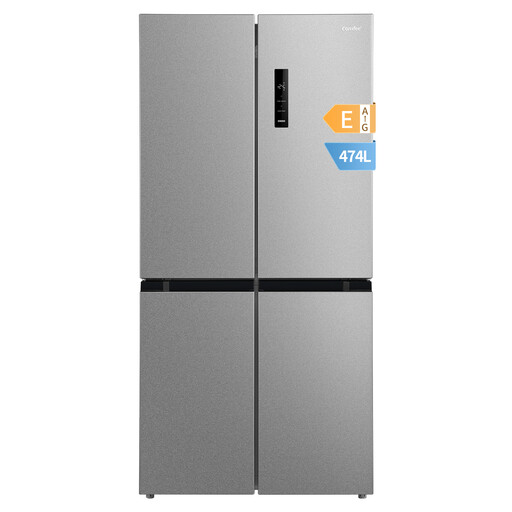 Image unavailable
This four-door appliance is worth considering if you’re looking for a large capacity for both fresh and frozen food.
Its stated total capacity is 474 L, with an energy rating of E and a drawer featuring three temperature settings. Check the separate usable capacities of the fridge and freezer to see how much space is available for each type of food.
Compare the usable capacity in litres of the fridge and freezer separately with the amount of fresh food, prepared meals and frozen food you usually store. For the fridge compartment, Que Choisir suggests allowing 100 to 150 litres for one person, then 50 litres for each additional person. Adjust this to suit how often you shop.
Yes, as long as the model’s specified ambient temperature range covers the room’s temperatures throughout the year. Que Choisir’s glossary gives 10 to 32 °C for climate class SN and 16 to 38 °C for class ST. Check the chest freezer’s climate class and manual before installing it.
Compare the energy rating and stated annual energy consumption, taking into account the capacity you actually need. For applicable appliances, the European Commission’s EPREL database also lists the dimensions and stated capacity of each compartment.
According to the French Ministry of the Economy, an appliance sold by a business to an individual may be covered by the legal guarantee of conformity if it doesn’t match its description. A commercial guarantee offered by the retailer doesn’t replace this legal guarantee. Keep a copy of the product description and proof of purchase so you can report the issue.
If the appliance still works, consider passing it on for reuse. Otherwise, ecosystem offers collection options for removing pollutants and recycling it. If your new appliance is being delivered, check whether the retailer offers a take-back service.