If your freezer compartment has enough room for the portions you’ve prepared and the food you buy, a fridge-freezer could save you from needing a second appliance. If you regularly store large quantities, compare separate freezers by usable capacity, access to your food and the space available. Then check the climate class and usage figures for the model you’re considering.
Who is this choice for?
Households that prepare portions in advance
If you freeze several meals in small containers, you’ll want to be able to organise them and find the one you’re looking for easily. Look at the drawers or baskets, then check how much usable space is actually available for frozen food.
Households that buy in bulk
Multipacks and bulky food need plenty of space, as well as practical storage once the appliance is full. If you often add a lot of unfrozen food at once, also compare the freezing capacity, shown in kg/24 h.
Households with limited space
In a small kitchen or utility room, checking the dimensions alone isn’t enough: the door or lid needs room to open, and the manual may specify clearance requirements. If the room temperature varies, check the model’s climate class too.
What sets the different formats apart?
Start by distinguishing the capacity of the freezer compartment from that of the whole appliance. A fridge-freezer gives you refrigeration and freezing in one appliance. If you’re adding a freezer, choose between a front-opening upright model, the open space of a chest freezer and the compact footprint of an under-counter model, depending on what your room can accommodate.
| Criteria |
What to check |
Who it matters to |
| Freezing capacity |
Compare the freezer’s usable capacity, not the total capacity of a fridge-freezer. If you regularly bring home large quantities of unfrozen food, also check the freezing capacity in kg/24 h. |
If portions and bulk buys quickly fill my current compartment, I want more space to store them first and foremost; around 31% of shoppers in this position would make capacity their priority. |
| Organisation and access |
Check the drawers or baskets and how much room they leave for your containers. Make sure you can open and remove them in the space where the appliance will go. |
When I freeze a variety of portions, I want to find a container without rummaging through everything; easy access to food would come first for around 25% of shoppers in this position. |
| Location |
Measure the appliance and the clearance needed for installation and opening. Compare the possible room temperatures with the model’s climate class. |
If space is limited or the temperature fluctuates, I first need to find an appliance that can be installed there; around 25% of shoppers in this position would prioritise this constraint. |
| Continuous use and power cuts |
For models suited to your needs, compare annual energy consumption in kWh, noise in dB, storage time during a power cut and any alarms. |
If I regularly store food, I want to know how much energy the appliance uses and what happens during a power cut; around 19% of shoppers in this position would put these factors first. |
Mistakes to avoid
-
Going by a fridge-freezer’s total capacity
A large advertised capacity may be split between refrigeration and freezing. For example, Bosch lists 189 l for refrigeration and 90 l for freezing in its KGN33NWDA.
Check the usable capacity of the freezer compartment alone and compare it with the portions and frozen food you plan to store.
-
Installing the appliance without checking the room temperature
The climate class specifies the ambient temperature range the model is designed for. Bosch notes that temperatures outside this range can affect how the appliance works or how much energy it uses.
Check the temperatures the room may be exposed to, then check the climate class and installation instructions for the appliance you’re considering.
-
Choosing a chest freezer for its capacity alone
Its open space can accommodate bulky containers, but food stored at the bottom is less easy to reach. The lid also needs room to open.
Plan how you’ll separate different types of food and check that the lid can open where you intend to place the freezer.
-
Forgetting that a freezer runs continuously
ADEME points out that cooling appliances run all the time. So it’s worth considering energy use and noise alongside capacity, while storage time during a power cut is particularly important if you keep large quantities of food.
Compare the kWh/year and noise levels of models that meet your needs, then check their storage time during a power cut and whether they have any alarms.
Brands to compare
These product ranges show a variety of formats. The capacities and features below apply to the models named, not every appliance from each brand.
Bosch
Fridge-freezers, upright freezers and under-counter models give you several ways to make the most of your space.
- Bosch lists 328 l of usable freezer capacity for the GSN54EWCV upright model, compared with 83 l for the GTV15NWEB under-counter model.
- Check the dimensions and features of each model: these two capacities suit different storage needs.
Liebherr
Its upright freezers may suit households that want to organise their food and access it from the front.
- Liebherr lists a capacity of 277 l, noise of 36 dB and a NoFrost feature for the FNd 522i.
- Check features and installation dimensions for each model, particularly built-in models.
Whirlpool
Its chest and upright freezers offer two different ways to organise your food, depending on the size and shape of what you store.
- For the WHCF2044 chest freezer, Whirlpool lists a capacity of 204 l, two baskets and a freezing capacity of 11 kg/24 h.
- Make sure the access to the bottom of the chest and the space needed to open it suit your room and the way you organise your food.
Appliances to suit your needs
These appliances include a small chest freezer, upright freezers and two fridge-freezers. First compare the capacity available for freezing and the format that will fit in your room: a small extra freezer won’t meet the same needs as a large stock of food.
 Image unavailable
AUCMA 95 l convertible chest freezer
This chest freezer could provide extra capacity if 95 l is enough for your portions and shopping. Its listing mentions a removable basket, a seven-setting thermostat, a defrost drain and an E energy rating. Before placing it in a room where the temperature varies, check its climate class. Also make sure there’s enough space to open the lid.
View on Joybuy
 Image unavailable
COMFEE' RCU60WH2(E), 60 l upright freezer
This 60 l model is suited to a modest freezing requirement in a small space, rather than storing a large shop. Its listing mentions three drawers, a reversible door and an E energy rating. Before choosing a location, check the installation clearances, climate class and annual energy consumption.
View on Joybuy
 Image unavailable
Heinrich´s 161 l No Frost upright freezer
This 161 l upright freezer is worth considering if you’d rather organise portions in drawers than in a chest freezer. Its listing specifies No Frost, a reversible door hinge and a C energy rating. Measure the space and check the model’s annual energy consumption and climate class.
View on Joybuy
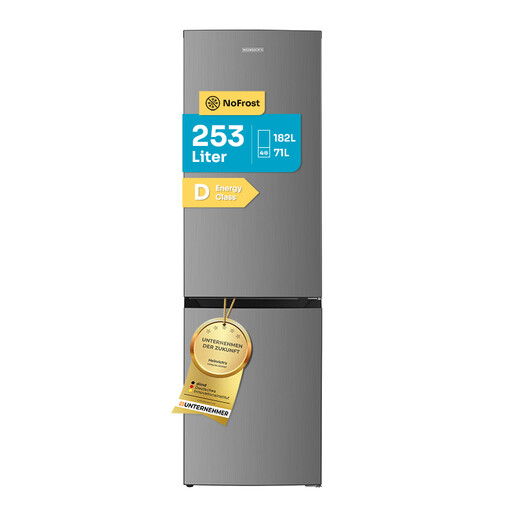 Image unavailable
Heinrich´s 253 l fridge-freezer, including 71 l of freezer space
This fridge-freezer could be a good fit if you’re also replacing your fridge and 71 l of freezer space is enough for your needs. Its listing specifies 182 l of fridge space and 71 l of freezer space, as well as No Frost and a noise level of 39 dB. Check its full dimensions and annual energy consumption before comparing it with a separate appliance.
View on Joybuy
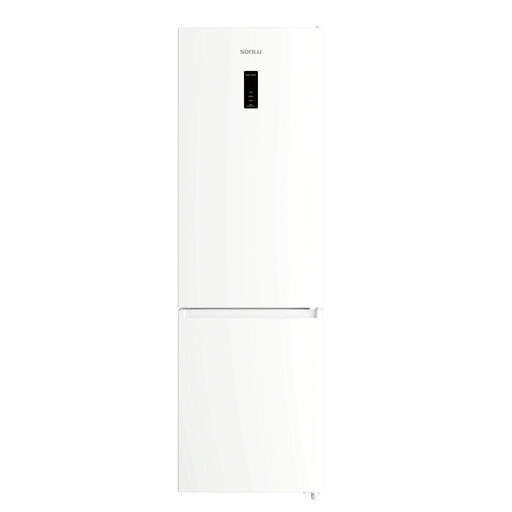 Image unavailable
Sonlu CD‑400RW, 355 l fridge-freezer including 103 l of freezer space
If you’d like to keep to one appliance while having 103 l of freezer space, compare this compartment with the portions and shopping you expect to store. The listing specifies 252 l of fridge space, a width of 60 cm, a reversible door and an E energy rating. Width alone won’t confirm that it will fit: check the other dimensions and the clearance required.
View on Joybuy
Frequently asked questions
Can you install a freezer in a garage or cellar?
Yes, provided the room’s possible temperatures stay within the range specified for the model and you follow its installation instructions. Bosch lists, for example, temperature ranges of 10 to 32 °C for climate class SN and 16 to 32 °C for N. Check the exact climate class of the appliance rather than relying on the name of the room alone.
How can you check whether a chest freezer will fit in the room?
Measure the space and the route into the room, then check the model’s dimensions and the clearance needed to open its lid. Don’t choose on usable capacity alone: you’ll also need to be able to get to the chest freezer once it’s in place.
Is No Frost essential for pre-prepared portions?
No. Capacity and how easily you can find your portions are separate things to consider. No Frost can reduce the need for manual defrosting, but check that the feature is included on the model you’re considering rather than assuming it comes as standard on all freezers.
What should you do with an old freezer when replacing it in France?
Take it to an appropriate collection point for electrical and electronic equipment. France’s Ministry for Ecological Transition says that a collection and recycling scheme for household waste electrical and electronic equipment is in place in France. Ask the retailer what collection options are available when you replace your appliance.


