For family shops every few days, a fridge-freezer may be enough if its freezer section can genuinely hold your frozen food. A multi-door model offers more storage if your kitchen and delivery route can accommodate it; two separate appliances are mainly worth considering when you consistently need more freezer space and have room for both. In every case, compare the net capacity of each compartment, the stated energy consumption and the installation requirements of the specific models.
Which households are these options suited to?
Families shopping for several days at a time
If fresh food, leftovers and frozen food all need to fit until your next shop, start with what you usually keep in stock rather than relying on the total capacity alone. Check the space allocated to fresh food and freezing separately.
Households that regularly freeze food
Prepared meals and bulk buys can fill the freezer before the fridge. Check its net capacity in litres, as well as the number and size of its drawers. If you consistently need more space, consider a separate freezer.
Households with a small kitchen or restricted access
A large appliance needs to fit through your access points, into its space and have room for its doors to open, while also meeting the specified ventilation requirements. Check the delivery route and the manual before choosing a wider model.
What should you compare before choosing?
First work out how much space you need for fresh and frozen food, then check how each format will fit in your kitchen and meet the installation requirements.
Fridge-freezer
Consider it: if you want fresh and frozen food in one main appliance.
Trade-off: its fixed layout may leave too little room for frozen food.
Multi-door
Consider it: if separate storage areas and a larger capacity suit your shopping habits, and you have enough space for the appliance.
Trade-off: its wider format can make it harder to get through and install in some kitchens.
Two separate appliances
Consider them: if you consistently need more freezer space and have room for two appliances.
Trade-off: each appliance needs its own space, power supply and suitable ventilation.
| What to consider | What to check | What I need |
|---|
| Usable capacity |
Compare the net capacity in litres of the fridge and freezer separately. UFC-Que Choisir suggests 100 to 150 L as a starting point for one person, then around 50 L for each additional person. Adjust this guide to suit your shopping habits. |
I want enough room for the fresh and frozen food from a typical shop without choosing an appliance that is too large for my household. |
| Access and installation |
Measure the appliance both packaged and unpackaged, the delivery route and the space needed to open the doors. Check the clearances in the manual; Bosch’s general advice recommends at least 200 cm² of clear space behind and beneath the appliance. |
A large fridge needs to fit through my doorways and remain practical to use once installed in my kitchen. |
| Energy consumption |
Compare the stated kWh/year for the specific models, along with their capacities. If you choose two separate appliances, check both energy labels. As the ADEME points out, size and features also make a difference. |
I’d rather compare the likely consumption of the appliances I’m considering than rely on their format or energy rating alone. |
| Storage |
Check the number and usable dimensions of the freezer drawers, then look at the compartments for fresh food. Check the product details for any adjustable storage area on the model you choose. |
My prepared portions and frozen food packaging need to fit without making it harder to reach the food I use every day. |
Which mistakes should you avoid?
-
Looking only at the total capacity
An appliance may be spacious overall but still have a freezer section that’s too small for prepared meals and frozen food shopping.
Compare the net capacity of each compartment with the contents of your usual shop, then check that the drawers can hold your packaging.
-
Forgetting the delivery route for a large appliance
Being the right width for its final spot doesn’t guarantee an appliance will fit through your doorways, hallways or around corners.
Measure the whole route and the clearance needed to open the doors. Compare these measurements with the packaged dimensions of the model you’re considering.
-
Guessing energy consumption from the appliance’s age or format
The ADEME points out that an appliance’s size and extra features can affect its energy consumption.
Check the kWh/year on the labels of the models you’re considering and compare them in light of the capacity you need.
-
Overlooking ventilation
The clearance needed depends on how the appliance will be installed. Bosch’s general advice recommends at least 200 cm² of clear space behind and beneath the fridge.
Check the manual for the ventilation requirements of the model you choose, and make sure your available space meets them.
Which brands should you consider for each format?
Beko
Worth considering for fridge-freezers, particularly if you’re looking for an adjustable layout on a specific model.
- On some models, Beko’s Multizone feature lets you convert the freezer section into a fridge.
- Check that the model you choose has this feature. It won’t replace adequate freezer capacity if you need space to freeze food.
Haier
Haier’s French range includes several configurations, including two-door, fridge-freezer and side-by-side models.
- These formats offer different storage layouts to compare against the space you have available.
- Check the capacity, dimensions and energy consumption of each model rather than assuming they’re the same across a range.
Samsung
A brand to consider if a larger format suits your storage needs and kitchen.
- Samsung France features models with capacities of over 600 L and widths of more than 90 cm.
- Measure your access points and the space available before choosing a model of this size. Check the compartments and features on the individual product page.
Bosch
A useful brand to consider when checking installation requirements, particularly in a fitted kitchen.
- Bosch provides general guidance on fridge ventilation and installation.
- The manual for the model you choose will specify the clearances required for your installation.
Which Joybuy models should you compare?
These appliances combine refrigeration and freezing in fridge-freezer, four-door and side-by-side formats. If you shop every few days, compare their storage layouts with your needs, then check the space available and the installation requirements.
 Image unavailable
Samsung RB33B612EBN, 344 L black fridge-freezer, E rated
This fridge-freezer keeps fresh and frozen food in one appliance. Check that the freezer capacity suits your shopping habits, and review the delivery route, ventilation requirements and energy label for this model.
View on Joybuy
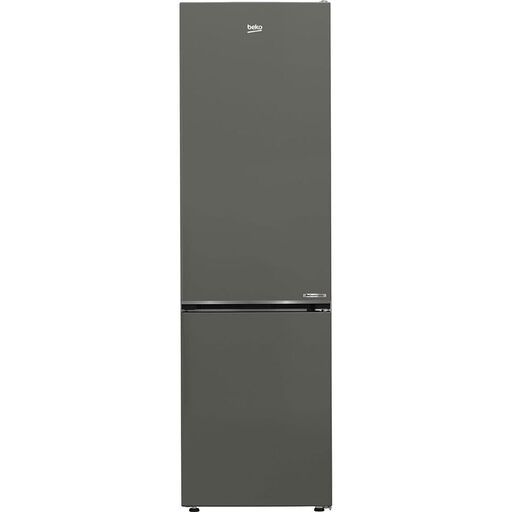 Image unavailable
Beko B5RCNE406HG, 355 L grey fridge-freezer, Total No Frost, C rated
If your regular shop includes frozen food, check the capacity and layout of this fridge-freezer’s freezer section. Also check the packaged dimensions, required clearances and the model’s energy label.
View on Joybuy
 Image unavailable
Candy CFQQ5T817EPS, 467 L silver four-door fridge-freezer, Total No Frost, E rated
Check that you have enough room for this four-door model. Its stated width of 83,3 cm also needs to suit your delivery route and allow the doors to open. Compare the capacity of each compartment with what you usually keep in stock, then check the manual and energy label.
View on Joybuy
 Image unavailable
Haier HTW5618ENMG, 360 L three-door fridge-freezer, Total No Frost, E rated
If you want to store fresh and frozen food in one appliance, check that each compartment in this model can hold the amounts you usually buy. Also check the delivery dimensions, ventilation requirements and energy label.
View on Joybuy
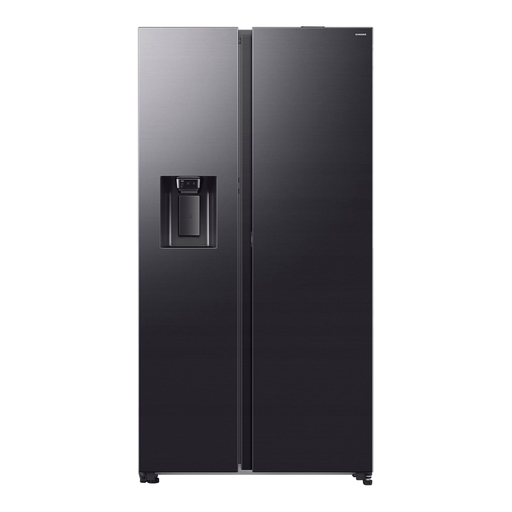 Image unavailable
Samsung RS80F64KEF, 640 L black side-by-side fridge-freezer
This side-by-side model is designed for households that need plenty of storage, provided its stated width of 91,2 cm and weight of 115 kg are suitable for your access points and installation. Check the capacity of each section, the packaged dimensions and ventilation requirements. If you plan to use the dispenser, check the water connection requirements too.
View on Joybuy
Frequently asked questions
What capacity do you need for family shops every few days?
Start with what you usually keep in stock, then check the space for fresh and frozen food separately. UFC-Que Choisir gives a general guide of 100 to 150 L for one person, then around 50 L for each additional person. Adjust this to the frozen food and meals your household actually keeps.
Is a multi-door model always suitable for a large family?
No. Its capacity is only useful if the compartments suit what you keep in stock and the appliance can get all the way to your kitchen. UFC-Que Choisir notes that a large American-style model may need around 1 m of width, compared with 70 cm for a standard model. Measure the model you’re considering and its entire delivery route.
How do you compare the energy consumption of a fridge-freezer and two separate appliances?
Compare the kWh/year and usable capacity of the specific models. If you’re choosing a separate fridge and freezer, take both appliances into account. The ADEME’s general guidance can’t predict the energy consumption of the combination you choose.
How much ventilation space should you leave around a fridge?
Follow the clearances specified in the manual for the model you choose. Bosch’s general advice recommends at least 200 cm² of clear space behind and beneath the fridge. Check the instructions for your specific appliance before preparing its space.


