Households preparing portions to freeze
If the freezer compartment fills up before the fridge, start by looking for enough freezer capacity and easy-to-access storage. Also measure the space available if you’re considering a separate appliance.


Choose according to what you’re actually short of for meal prep and bulk shopping: space for fresh food, frozen portions, or both. A fridge-freezer combines fresh and frozen storage in one appliance; a separate freezer is a good option when you need more room for frozen food but your current fridge still has enough space. Compare the capacity of each compartment and the installation requirements rather than relying on the total capacity alone.
If the freezer compartment fills up before the fridge, start by looking for enough freezer capacity and easy-to-access storage. Also measure the space available if you’re considering a separate appliance.
If fresh ingredients and meals for the next few days already take up all the shelves, consider the fridge capacity and layout. ANSES recommends keeping perishable foods in the coldest part of the fridge and avoiding overfilling it.
If you store fresh and frozen food every week but don’t want to add a second appliance, check the capacity allocated to each compartment in a fridge-freezer, then measure up for installation.
Before replacing your appliance, pay attention to what actually overflows after your shopping trips and meal prep. This will help you decide whether you need more fridge space, more freezer space or a balance of both in a fridge-freezer.
Consider this if: you regularly need room for both fresh and frozen food and want a single appliance.
Bear in mind: the split between compartments varies by model. A large total capacity doesn’t guarantee enough space in the compartment you need most.
Consider this if: frozen portions fill up your current freezer compartment, but you still have enough room for fresh food.
Bear in mind: you’ll need space for a second appliance that runs continuously, as ADEME points out.
Consider this if: you’re short of space for fresh groceries and meals you plan to eat soon, but don’t need as much extra freezer capacity.
Bear in mind: more fridge space won’t solve a shortage of room for frozen portions.
| What you need | What to check | Who is this for? |
|---|---|---|
| Space for frozen portions | Net freezer capacity and the layout of the drawers or chest. | I prepare portions in advance and the freezer compartment fills up before the rest; around 31% of consumers prioritise freezer space. |
| Space for fresh food | Net fridge capacity and the layout of the shelves and drawers. | After a big shop, I need to put away fresh produce and meals for the next few days without cramming the coldest section; around 31% of consumers prioritise space for fresh food. |
| A balance of fresh and frozen storage | Net capacity of each compartment and whether the appliance is freestanding or built-in. | I use both compartments every week but would rather have just one appliance; around 23% of consumers prioritise this balance. |
| Installation and energy use | Dimensions, ventilation, climate class and annual energy consumption in kWh. | When space is limited, I want to check that the appliance can be installed and used in the conditions intended; around 15% of consumers prioritise these requirements. |
Two fridge-freezers with similar total capacities may split that space differently. For example, Electrolux lists 194 L of fridge space and 62 L of freezer space for its built-in LNG7TE18S model. This may not suit you if you mainly need more freezer space.
For a week or two, note which compartment runs out of room, then compare their net capacities separately.
ADEME points out that fridges and freezers run continuously, and that their size and certain features affect energy use. Appliances must also be installed with the clearances and in the conditions specified by the manufacturer.
Measure the space, check the ventilation requirements and climate class, then compare the annual energy consumption listed for the models you’re considering.
A larger capacity doesn’t mean you can overlook where to store perishable food. ANSES recommends aiming for 4 °C in the coldest part of the fridge and avoiding overfilling it so that air can circulate.
Check the shelf positions and make sure there’s room for your containers before choosing a larger capacity.
Bosch’s range includes fridge-freezers and separate freezers, giving you two configurations to consider depending on where you need more space.
Electrolux’s range includes built-in fridge-freezers and freezers, which are worth comparing if your installation requires a housing space or a separate freezer compartment.
Beko offers freestanding fridge-freezers, including large-capacity models to consider for bulk shopping.
Whirlpool offers freestanding and built-in fridge-freezers for keeping fresh and frozen food in one appliance.
These appliances illustrate two options: keeping fresh and frozen food in one appliance, or adding a freezer when you already have enough room for fresh food. Compare their capacities with what you actually store, and check the installation requirements for each model.
 Image unavailable
Worth considering if you want to store fresh and frozen food in a four-door appliance. The model name lists a capacity of 467 L, Total No Frost cooling and an E energy rating. Check how the capacity is split between compartments and allow enough room to open the doors.
 Image unavailable
Worth comparing if your shopping needs call for space for both fresh and frozen food in one appliance. The model name lists a capacity of 495 L and an E energy rating. Check the dimensions and, if you plan to use the water and ice dispenser, the connection requirements.
 Image unavailable
Worth considering if you’re short of room for frozen portions but your fridge has enough space for fresh food. The model name lists a capacity of 161 L, drawers, No Frost and a C energy rating. Check its dimensions, annual energy consumption and the temperature settings specified in the manual.
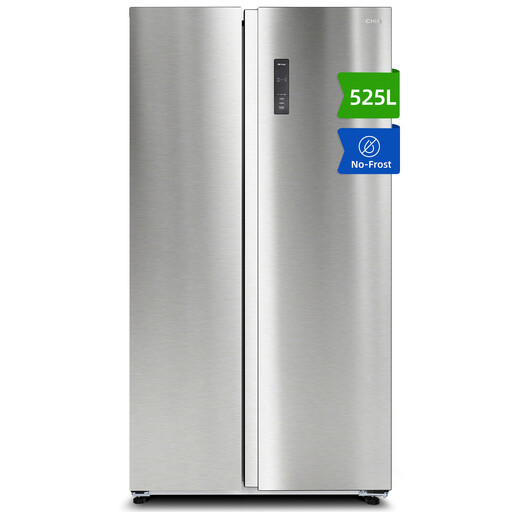 Image unavailable
Worth comparing if you need plenty of space in both compartments. The model name splits the stated 525 L capacity into 333 L of fridge space and 192 L of freezer space. It also lists 37 dB, No Frost and an E energy rating. Measure the space and check the annual energy consumption before choosing this style.
 Image unavailable
Worth considering if your kitchen needs a built-in fridge-freezer for fresh and frozen food. The model name lists a capacity of 249 L, TwinTech No Frost and an E energy rating. Check the capacity of each compartment in the product specifications, along with the housing dimensions, before you buy.
ANSES recommends a temperature of 4 °C in the coldest part of the fridge, where cooked meals and other perishable foods should be stored. Make sure there’s enough room to put them away without overfilling the appliance, so that air can circulate.
A separate freezer can solve a shortage of space for frozen portions if your fridge still has enough room for fresh food. If you’re short of space in both compartments and want just one appliance, compare the net fridge and freezer capacities of fridge-freezers.
Compare the energy rating, annual consumption in kWh, the capacity listed for each compartment and the stated noise level. To compare energy use fairly, look at appliances with capacities that genuinely suit the same needs. The energy label doesn’t replace checking the installation dimensions.
Measure the space, the clearance needed for the doors and, for a built-in model, the housing. Check the manual for ventilation clearances and the climate class suited to the room. Electrolux, for example, reminds users to allow air to circulate around the appliance.