Start by choosing the capacity you need for fresh and frozen food, then compare the annual energy use in kWh of appliances designed for the same purpose and with a similar capacity. A fridge-freezer suits regular storage needs for both types of food; a fridge without a freezer, or with a small freezer compartment, is suitable if you freeze little or have another freezer. A separate freezer adds capacity, but it’s another appliance that runs continuously, so make sure its size meets a genuine need.
Who is this choice for?
Households mindful of their annual energy use
You’re replacing or choosing an appliance that will run continuously and want to compare kWh/year without treating very different formats and capacities as equivalent. ADEME highlights the importance of size and features when making this choice.
Households looking to adjust their storage space
You’re choosing between a fridge, a fridge-freezer and a separate freezer. The capacity in litres for fresh and frozen food should reflect your habits, rather than just the total capacity shown.
Households with specific kitchen dimensions to work around
Your available space limits the appliance’s height, width or depth. Check that the doors can open fully and that the appliance will fit through to the kitchen before comparing models by energy use.
Which criteria should you prioritise?
The right format depends first on how much space you actually need for fresh and frozen food. Annual energy use and dimensions can then help you compare models suited to your needs.
Fridge without a freezer
Consider this if: you don’t store frozen food or already have another way to freeze food.
Bear in mind: you’ll need another appliance if your freezing needs change.
Fridge with a freezer compartment
Consider this if: you only store a limited amount of frozen food.
Check: the freezer compartment takes up some of the appliance’s capacity, so check the available litres for each purpose separately.
Fridge-freezer
Consider this if: you regularly need to store both fresh and frozen food in one appliance.
Check: the total capacity doesn’t show how much space is available for refrigeration and freezing.
Separate freezer
Consider this if: you regularly store more frozen food than will fit in a fridge-freezer that suits you.
Bear in mind: this extra appliance takes up space and also runs continuously, as ADEME points out.
| Criterion |
What to check |
Who is this for? |
| Annual energy use |
Compare kWh/year and the A to G energy rating for appliances designed for the same purpose, with a similar capacity and comparable features. |
If I’m replacing an appliance that runs continuously, I want to reduce the electricity it uses without choosing the wrong capacity; around 42% of consumers rank energy use as their top priority. |
| Fresh and frozen capacity |
Check the litres available in each compartment, not just the total capacity. UFC-Que Choisir recommends 100 to 150 L for one person, plus 50 L for each additional person, adjusted to suit the household’s habits. |
I need enough room for my shopping and frozen food, without giving too much space to one at the expense of the other; around 33% of consumers would prioritise how storage space is divided. |
| Space required |
Measure the available space, access route and door clearance; for a built-in model, also check the housing and door fitting. |
When every centimetre counts in the kitchen, I need to be able to install and use the appliance without obstructing movement; this would be the top consideration for around 25% of consumers. |
Mistakes to avoid before you buy
-
Relying on the energy rating alone
The rating letter doesn’t tell you the annual energy use when the appliances you’re comparing differ in size or features. ADEME says that an appliance’s size and extra features can affect its energy use.
Check the kWh/year alongside the A to G rating, then compare models designed for the same purpose and with a similar capacity.
-
Choosing based only on total capacity
Two fridge-freezers with a similar total capacity may offer different amounts of space for fresh and frozen food. EPREL product information lists these capacities separately.
Think about what you usually store in each compartment, then check the corresponding capacity in litres for the exact model.
-
Measuring the space but not the delivery route
An appliance may fit its allotted space but still be difficult to get into the kitchen or use if you haven’t allowed for the doors to open.
Measure the space and access route, then check the dimensions and installation instructions for your chosen model.
-
Adding features without thinking about how you’ll use them
ADEME lists ice making as one of the features that can increase energy use.
Decide which features you’ll use regularly before comparing the usable capacity and kWh/year of the appliances you’re considering.
Brands to consider by model
Bosch
Bosch offers fridge-freezers, fridges without freezers and freezers, so you can explore several formats across its range.
- Some Bosch product listings include features such as NoFrost or model-specific installation options.
- These features aren’t available across the whole range: check the dimensions, capacities and kWh/year for the exact appliance.
Liebherr
The range includes fridge-freezers with different capacities, to suit the space available and the balance you want between fresh and frozen storage.
- Depending on the model, Liebherr product listings give the dimensions, total capacity and noise level.
- Capacity and overall size vary between models. BioFresh is a feature the manufacturer lists for certain models, not the whole range.
Samsung
Samsung offers fridge-freezers, including some SpaceMax models for households comparing storage capacity with overall dimensions.
- Samsung describes SpaceMax as a way to increase storage space on some RB7300 models.
- When comparing two appliances, look at the capacity in litres, kWh/year, noise level and dimensions of the exact models, rather than relying on this brand claim alone.
Fridge-freezers available from Joybuy
These five fridge-freezers combine fresh and frozen food storage in one appliance. Start by choosing the capacity that suits you, then check the energy label and dimensions for the exact model before comparing the options.
 Image unavailable
Samsung RB33B612EBN, black 344 L fridge-freezer
Worth considering if you want to store fresh and frozen food in one appliance. The model name lists a total capacity of 344 L and an E energy rating; check the capacity split and kWh/year on the exact model’s energy label.
View on Joybuy
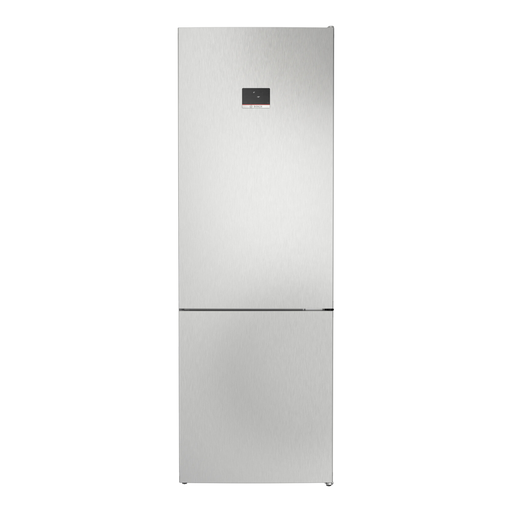 Image unavailable
Bosch KGN497LDF, grey 440 L fridge-freezer
Worth considering if you need 440 L of total capacity for fresh and frozen food, provided it suits your actual storage needs and kitchen. The model name lists a D energy rating; check the kWh/year, capacity of each compartment and dimensions for the exact model.
View on Joybuy
 Image unavailable
Candy CFQQ5T817EPS, four-door 467 L fridge-freezer
Worth considering if a four-door fridge-freezer suits the way you store fresh and frozen food. The model name lists 467 L, an E energy rating and Total No Frost; check the kWh/year, capacity split and clearance needed to open the doors.
View on Joybuy
 Image unavailable
Haier HTW5618ENMG, three-door 360 L fridge-freezer
Worth considering if you’re looking for a three-door fridge-freezer for everyday storage of fresh and frozen food. The model name lists 360 L, an E energy rating and Total No Frost; compare the kWh/year and capacity of each compartment for the exact model.
View on Joybuy
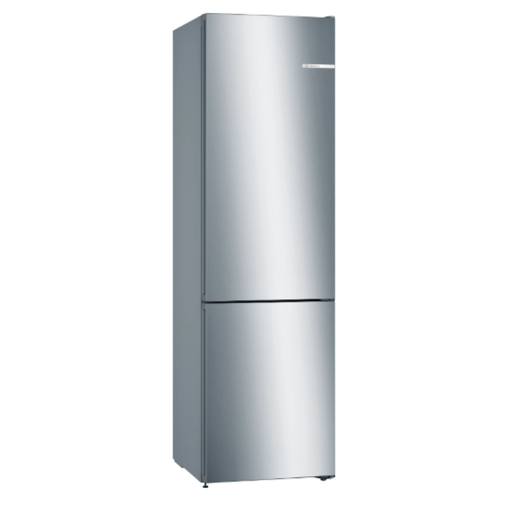 Image unavailable
Bosch KGN39VLEB, 368 L fridge-freezer with stainless steel effect finish
Worth considering if a 368 L fridge-freezer meets your fresh and frozen storage needs. The model name lists an E energy rating; check the capacity of each compartment, kWh/year, dimensions and noise level for the exact model.
View on Joybuy
Frequently asked questions
What should I check on a fridge-freezer’s energy label?
Check the A to G energy rating and the exact model’s annual energy use in kWh. To see if it meets your needs, also check the capacity of the fridge and freezer compartments, the dimensions and the noise level. The European EPREL database also lets you look up product details for the model.
Does a better energy rating always mean lower annual energy use?
No. To estimate annual electricity use, compare the kWh/year of appliances designed for the same purpose, with a similar capacity and comparable features. ADEME points out that size and additional features can affect energy use.
What size fridge does a household need?
UFC-Que Choisir suggests 100 to 150 L for one person as a starting point, plus 50 L for each additional person. Adjust this guideline to suit your usual shopping and check separately how much space you need for frozen food.
Should I add a separate freezer to reduce energy use?
No. A separate freezer is primarily for extra storage and runs continuously. If a fridge-freezer has enough room for your frozen food, you don’t need an additional appliance for this purpose. Then compare the kWh/year of the options that suit your household.


