Households that store fresh and frozen food
If your shopping fills both compartments, compare their usable capacities separately. How the space is divided matters just as much as the fridge freezer’s total capacity.


If you regularly store fresh food and a moderate amount of frozen food, start by comparing the separate capacities of fridge freezers. A freezer compartment may be too small if you buy frozen food frequently. A separate freezer is better suited to storing larger reserves, provided you have room and power for two appliances. Whatever you choose, check the dimensions, ventilation requirements and delivery access for the model you’re considering.
How much room you need for fresh and frozen food depends more on your usual shopping habits than on the total capacity shown on the label.
If your shopping fills both compartments, compare their usable capacities separately. How the space is divided matters just as much as the fridge freezer’s total capacity.
If the freezer compartment in your fridge freezer regularly fills up, consider the capacity of a separate appliance and how much space it would take up. Que Choisir distinguishes between upright freezers, which are more compact, and chest freezers, which are designed for storing larger quantities.
Measure doorways, the lift and the final installation space before choosing a model. The manual will specify the ventilation clearances to leave once the appliance is installed.
First work out how much space you need for frozen food, then check that your chosen format suits your kitchen, energy needs and maintenance preferences.
| Criteria | What to check | My needs |
|---|---|---|
| Usable capacity | Compare the fridge and freezer capacities in litres separately. Also check whether the drawers can accommodate the packaging you usually buy. | After doing my shopping, I want enough room for fresh food without running short of space for frozen food. |
| Freezing format | Que Choisir says that a small freezer compartment may not be enough if you eat a lot of frozen food. If the freezer space in a fridge freezer is too limited, compare an upright or chest freezer, depending on the space available and how easily you need to access your food. | I only buy frozen food occasionally, or I want to store larger quantities for longer. |
| Energy consumption | Check the kWh/year figure and usable capacity on each model’s label. If you’re considering two appliances, add their stated energy consumption together before comparing it with that of a fridge freezer with a suitable capacity. | If I choose two appliances that run continuously, I want to assess their combined energy consumption. |
| Installation | Measure the height, width and depth, including all access routes. Check how the doors open and the ventilation clearances specified in the model’s manual. | The appliance must fit through my access routes and in the space available. |
| Maintenance | Check which compartment has No Frost or Low Frost and whether manual defrosting is still required. Consider how easy it is to reach the drawers or the bottom of a chest freezer. | I’d rather know in advance how often I’ll need to defrost it and how easy it will be to find what I’ve stored. |
A large fridge may leave little room for frozen food. Que Choisir also points out that a small freezer compartment may not be enough if you eat a lot of frozen food.
Think about what your usual shopping looks like, then compare the usable capacity of each compartment.
Fridges and freezers run continuously. The average figures published by ADEME aren’t enough on their own to compare models with different capacities.
Add together the kWh/year figures for the two models you’re considering, then compare the result with a fridge freezer that has enough capacity for your needs.
A chest freezer offers plenty of storage, but it needs floor space and easy access to its contents. Que Choisir presents an upright freezer as a more compact option.
Measure the space and compare how food is organised in a chest freezer with the drawers in an upright model.
An appliance may fit its intended space but still be difficult to get through the stairs, lift or doorways. You’ll also need to follow the model’s ventilation requirements.
Measure the appliance and access routes, check the installation clearances, and confirm what delivery and installation include before you order.
For a built-in model, you may need to arrange carpentry, plumbing or electrical work separately, depending on the service you choose.
These brands offer useful points of comparison for different formats and features. Always check the details of the specific model you’re interested in.
If you’re comparing the capacity of the two compartments in a freestanding fridge freezer, Bosch’s KGN36VXCT specification lists 218 l for the fridge and 103 l for the freezer.
Electrolux’s range includes both built-in and freestanding fridge freezers. Each type of installation calls for different checks.
Liebherr offers fridge freezers with a separate freezer compartment, as well as dedicated freezers. These are worth considering if you want to choose your frozen food storage capacity independently.
These five models are fridge freezers. Compare their fresh and frozen food capacities if this format suits your shopping habits. A separate freezer is still worth considering if you need extra storage and have the space for it.
 Image unavailable
If you want to divide your shopping between two separate compartments, this model offers 235 l of fridge space and 125 l of freezer space. Its specification lists Total No Frost, three freezer drawers, an E energy rating and 271 kWh/year. The stated dimensions are 185 × 59,5 × 66,7 cm; check the manual for ventilation clearances and the space needed to open the doors.
 Image unavailable
If space is limited, check that its stated width of 54 cm suits your available space and access routes. The 262 l capacity is divided into 187 l of fridge space and 75 l of freezer space. The stated dimensions are 176 × 54 × 55 cm, and it has an E energy rating and uses 215 kWh/year. The Low Frost freezer still needs manual defrosting; check the manual for ventilation clearances too.
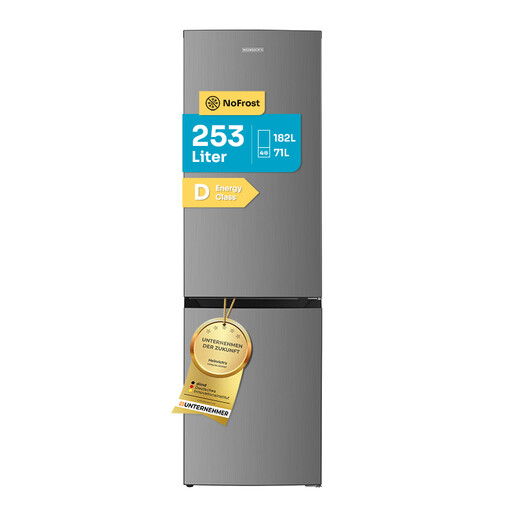 Image unavailable
If you need separate space for frozen food, this model offers 182 l of fridge space and 71 l of freezer space. Its specification lists No Frost, a D energy rating and a height of 181 cm. Before choosing this model, check its width, depth, installation clearances and kWh/year in the product documentation.
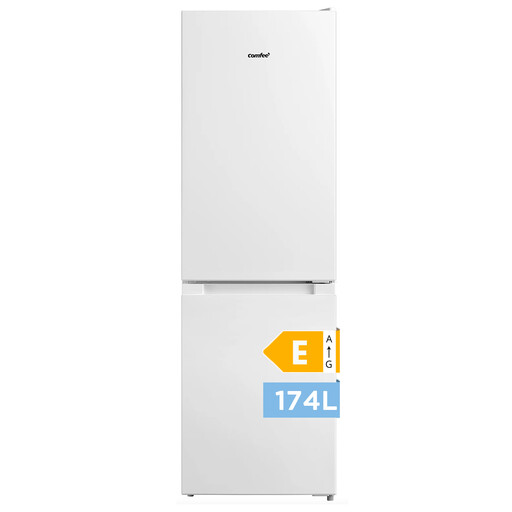 Image unavailable
If you’re looking for two compartments in a compact appliance, this model offers 115 l of fridge space and 59 l of freezer space. Its stated dimensions are 50 × 55 × 150 cm, and it has an E energy rating. Low Frost doesn’t eliminate the need to defrost the freezer. Check its kWh/year figure and the installation clearances too.
 Image unavailable
If you’re comparing appliances that are 54 cm wide, this model offers 153 l of fridge space and 74 l of freezer space. Its specification also lists a reversible door and an E energy rating. The Low Frost freezer still needs manual defrosting. Check the height, depth, kWh/year figure and ventilation clearances before confirming it’s right for your kitchen.
Start by thinking about how much fresh food you keep after your usual shop, then check the fridge’s usable capacity. Compare the freezer capacity separately too: two fridge freezers with the same total capacity may divide the space between their compartments differently.
A small freezer compartment may not be enough if you eat a lot of frozen food, as Que Choisir points out. Compare the type and usable capacity of the freezer compartment with how much you want to store between shops.
The kWh/year figure shows the model’s stated annual energy consumption, while the rating letter alone doesn’t tell you its capacity or how it will work in your home. If you’re considering a separate fridge and freezer, add together the stated energy consumption for both appliances and compare it with that of a fridge freezer with a suitable capacity.
No. The required clearances depend on the appliance and how it’s installed. Check the manual, then measure the space, taking into account how the doors open and the route into your kitchen.
Compare the appliance’s dimensions with your doorways, corridors, stairs and lifts, and tell the delivery company about any access issues. Also check what the installation service includes, especially for a built-in model that may need additional work.