What should you compare before replacing your appliance?
First work out how much space you need for fresh and frozen food, then compare the energy use of appliances that can meet those needs.
Fridge only
Consider this if: you rarely freeze food or already have a freezer that suits your needs.
Bear in mind: a small freezer compartment inside the fridge may not meet your needs if you regularly store frozen food.
Fridge-freezer
Consider this if: you store both fresh and frozen food and want them in one appliance.
Bear in mind: the freezer compartment needs to be big enough for your usual shopping.
Separate freezer
Consider this if: you regularly need more freezer space than a fridge-freezer suited to your household can provide.
Bear in mind: you’ll need to make room for it and factor in its energy use as well as the fridge’s.
| Factor | What to check | Depending on your needs |
|---|
| Usable capacity |
Compare the litres available for fresh and frozen food separately. Also measure the space available for the appliance. |
I want enough room for my usual shopping, without choosing a large freezer compartment I’d rarely use. |
| Annual energy use |
Check the kWh/an and energy rating on the label for the exact model. Compare appliances designed for the same use and with similar capacity, as well as your current appliance’s energy use if you can establish it. |
An energy rating alone isn’t enough: I want to know how much energy an appliance suited to my storage needs would use. |
| Installation and noise |
Check the dimensions, the clearances required by the manufacturer and the climate class for the room temperature. Check the stated noise level if the appliance will be near a living area. |
In an open-plan kitchen or utility room, I need to be able to fit the appliance in the space available and live with the noise it makes. |
| Food preservation features |
Check which compartments and features the exact model has, particularly if you want a No Frost system. Then compare its kWh/an without assuming that a feature alone will save energy. |
I prioritise features that suit the food I store and the maintenance I’m prepared to do. |
Brands worth considering
These examples highlight features to compare on specific models; they don’t represent every range from these brands.
Bosch
If you’re looking at a freestanding fridge-freezer, the Bosch KGN492IAF is one model you can compare with your capacity and installation needs.
- Bosch gives the KGN492IAF an A energy rating.
- Check this model’s kWh/an, capacity and dimensions before comparing it with your current appliance.
Liebherr
The Liebherr RBsfd 5221 Plus BioFresh fridge is worth comparing if you’re considering an option without a freezer compartment.
- Liebherr lists a total capacity of 351 L and a noise level of 35 dB for this model.
- These figures apply to the RBsfd 5221; also check its annual energy use and the space needed for installation.
Whirlpool
The Whirlpool W9C841COX fridge-freezer is worth considering if a No Frost defrosting system is important to you.
- Whirlpool lists a C energy rating and a Dual No Frost system for the W9C841COX.
- Even with this feature, you’ll still need to compare the exact model’s kWh/an and capacity.
Cooling appliances available on Joybuy
This selection includes fridge-freezers for storing fresh and frozen food in one appliance, as well as a separate freezer for regular extra storage. Compare each model with the capacity you need.
 Image unavailable
Samsung RB33B612EBN, 344 L black fridge-freezer, E energy rating
Worth considering if you want to keep fresh and frozen food in one appliance. It has a stated total capacity of 344 L and an E energy rating. Compare the capacity of each compartment and its kWh/an with those of your current appliance.
View on Joybuy
 Image unavailable
LG GBBSJ1CCSW, 333 L white fridge-freezer, C energy rating
Compare this fridge-freezer if you need space for both fresh and frozen food in one appliance. Its title lists a capacity of 333 L and a C energy rating; check the kWh/an and the clearance needed for installation before deciding.
View on Joybuy
 Image unavailable
Sonlu CC-520WE, 444 L silver fridge-freezer, E energy rating
Its stated total capacity of 444 L is worth comparing with the amount of food you actually store. The title mentions a frost-free system and 40 dB; check how the capacity is divided, the dimensions and the kWh/an to see if it’s right for you.
View on Joybuy
 Image unavailable
Heinrich´s, 161 L No Frost freezer, C energy rating
A separate freezer to consider if you already have a fridge and regularly need more space for frozen food. Its title lists a capacity of 161 L, a C energy rating and a reversible hinged door; check its kWh/an and dimensions to see what adding a second appliance would involve.
View on Joybuy
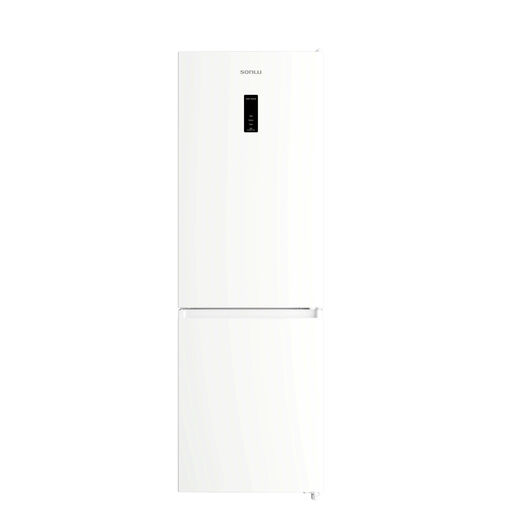 Image unavailable
Sonlu CD‑350RW, 310 L fridge-freezer, E energy rating
This fridge-freezer lets you compare the space for fresh and frozen food separately: its title lists 211 L for the fridge and 99 L for the freezer. It has a stated width of 60 cm and a reversible door; check the other dimensions and kWh/an before comparing it with your current appliance.
View on Joybuy
Frequently asked questions
How can I tell whether replacing my fridge-freezer will reduce its energy use?
If you can establish your current appliance’s energy use, compare it with the kWh/an of a new model offering similar storage capacity. ADEME points out that cooling appliances run continuously, but a typical energy-use figure alone can’t show how much you’ll save at home. Also check the installation and maintenance of your current appliance.
Is the energy rating enough to make a choice?
No. The European Commission says the label shows, among other things, a rating from A to G, energy use and capacity. Compare the kWh/an and litres for each compartment across appliances that meet the same needs; also check their dimensions and noise levels.
What size fridge do I need?
UFC-Que Choisir suggests 100 to 150 L as a starting point for one person. Then adjust the capacity to how often you shop and your storage habits, working out separately how much room you need for frozen food. Compare the annual energy use of models that meet those needs.
Does a separate freezer use less energy than a fridge-freezer?
You can’t tell from the type of appliance alone. If you use a fridge and a separate freezer, add together their annual energy use in kWh and compare the total with that of a fridge-freezer whose two compartments would meet your needs. ADEME points out that every cooling appliance runs continuously.
Why check the climate class before buying?
It helps you check whether the model’s specified ambient temperature range suits the place where you plan to install it. This is particularly important in a garage, cellar or warm room: UFC-Que Choisir warns that performance may suffer outside the recommended range. Also check the manufacturer’s clearance instructions.


