Which factors should guide your choice?
Start by working out what your current compartment is missing: more room, easier access or both. Then choose a format that suits the room, rather than focusing on the number of litres alone.
Fridge-freezer
Consider it if: your portions and frozen shopping fit easily into the existing compartment.
Bear in mind: your stock is limited by the space available. If you plan to freeze freshly prepared meals, check the compartment’s star rating and the instruction manual.
Upright freezer
Consider it if: you organise portions and need to find them regularly using easy front access.
Bear in mind: drawers make it easier to sort food, but their dimensions may not suit large packs. Also check how much space you need to open the door.
Chest freezer
Consider it if: bulk shopping or large batches of meals call for dedicated storage, and you have enough floor space.
Bear in mind: the top-opening lid and depth mean you’ll need to plan how to reach food stored at the bottom.
Under-counter freezer
Consider it if: you need a little extra capacity but don’t have room for a large appliance.
Bear in mind: this format is best for extra capacity rather than a large stock. Check the clearances required in the instruction manual.
| Factor |
What to check |
Who it matters to |
| Access to portions |
Check the opening, the size of the drawers or baskets, and access to the back of the appliance. |
I prepare portions that I use often and want to find them without searching through the whole freezer; around 31% of consumers prioritise organised access. |
| Storage capacity |
Compare the net capacity with the packaging and quantities you store after shopping. Also check the stated storage time in the event of a power cut. |
When I bring home large quantities, I need to be able to fit my new shopping in alongside the food already stored. Storage capacity comes first for around 31% of consumers. |
| Space at home |
Measure the space, the delivery route and the clearance needed to open the door or lid. |
I need a little extra room for freezing food without cluttering my kitchen; around 23% of consumers prioritise a space-saving extra appliance. |
| Use and installation |
Check the kWh/year and capacity on the energy label; make sure the permitted ambient temperature range suits the room you have in mind. |
If the appliance will stay plugged in all the time, I want to compare its energy consumption and check that it’s suitable for its location. Around 15% of consumers put these usage conditions first. |
To give you an idea of the different formats, UFC-Que Choisir describes upright freezers as generally close to 200 L, while chest freezers can reach 600 L. These are typical range figures, not the capacity of every model. The DGCCRF says that the energy label on a new appliance includes details such as its model reference, energy class and annual consumption in kWh. Compare these figures across appliances suited to similar storage needs.
Brands to consider across different ranges
These ranges can help you compare formats. The features mentioned depend on the specific models, not the brand as a whole.
Beko
Beko’s range in France includes upright and chest freezers.
- Beko states that certain Freezer Guard models work at ambient temperatures down to −15 °C; some also have No Frost.
- If you’re choosing a freezer for a cold room or want to reduce the need for defrosting, check the model reference, permitted ambient temperature range and the features listed in its instruction manual.
Whirlpool
In France, Whirlpool offers chest, upright and built-in freezers.
- The brand describes upright models as making food easier to see, and chest freezers as a high-capacity storage option.
- Compare the capacity, dimensions, opening and energy consumption of the specific models instead of assuming these features apply to every appliance in the range.
Liebherr
Liebherr offers freestanding, under-counter and built-in freezers, including some NoFrost models.
- Liebherr lists the FNdi 1624 Plus NoFrost with a capacity of 92 L and external dimensions of 85 × 60 × 60.7 cm. It’s a useful example when assessing a compact space.
- These measurements apply to this model only. Check the reference you’re considering and its instruction manual. Liebherr describes NoFrost as a feature that reduces frost build-up, but this doesn’t describe the whole range.
Appliances to keep or increase your capacity
These products illustrate three options for prepared meals and bulk shopping: stick with a fridge-freezer, add a chest freezer for dedicated storage, or choose a small upright freezer. Work out how much space you really need before adding a second appliance.
 Image unavailable
Candy CFQQ5T817EPS — 467 L fridge-freezer
Worth considering if you’d prefer to keep just one appliance for chilled food and frozen portions. The model is listed with four doors, Total No Frost and an E energy rating; the 467 L refers to the stated capacity of the whole appliance, not just the freezer.
Check the freezer compartment capacity and dimensions for your containers and meals, as well as the installation and delivery dimensions.
View on Joybuy
 Image unavailable
Haier HTW5618ENMG — 360 L fridge-freezer
Compare it with your current fridge-freezer if you’d prefer to organise meals and frozen food in one appliance. The listing specifies three doors, Total No Frost, an E energy rating, Wi-Fi and My Zone; the 360 L refers to the stated capacity of the whole appliance.
Compare the freezer compartment capacity with the amount you usually store, and check the manual for dimensions and installation clearances.
View on Joybuy
 Image unavailable
AUCMA — 291 L convertible chest freezer
Consider it for dedicated storage of bulk shopping or portions if you have room for a chest freezer. The listing specifies fridge and freezer modes, a removable basket, LED lighting, five settings and an E energy rating.
Allow for access to the bottom and room to open the lid. If you plan to keep it in a cellar or garage, check the ambient temperature range allowed in the model’s instruction manual.
View on Joybuy
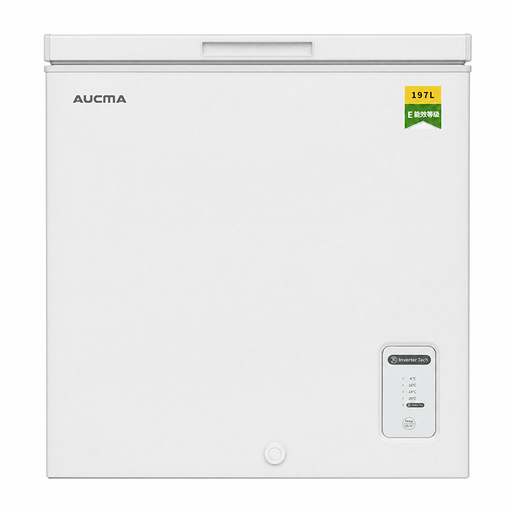 Image unavailable
AUCMA — 197 L convertible chest freezer
Worth considering if you want dedicated storage but don’t need the capacity of the AUCMA 291 L chest freezer. This 197 L model is listed with fridge and freezer modes, a removable basket, five settings and an E energy rating.
The open space means you’ll need a system for finding food at the bottom. Also check the floor space required, the lid opening and the permitted ambient temperature range for your chosen location.
View on Joybuy
 Image unavailable
COMFEE' RCU60WH2(E) — 60 L upright freezer
Consider it as extra storage rather than a solution for large bulk shops. The listing specifies a capacity of 60 L, a reversible door, freestanding installation and an E energy rating.
If you plan to place it under a worktop, check its dimensions, ventilation clearances and the installation requirements in the instruction manual. Also compare its annual energy consumption with that of other models you’re considering.
View on Joybuy
Frequently asked questions
Is a freezer compartment enough to freeze prepared meals?
Not if you need to freeze fresh food. The Ministry of Agriculture distinguishes between a freezer compartment, intended for temporarily storing food that is already frozen, and a four-star compartment, which can freeze food. Check your appliance’s star rating and instruction manual before preparing portions to freeze.
What should I compare on the energy label of a new freezer?
Compare annual energy consumption in kWh with the capacity and format you need, rather than looking at the energy rating letter alone. The DGCCRF says the label identifies details such as the manufacturer, model reference, energy class and annual energy consumption.
Can you put a freezer in a cold garage?
Yes, as long as the garage temperature stays within the ambient range allowed for the model you choose. Check its climate class and instruction manual: Beko’s Freezer Guard feature, rated to −15 °C, is available on certain models only.
Does a No Frost freezer need no maintenance?
No. Brands describe No Frost as a feature that limits frost build-up, but you should still follow the cleaning and maintenance instructions for your model. Also check the correct procedure before removing or replacing your food.


