If you mainly store fresh food and leftovers to eat soon, start by checking the capacity and layout of your fridge. A fridge-freezer suits regular use of both compartments; a separate freezer makes more sense if you often freeze portions and already have enough fridge space. In either case, compare the capacity of each compartment, annual energy consumption and the space available: adding more cold storage doesn’t replace keeping track of what you have.
Which households is each option suited to?
The right balance between fridge and freezer space depends on the food you actually keep from week to week, not just the total capacity advertised.
Households that cook ahead
If you regularly prepare portions to freeze, check how much space they take up in your current freezer compartment before considering a separate freezer. Also make sure your fridge still has room for fresh ingredients and meals you plan to eat soon.
Households that mainly store fresh food and leftovers
A clear, organised layout may be more useful than another freezer compartment if opened products and prepared meals are hard to find. For foods that need careful handling, Anses recommends keeping an eye on the temperature in the coldest part of the fridge, which should be 4 °C.
Households mindful of electricity use and space
Before replacing or adding an appliance, check its dimensions against your kitchen and its capacity against the amount of food you usually store. ADEME points out that fridges and freezers run continuously, and a larger or additional appliance can increase energy consumption.
What should you compare before choosing?
First decide whether you’re short of space for fresh food, frozen portions or simply need a better way to organise what you have. Then compare the features of appliances that could meet that need.
Fridge
Best if: your shopping, prepared meals and leftovers are mainly for eating soon.
Limitation: it won’t provide enough freezer capacity for a regular stock of frozen portions.
Fridge-freezer
Best if: you use both fridge space and a moderate amount of freezer space every week.
Consider: the total capacity is split between two compartments, so check the capacity of each one.
Separate freezer
Worth considering: if you regularly freeze more portions than your current compartment can hold and already have a suitable fridge.
Trade-off: it takes up extra space and runs continuously, but won’t replace the fridge space you need for fresh food.
Organising your existing appliance
Try this first: if you mainly lose track of opened food or prepared portions, rather than running out of space.
Limitation: containers and a clearer layout won’t solve insufficient capacity or an unsuitable temperature.
| Criterion |
What to check |
Based on your needs |
| Fresh food and leftovers |
Find the coldest part of the fridge and check its temperature: Anses recommends 4 °C. Make sure shelves and containers keep food accessible without overfilling the appliance. |
I mainly store fresh ingredients, opened products and meals to eat soon; I want to be able to find them and keep track of what needs using up. |
| Freezer capacity |
Compare the usable capacity of the freezer compartment separately from that of the fridge. Check how portions can be arranged and identified in the drawers or bins. |
My food prep regularly fills the current freezer compartment. More freezer space could meet this need without reducing the room needed for fresh food. |
| Energy consumption |
Check the annual energy consumption in kWh on the energy label and compare appliances of a similar type and capacity. The European Commission says the label also shows storage volumes. |
If I add an appliance that will run continuously, I want its capacity to suit the amount of food I usually store, rather than just a few unusually large shops. ADEME recommends taking size and over-equipping into account. |
| Installation and access |
Measure the space and check the model’s dimensions, door opening direction and required clearances. Also compare its noise level if it will be near a living area. |
In my kitchen, I need to be able to open the door, reach the food and put away the shopping without the appliance blocking the way. |
What mistakes should you avoid?
-
Looking only at the total capacity
With a fridge-freezer, this figure doesn’t show how much space is set aside for fresh and frozen food respectively. The European Commission says the energy label lists the storage volumes of the compartments separately.
Take note of what fills your appliance over a week or two, then compare the fridge and freezer capacities separately on the models you’re considering.
-
Adding a freezer to solve a fresh-food storage problem
A freezer won’t make leftovers in the fridge easier to find or replace the space you need for fresh food.
If your current freezer capacity is sufficient, start by organising your containers and keeping track of opened food. Choose a separate appliance only if you regularly need more freezer space.
According to ADEME, an additional freezer means another appliance that uses electricity continuously; its energy consumption depends, among other things, on its model and size.
-
Choosing an appliance that’s much larger than your usual stock
ADEME highlights that size and over-equipping can increase the energy consumption of cooling appliances. An energy rating alone therefore isn’t enough to compare appliances with very different capacities.
Work out how much space you normally use, then compare the annual energy consumption in kWh of models with similar types and capacities.
Which branded models are worth considering?
These examples show features you can compare on specific models; their specifications won’t necessarily apply to other appliances from the same brand.
Bosch
The freestanding KGN39AIAU fridge-freezer lets you compare the stated capacities for its fridge and freezer compartments.
- Bosch lists 260 L of fridge capacity and 103 L of freezer capacity for this model: compare each figure with the food you usually store.
- These capacities apply to the KGN39AIAU, not all Bosch fridge-freezers; check its dimensions too before choosing.
Liebherr
The CBNstb 579i Peak is a useful point of comparison if total capacity and noise matter to you.
- Liebherr lists a total capacity of 362 L and a noise level of 33 dB for this model.
- Total capacity alone doesn’t tell you how much space will suit your fresh and frozen food; check the compartments and the exact model’s dimensions.
Whirlpool
The WHC18T132FR built-in fridge-freezer is worth considering if fitting the appliance into a cabinet space is part of your decision.
- Whirlpool lists a total capacity of 250 L and an energy rating of E for the WHC18T132FR. The brand also has an official shop for genuine spare parts.
- Check the cabinet dimensions, how the capacity is divided between compartments and whether parts are available for the exact model you choose.
Appliances for fresh and frozen food
This Joybuy selection includes appliances that combine fridge and freezer compartments, as well as separate freezers to consider alongside a suitable fridge. Before choosing, check the product page for the features that will affect installation and everyday use in your home.
 Image unavailable
CHiQ JR263LGE 262 L Low Frost 70/30 black
A fridge-freezer to consider if you want to store fresh food and frozen portions in the same appliance. The product title lists a capacity of 262 L, a 70/30 split, a width of 54 cm and a height of 176 cm. Check the usable capacity of each compartment and the space needed for installation. Once it’s set up, check the temperature in the coldest part.
View on Joybuy
 Image unavailable
Samsung RF50C530EB1 multi-door 495 L energy rating E black
Consider this multi-door model if you regularly use both the fridge and freezer compartments. The product title lists a total capacity of 495 L and an energy rating of E. Compare the capacity of each compartment, annual energy consumption and dimensions before deciding whether this size is right for you. Also check whether this particular version needs a water connection for its dispenser, and check the temperature in the coldest part.
View on Joybuy
 Image unavailable
Candy CFQQ5T817EPS 4-door 467 L Total No Frost energy rating E silver
This four-door fridge-freezer may suit you if you need separate spaces for fresh and frozen food. The product title lists a total capacity of 467 L, Total No Frost and an energy rating of E; check how the capacity is divided between compartments rather than choosing on total capacity alone. Measure the space, ventilation clearances and door-opening space, then check the temperature in the coldest part after installation.
View on Joybuy
 Image unavailable
COMFEE' RCU60WH2(E) 60 L, 3 drawers, energy rating E, white
This 60 L upright freezer could complement a fridge if you regularly run out of room for frozen portions. The product title mentions three drawers and a reversible door; check the dimensions and door-opening direction to make sure it suits your kitchen. As it won’t keep fresh food chilled, check the exact model’s annual energy consumption on its energy label before adding another appliance.
View on Joybuy
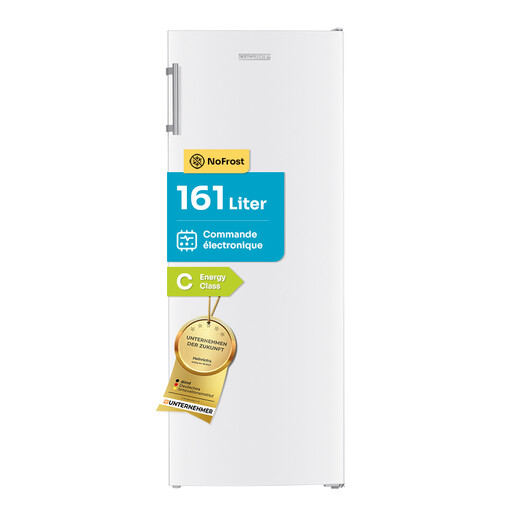 Image unavailable
Heinrich´s 161 L freezer, No Frost, energy rating C, white
This separate 161 L freezer is designed for households that already have fridge space and regularly freeze more than their current compartment can hold. The product title mentions No Frost and an energy rating of C. Before choosing, check the installation dimensions, annual energy consumption in kWh and temperature settings in the model documentation.
View on Joybuy
Frequently asked questions
What temperature should you check for foods that need careful handling in the fridge?
Anses recommends keeping an eye on the temperature in the coldest part of the fridge, which should be 4 °C. Check this area after installation and during everyday use, using a thermometer if the appliance doesn’t provide a clear enough reading.
What should you compare on a fridge or freezer energy label?
For applicable appliances, compare the annual energy consumption, storage volumes and noise emissions shown on the European energy label, as the European Commission explains. Most importantly, compare models of a similar type and capacity that suit the same need: an energy rating alone doesn’t tell you their annual energy consumption.
Will a larger fridge make it easier to manage leftovers?
Not necessarily. More space can help if you’re genuinely short of room, but it won’t automatically make food easier to keep track of. Keep leftovers easy to spot, check the temperature in the coldest part as recommended by Anses, and review what you have before deciding you need a larger appliance.


