When replacing your main fridge-freezer, first check that the new appliance can be delivered, installed and ventilated in the space, and that its doors can open fully. Next, choose the balance between fridge and freezer capacity to suit your habits, then compare the exact model’s annual energy consumption, noise level and power-cut storage time. A freestanding model avoids the restrictions of a cabinet space; an integrated model requires a compatible installation, while separate appliances need two spaces.
Who is this choice for?
Households with a cabinet space or a small kitchen
If space is limited, measure the delivery route as well as the room needed to open the doors. For an integrated model, the cabinet space, hinges and ventilation must meet the requirements in the model’s instructions. The European Commission publishes overall dimensions in EPREL; Bosch refers users to its instructions for installation and door-opening requirements.
Households that use the freezer regularly
Total capacity doesn’t tell you how much room there is for frozen food. Compare the fridge and freezer compartments separately, then check that the drawers and shelves suit the way you usually store food. The European Commission’s EPREL database includes capacity figures for each compartment.
Households mindful of energy use and noise
Compare the kWh per year and noise level of appliances with similar capacities and configurations. ADEME recommends checking the energy label, while EPREL lets you look up the specifications of registered models.
Which criteria should you compare?
First choose a configuration that works in your kitchen, then compare models based on the storage your household really needs.
Freestanding fridge-freezer
Consider this if: the appliance doesn’t need to be built into a cabinet.
Make sure you have: a suitable delivery route, plus enough space for ventilation and to open the doors.
Integrated fridge-freezer
Consider this if: you have a compatible cabinet space and cabinet door.
Make sure you check: the cabinet door fitting, hinges and ventilation requirements in the model’s instructions.
Separate fridge and freezer
Consider this if: you want to choose the space for fresh and frozen food independently.
Make sure you have: two suitable spaces, and check the installation requirements for each appliance.
| Criteria |
What to check |
Who is this for? |
| Size and installation |
Measure the height, width and depth, and check that the doors can open fully. Check the clearances and, for an integrated model, the cabinet space and hinges in the instructions. |
If my kitchen has little room to spare, I want to be able to install the appliance and use its drawers without the door getting in the way. Around 31% of consumers would make this compatibility their top priority. |
| Capacity and storage |
Compare the litres of fridge and freezer space, then check the layout of the drawers and shelves. |
If I regularly store frozen food, total capacity alone doesn’t tell me whether each compartment will meet my needs; around 31% of consumers would put this balance first. |
| Food preservation and storage time |
Check the storage time in the event of a power cut and the exact model’s freezing functions; don’t confuse these with its defrosting system. |
If I often freeze food, I want to know the freezer’s stated capabilities and how long it can keep food frozen during a power cut. This would be a top priority for around 19% of consumers. |
| Energy use and noise |
Check the kWh/year and noise level, preferably across models with similar capacities and configurations. |
In an open-plan kitchen, I pay attention to everyday noise without overlooking the energy use of an appliance that runs continuously; around 19% of consumers would prioritise these criteria. |
Mistakes to avoid
-
Choosing based only on total capacity
Different balances of fridge and freezer space can affect how useful the same total capacity is for your household.
Compare the capacity of each compartment in the product details or in EPREL, then check the layout of the storage space.
-
Measuring only the old appliance or cabinet space
An appliance may fit in the space but still not have enough room for ventilation or to open the doors fully.
Measure the delivery route and the space needed to use the appliance. For an integrated model, check the cabinet space, cabinet door and hinges against the installation instructions.
-
Confusing No Frost with storage time during a power cut
Frost management alone doesn’t tell you how long the appliance is expected to keep food frozen during a power cut or how well it can freeze food.
Check these specifications separately for the model you’re considering, and see which compartments the No Frost function applies to.
-
Waiting until delivery to arrange collection of your old appliance
Taking away your old appliance is one of the practical things to consider when replacing it, especially if you can’t keep two appliances temporarily.
When placing your order, ask about free collection of an old appliance of equivalent type. Ecosystem says retailers must offer a take-back solution when you buy a new, equivalent appliance.
Brands to consider
Bosch
In France, Bosch offers freestanding fridge-freezers as well as models designed to sit behind a cabinet door.
- Its ranges let you consider both installation types for a main appliance.
- For an integrated model, check the cabinet space, ventilation, hinges and whether the door can be reversed in its instructions.
Liebherr
For models featured in its range, Liebherr publishes dimensions, total capacity and noise levels.
- These specifications help you compare the models you’re considering with the space available.
- Check the dimensions of each model. Food-preservation benefits associated with BioFresh are claims made by Liebherr, rather than results that apply to all its models.
Whirlpool
In France, Whirlpool offers freestanding and integrated fridge-freezers, including No Frost models.
- The range lets you consider both installation type and defrosting system.
- The Total No Frost function varies by model. Compare capacity, energy use, noise and stated storage time during a power cut, too.
Appliances to explore on Joybuy
These fridge-freezers include freestanding models and one integrated model. Compare their size and capacity with your available space and storage habits. If you’re considering separate appliances, check each one individually.
 Image unavailable
Bosch KGN33NLEB, 282 L freestanding fridge-freezer
Worth considering if you’re replacing a freestanding fridge-freezer and its stated capacity suits your needs.
Stated total capacity: 282 L; energy rating E. Check the dimensions, ventilation clearances and storage time during a power cut for this model.
View on Joybuy
 Image unavailable
AEG NSC6M18FES, 249 L integrated fridge-freezer
Consider this if your kitchen has space for an integrated fridge-freezer.
Stated total capacity: 249 L; energy rating E; TwinTech No Frost technology. Before choosing it, check the cabinet space, cabinet door and ventilation requirements against the installation instructions.
View on Joybuy
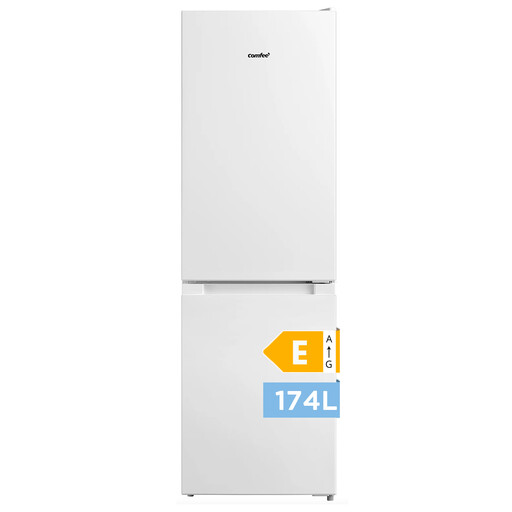 Image unavailable
Comfee' RCB169WH2(E), 174 L freestanding fridge-freezer
Worth considering if you want two compartments in an appliance stated to be 150 cm tall.
Stated total capacity: 174 L; Low Frost, four-star freezer, reversible door, 39 dB and energy rating E. Check the depth and required clearances before choosing this size.
View on Joybuy
 Image unavailable
CHiQ JR227LSE, 227 L fridge-freezer
Worth considering if width is an important factor when choosing a freestanding fridge-freezer.
Stated width: 54 cm; 153 L fridge capacity and 74 L freezer capacity. The product details list Low Frost, a reversible door and energy rating E. Check the height, depth and ventilation clearances as well.
View on Joybuy
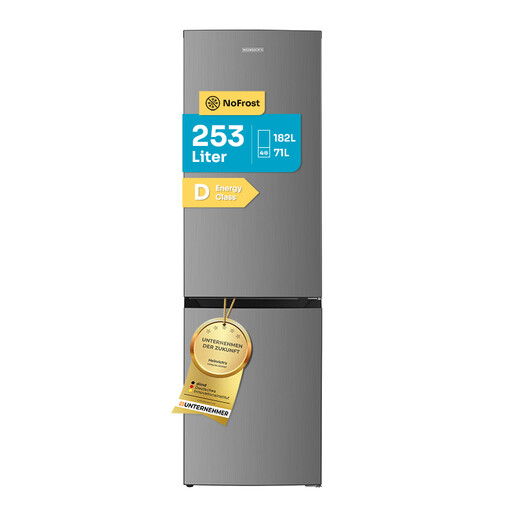 Image unavailable
Heinrich´s, 253 L fridge-freezer
Worth considering if the balance between fridge and freezer capacity suits your everyday storage needs.
Stated capacities: 182 L for the fridge and 71 L for the freezer; No Frost and 39 dB are listed in the product title. Check the dimensions, installation requirements and annual energy consumption for this model.
View on Joybuy
Frequently asked questions
What should I compare on the energy label and in EPREL?
Compare the energy rating and kWh/year, then consider these alongside the compartment capacities, dimensions and noise levels of the models you’re looking at. EPREL, the European Commission’s public database, lists these specifications for registered appliances. ADEME recommends checking the energy label when choosing an appliance.
Is the same ventilation clearance suitable for every model?
No. Follow the clearances and installation instructions for the model you choose, particularly if it’s integrated. Bosch’s installation documentation shows why you need to check these requirements for each model individually.
Can you always reverse a fridge-freezer’s doors?
No. This depends on the model and how it’s installed. Check the instructions before buying, and make sure the doors will open far enough to access the drawers. Bosch refers users to its installation instructions for details on reversing the doors.
How do I arrange collection of my old fridge?
Ask about collection arrangements when you order your new appliance. Ecosystem says that when you buy a new, equivalent appliance as a replacement, the retailer must offer a free take-back solution for your old one.


