What should you look at?
Decide how much space you need for fresh and frozen food before comparing appliances by their energy label. A fridge, a fridge freezer and a separate freezer each meet different storage needs.
Fridge
Consider this if: you mainly need to store fresh food, particularly if you already have a separate freezer for frozen food.
Bear in mind: without a freezer compartment, the appliance can’t store frozen food on its own. Liebherr presents this as an option for households that already have a freezer.
Fridge freezer
Consider this if: you want fresh and frozen food compartments in a single appliance.
Bear in mind: the capacity split needs to suit your habits. A large total capacity alone doesn’t tell you whether you’ll make good use of each compartment.
Separate freezer
Consider this if: you have a separate or greater need for frozen food storage than a fridge freezer compartment can meet.
Bear in mind: both an upright freezer and a chest freezer need suitable space and access. Compare their energy consumption model by model, rather than assuming one format is more efficient.
| Criteria |
What to check |
Who it matters to |
| Electricity use |
Compare the kWh/year and energy ratings of appliances with similar cooling needs and capacities. The model’s energy label also shows its noise level. |
When an appliance runs all the time, I want to compare its stated energy use without mistaking it for my household’s future consumption. Around 40% of consumers would put this energy comparison first. |
| Format and capacity |
Check the capacity in litres of each compartment, the installation dimensions and whether an integrated freezer compartment would be useful. |
If the amount of fresh and frozen food I need to store has changed, I’d rather adjust the capacity of each compartment than choose based on total capacity alone. For around 40% of consumers, getting the capacity right would be the main priority. |
| Delivery and collection |
Confirm the delivery and collection arrangements for your old appliance, including how it will be taken away and any access requirements at your home. |
When my old appliance needs to be taken away, I need to know how its removal will fit in with the arrival of the new one. This would be the main consideration for around 20% of consumers. |
Brands to compare
These brands offer a range of refrigeration appliances. Check the energy label and product information for the model you’re interested in, rather than assuming the features of one range apply to every model from the brand.
Liebherr
Liebherr offers, among other options, single-door fridges, fridge freezers and freezers, with features that vary across its ranges.
- The brand provides energy labels and technical information to help you compare specific models.
- Its sizing advice and energy-use claims are the manufacturer’s own statements. Check the kWh/year, capacities and installation requirements for the model you choose.
Bosch
Bosch offers fridges and freezers, including freestanding and built-in models.
- The product information and explanations of the energy label help you check energy use, capacity and noise levels for the models concerned.
- The brand’s energy-saving claims can’t predict a household’s energy consumption. Compare the figures for models suited to the same needs.
Whirlpool
Whirlpool offers freestanding and built-in fridges, as well as fridge freezers, with product information for each model.
- You can check a model’s features in its product information, and the brand also has a spare parts shop.
- The presence of spare parts in the catalogue doesn’t guarantee they’ll be available for every model, or that an entire range is energy efficient. Check the documentation for the specific model.
Fridge freezers on Joybuy
These appliances combine a fridge compartment with a freezer compartment. If you’re replacing your appliance to reduce electricity use, check that the capacities suit your household, then compare the annual energy consumption shown on each model’s label.
 Image unavailable
Sonlu CC-520WE, 444 L, light silver
Worth considering if you’re looking for an appliance that combines refrigeration and freezing with a total capacity of 444 L.
Energy rating E; stated noise level of 40 dB; frost-free technology noted in the model name. To see how much usable space you’ll have, check the separate compartment capacities in the product information.
View on Joybuy
 Image unavailable
Candy CFQQ5T817EPS, four-door, 467 L, silver
Worth considering if you want to store fresh and frozen food in a single four-door appliance.
Total capacity of 467 L, energy rating E and Total No Frost technology as stated. Check that the compartment layout and installation dimensions suit your needs.
View on Joybuy
 Image unavailable
Samsung RF50C530EB1, multi-door, 495 L, black
Worth considering if you need fresh and frozen food compartments in a 495 L multi-door appliance.
Energy rating E. Measure the space and check the capacity of each compartment and the model’s installation requirements before opting for this capacity.
View on Joybuy
 Image unavailable
CHiQ JR227LSE, 227 L, silver
Worth considering if width and the split between fresh and frozen storage are important to you.
153 L fridge and 74 L freezer; 54 cm wide, reversible door and energy rating E. Low Frost doesn’t mean you’ll never need to defrost it: check the care instructions and the model’s kWh/year on its energy label.
View on Joybuy
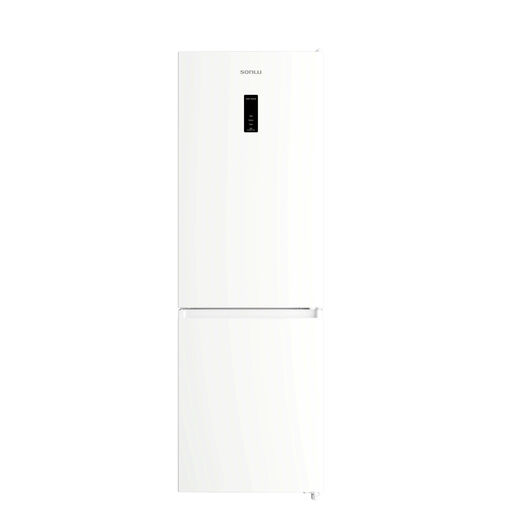 Image unavailable
Sonlu CD‑350RW, 310 L
Worth considering if you’re looking for a fridge freezer with separate capacities listed for the fridge and freezer compartments.
211 L fridge and 99 L freezer; 60 cm wide, reversible door and energy rating E. Check the model’s kWh/year on its energy label to compare electricity use.
View on Joybuy
Frequently asked questions
How do I compare two fridges or freezers?
First, compare appliances that meet the same storage needs and can be installed in your home. The European energy label shows the annual energy consumption in kWh, compartment capacities, energy rating and noise level, among other details. Its QR code takes you to the model’s product information sheet in EPREL. According to ADEME, actual energy consumption also depends on the appliance’s size and how it’s used.
Is a better energy rating enough to reduce my energy use?
No. The energy rating alone isn’t enough to predict your household’s energy consumption. ADEME explains that this also depends on factors such as size and how the appliance is used. Choose the capacity you need first, then check the rating alongside each model’s kWh/year figure.
How can I arrange collection of my old appliance when I replace it?
When you buy a new appliance of the same type in France, the old one is covered by the ‘one-for-one’ take-back scheme, as set out by the ministry responsible for the ecological transition. Before delivery, ask the seller how to register the appliance for collection and where it will be taken from.
Where can I take an old fridge or freezer if it won’t be collected?
Take it to a suitable collection point for electrical and electronic equipment, such as a recycling centre that accepts it or another appropriate collection point. The ministry responsible for the ecological transition notes that this equipment may contain components or substances that are hazardous to the environment. Don’t leave it with your household rubbish.


