Priorities before buying
First compare your fresh-food and freezing needs, then check the organisation, energy use and room requirements for where the appliance will be installed.
| Priority |
What to check |
Your needs |
| Usable capacity |
Compare the net litres of the fridge and freezer separately. As a starting point, Que Choisir suggests 100 to 150 L for one person, followed by an additional 50 L per person for the fridge section. |
I want enough room for containers, drinks and fresh food after shopping, without finding that the freezer compartment is too small for my portions and frozen food. |
| Stock organisation |
Check the drawers, shelves, compartments and basket, and make sure they can be opened fully in the intended location. An upright freezer makes sorting easier; a chest freezer provides open space for large containers. |
I want to find everyday portions easily, or, alternatively, store large batches without being restricted by fixed dividers. |
| Continuous energy use |
Compare annual energy consumption in kWh between appliances of a similar format and capacity, as well as their A to G rating. ADEME reminds us that fridges and freezers run continuously. |
I would rather not pay for capacity or features that would rarely be used, while still keeping enough storage for my shopping routine. |
| Installation |
Check the climate class, room temperatures, required air clearances, door swing and the stated storage time in the event of a power cut. |
My appliance must be suitable for installation in my kitchen, utility room or a less temperate room without restricting access or compromising ventilation. |
Joybuy options
These Joybuy options include fridge freezers, an upright freezer and a chest freezer, allowing you to compare your needs for fresh food, frozen portions and frozen-food storage.
 Image unavailable
CHiQ JR263LGE 262 L Low Frost
For less frequent shopping with a balanced need for fresh and frozen food.
187 L of fridge capacity and 75 L of freezer capacity, three freezer drawers, three adjustable shelves, stated consumption of 215 kWh/year and up to 10 hours of cold retention.
The stated N-ST range is 16 to 38 °C, and the freezer requires manual defrosting.
Joybuy
 Image unavailable
Sonlu CC-520WE 444 L No Frost
A large-capacity option for substantial shops and prepared meals.
Stated total capacity of 444 L, Total No Frost, class E, stated consumption of 289 kWh/year and up to 10 hours of cold retention.
Before buying, check how the litres are divided between fresh and frozen storage, along with the dimensions, door swing and ventilation clearances.
Joybuy
 Image unavailable
Heinrich’s 161 L No Frost upright freezer
Use alongside a fridge when portions and frozen food require separate storage.
161 L dedicated freezer capacity, three drawers, two compartments, No Frost technology, class C, stated Fast Freeze function and reversible door.
The dimensions, climate class, annual energy consumption, storage time and required clearances should be confirmed on the technical sheet.
Joybuy
 Image unavailable
AUCMA 291 L convertible chest freezer
For increasing storage for prepared portions and frozen food when floor space is available.
Stated capacity of 291 L, fridge or freezer operation, class E, stated consumption of 226 kWh/year, removable basket, LED lighting and five-level digital controls.
Its stated dimensions are 1100 × 597 × 872 mm; check the lid opening, access to the bottom and compatibility with the installation room.
Joybuy
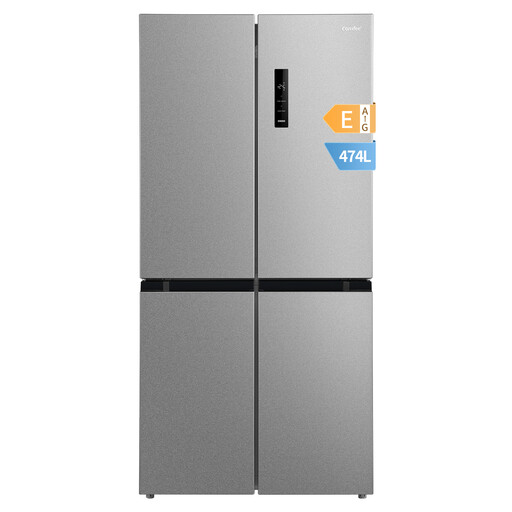 Image unavailable
COMFEE’ RCF470LS2EU(E) four-door 474 L
For versatile storage of large shops across several storage zones.
Stated total capacity of 474 L, four doors, Vario Box, three-temperature vegetable drawer and two connectable freezer drawers for bulky items.
With stated dimensions of 838 × 653 × 1775 mm, check access routes, the installation position and door swing; the separate capacities, climate class and storage time should be confirmed.
Joybuy
Frequently asked questions
How do you choose the capacity of a fridge freezer for less frequent shopping?
Start with the fridge’s net capacity: Que Choisir suggests 100 to 150 L as a guide for one person, followed by 50 L for each additional person. Then add the capacity needed for the containers, vegetables, drinks and frozen food you actually store, checking the freezer section separately.
Is a small freezer compartment enough for prepared meals?
Not if frozen portions and frozen food take up a significant amount of space, or if you stock up for one to two weeks. Que Choisir states that a simple freezer compartment is not sufficient in this situation; choose a fridge freezer with a proper freezer section or a separate freezer, depending on the capacity you need.
Should you choose an upright or chest freezer?
Choose an upright freezer if daily access through drawers and compartments is a priority. A chest freezer is more suitable if you have floor space available and want a large capacity for bulky containers; Que Choisir states that some chest freezers can reach 600 L.
Which installation conditions should you check before buying?
Check the minimum and maximum room temperatures against the climate class of the exact model, then check the ventilation clearances required in its manual. Ranges and distances vary by model: the manual for the model you choose takes precedence, particularly for a garage, cellar, conservatory or integrated installation.
How should you use the energy label to compare two appliances?
Compare the A to G scale with annual energy consumption in kWh, the capacity of each compartment and noise levels between appliances of the same format. The European regulation covers electric refrigeration appliances over 10 L and up to 1,500 L; the rating alone does not replace comparing usable capacities.


