Which configuration and features should you prioritise?
Start by working out how much space you need for fresh food and frozen meals, then check how much room you have in your kitchen. The energy label described by the European Commission shows, among other things, the capacity of each compartment, annual energy use and noise levels.
Fridge-freezer
Consider this if: you want to store fresh and frozen food in one appliance.
Bear in mind: the model determines how capacity is split between the two compartments. A large total capacity doesn’t guarantee enough space for your frozen meals.
Fridge with a small freezer compartment
Consider this if: you mostly buy fresh food and freeze very little.
Bear in mind: the space for frozen meals can quickly limit how much you can store, so check the capacity of this compartment.
Separate fridge and freezer
Consider this if: you regularly batch-cook or store lots of frozen food, and have room for two appliances.
Bear in mind: you’ll need space for both, and should check the annual energy use of each appliance.
Compact fridge
Consider this if: space is your priority and you don’t need to store much food or many meals.
Bear in mind: there’s less room for containers, and you should still check the noise and energy use.
| What to consider |
What to check |
What matters to shoppers |
| Balance of fresh and frozen storage |
Capacity in litres for each compartment; space and layout for meal containers. |
I keep fresh groceries while regularly freezing portions, so the total capacity doesn’t tell me whether there’s enough room in each compartment. Around 27% of shoppers would prioritise this balance. |
| Size and installation |
Dimensions and door clearance; housing and door fitting for built-in models. |
In a narrow kitchen or with an existing housing unit, I need to be able to install the appliance and access its compartments. This would be a priority for around 33% of shoppers. |
| Energy use and noise |
kWh/year and dB on the label, compared between appliances with a suitable capacity and configuration. |
If the appliance is near my living space, I want to consider both its electricity use and its stated noise level. Around 20% of shoppers would put both at the top of their list. |
| Defrosting and maintenance |
Which compartments have No Frost; the model’s instructions and repair information. |
I’d rather keep defrosting to a minimum and check the maintenance requirements before choosing. Around 20% of shoppers would put these points first. |
Fridge-freezers to consider on Joybuy
These models combine fridge and freezer storage in one appliance. Compare their size and the information listed for each variant with the space available and the capacity split you need.
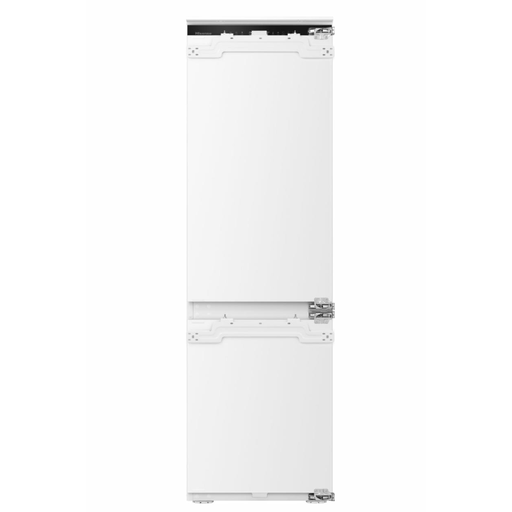 Image unavailable
Hisense RB3B250SAWC, 252 L built-in fridge-freezer
Worth considering if you want to combine fridge and freezer storage in a fitted kitchen.
This variant is listed with No Frost and an energy rating of C. Check the capacity of each compartment, the housing dimensions and the required door fitting before choosing it.
View on Joybuy
 Image unavailable
AEG NSC6M18FES, built-in TwinTech No Frost fridge-freezer
Consider this if you’re looking for a fridge-freezer to fit into a suitable housing unit.
The product listing gives a total capacity of 249 L and an energy rating of E. The total doesn’t exactly match the sum of the listed compartment capacities, so check the split on the energy label, along with the housing dimensions and door system.
View on Joybuy
 Image unavailable
Samsung RF50C530EB1, 495 L multi-door fridge
Worth considering if you’re looking for plenty of total capacity for groceries and frozen food.
The title gives an energy rating of E. The multi-door description doesn’t match the Side-by-Side description, so check the actual layout of the compartments, how the doors open and the clearance required.
View on Joybuy
 Image unavailable
Bosch KGN33NLEB, 282 L fridge-freezer with bottom freezer
Compare this if you want fridge and freezer space in one appliance, with the freezer at the bottom.
The title gives an energy rating of E. Check the capacity of each compartment, the noise level on the energy label and the ventilation clearance before deciding where to place it.
View on Joybuy
 Image unavailable
CHiQ JR227LSE, 227 L Low Frost fridge-freezer
Worth considering if you want to store groceries and frozen food in a 227 L fridge-freezer.
The title lists a 153 L fridge, a 74 L freezer, a reversible door and an energy rating of E. The stated width differs between the title and description, so confirm the exact dimensions before planning the installation. Low Frost doesn’t mean you’ll never need to defrost it manually.
View on Joybuy
Frequently asked questions
Which figures on the energy label should I compare first?
Compare the fridge and freezer capacities you need in litres, then compare the kWh/year and noise levels of suitable appliances. The European Commission says this information appears on the energy label. In France, the DGCCRF notes that household refrigeration appliances have used the new energy label scale since 1 March 2021. Don’t confuse it with the old A+ to A+++ ratings.
Does No Frost always apply to both compartments?
No, it depends on the model. Check the product listing or manual to see whether the feature applies to the freezer alone or to the fridge as well. The feature name alone doesn’t tell you how the cooling system is configured.
Can I have my old fridge taken away?
In France, the ‘one-for-one’ take-back scheme allows you to hand over a used appliance when buying a new appliance of the same type, according to the Ministry for the Ecological Transition. Ask the seller how to arrange the handover or collection of your old appliance.
Does an extended guarantee replace the legal guarantee of conformity?
No. The Ministry of the Economy says that, in France, the legal guarantee of conformity applies to goods sold by a professional to an individual; a commercial guarantee is added to it and doesn’t replace it. Read the services and exclusions included with an extended guarantee before deciding whether it’s useful for you.


