Households with a narrow alcove or doorway
You need to be able to get the appliance inside, open its doors and allow air to circulate once it’s in place. Height, depth and the delivery route are just as important as the available width.


First, choose a fridge freezer that can be brought along the delivery route and installed with the ventilation clearance specified in its instructions: width alone isn’t enough. Then compare the usable capacity of both compartments with your storage habits, followed by annual energy consumption and noise levels among appliances of a similar size. Consider a separate fridge and freezer only if your kitchen has room for both appliances.
You need to be able to get the appliance inside, open its doors and allow air to circulate once it’s in place. Height, depth and the delivery route are just as important as the available width.
For several people, the total capacity doesn’t tell you how much space each compartment offers. Compare the usable capacity and drawer layout with your usual shopping.
If your kitchen is open-plan or close to a living area, check the dB(A) rating and noise class. ADEME also recommends checking the energy label; compare annual energy consumption between appliances of similar dimensions and capacity.
| Criteria | What to check | Who it matters to |
|---|---|---|
| Access and installation | Measure the delivery route and the space in terms of width, height and depth; check the instructions for ventilation and door clearance. | If my entrance or alcove is narrow, I want to be sure I can get the appliance inside and install it; around 36% of consumers would prioritise this constraint. |
| Fresh and frozen capacity | Compare the usable litres in each compartment and the drawer space available for your usual shopping. | To store food for several people, I need enough room in both compartments; around 29% of consumers would prioritise this balance. |
| Energy use and noise | For models with similar capacity, check the kWh/year, dB(A), energy rating and noise class. | In an open-plan kitchen, I pay attention to noise while keeping an eye on annual energy consumption; around 21% of consumers would put these factors first. |
| Storage and maintenance | Check the exact model details for drawers, a door alarm and which compartments have a No Frost function. | I want to store food easily and keep routine maintenance to a minimum; this would be the main priority for around 14% of consumers. |
An appliance may fit the available width but still be too tall or too deep. Samsung also advises checking that the packaged appliance will fit through doors and along corridors.
Check the delivery route and all three dimensions of the space, then check the clearances and door swing specified in the model’s instructions.
The total capacity in litres doesn’t show how much room is set aside for frozen food. This matters if you freeze prepared meals or regularly buy frozen food.
Compare the usable capacity of the fridge and freezer separately, then check whether the drawers suit the food you store.
Energy and noise figures are most useful when comparing appliances that meet similar storage needs. The European Commission’s EPREL database includes details such as capacity, kWh/year and dB(A) for registered models.
First check the dimensions and capacity you need, then compare the energy rating, annual energy consumption and noise level.
The names and features used by Bosch, Samsung and Whirlpool vary depending on the model and the compartment concerned.
Check the details for your chosen model to see which compartments have this feature and whether it includes the alarm or storage options you want.
Bosch offers freestanding and built-in fridge freezers, including models with a freezer at the bottom.
Samsung offers fridge freezers with the freezer at the bottom, including models close to 60 cm wide.
Whirlpool offers a range of fridge freezers that combine refrigeration and freezing in one appliance.
Electrolux offers built-in fridge freezers, which are worth considering when your kitchen has a set alcove size.
These two Samsung fridge freezers are for households that want to store fresh and frozen food in one appliance. Before choosing, check each model against your available space, storage needs and installation details.
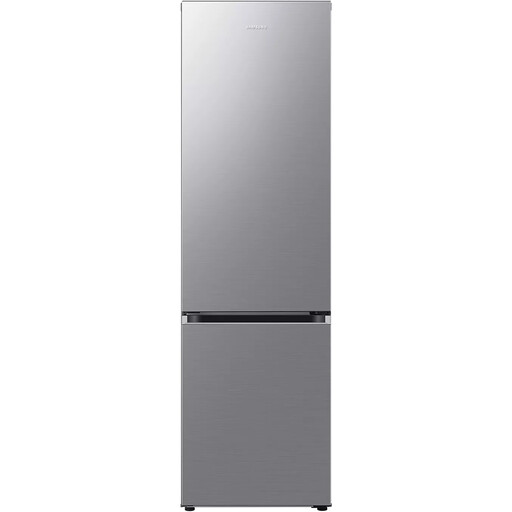 Image unavailable
Worth considering if you’re looking for one appliance for fresh and frozen food in a kitchen where space is limited.
Stated capacity: 390 L. Energy rating shown: C.
Before ordering, check the delivery route, depth, door clearance and the installation clearances required for this model.
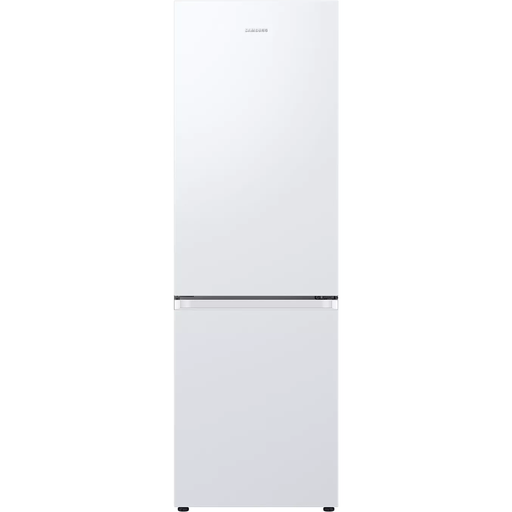 Image unavailable
Worth considering if you want to combine refrigeration and freezing in one appliance for a kitchen with limited width.
Stated capacity: 390 L. Colour: white.
If you want a freezer at the bottom, confirm its position for the exact model. Also check its energy label, delivery dimensions and installation instructions.
Measure the width, height and depth of the space, as well as the doors, corridors and lifts along the delivery route. Samsung recommends checking that the packaged appliance will fit through; then check the instructions for your chosen model for ventilation and door clearance.
No: compare the usable capacity of the fridge and freezer separately. For example, Bosch lists 330 L and 108 L for the KGN49XLEA, while Electrolux lists 201 L and 41 L for the ETS3LE16S. Choose the balance that suits your storage habits, after checking that the model fits in your kitchen.
When comparing fridge freezers with similar capacities, check the energy rating, annual energy consumption in kWh/year, capacity and noise level in dB(A). ADEME also highlights the noise class; the European Commission’s EPREL database lets you check the specifications of registered models.
Yes: check that the room temperature falls within the climate class shown on the appliance’s rating plate. Also follow the manufacturer’s installation and ventilation instructions, as Electrolux advises.