If you mainly store fresh food, consider a fridge-only model, particularly if you already have a freezer. A fridge-freezer keeps fresh and frozen food in one appliance, while two separate appliances let you choose the capacity of each independently, provided you have two suitable spaces. Whichever option you choose, compare the capacity of each compartment, installation requirements, noise levels and annual energy consumption.
Which setup is right for you?
Households that regularly buy frozen food
If your shopping includes both fresh and frozen food, a fridge-freezer keeps it all in one appliance. Check the capacity in litres of each compartment: the total capacity won’t tell you whether the split suits your habits.
Households that store lots of frozen food
If you batch-cook or often buy in bulk, a separate freezer lets you choose its capacity independently. You’ll need to allow for two spaces that meet the installation requirements in each appliance’s instructions.
People with a small or open-plan kitchen
Measure the space, access routes and door swing, then check the model’s ventilation requirements. In an open-plan living space, compare the stated noise level in dB(A) too.
What should you compare before choosing?
Start by working out how much space you need for fresh and frozen food. Then check that a suitable setup will fit and work in your kitchen.
Fridge-only
Consider this if: you mainly buy fresh food, or you already have a freezer.
Bear in mind: if the model has a freezer compartment, check its capacity before relying on it for regular frozen food shopping.
Fridge-freezer
Consider this if: you want to store fresh and frozen food in one appliance.
Bear in mind: a good total capacity can still hide a freezer compartment that’s too small for your shopping.
Two separate appliances
Consider this if: you store lots of frozen food and want to choose the capacity of each appliance separately.
Plan for: two spaces with adequate ventilation, and check the annual energy consumption of each appliance.
| Factor | What to check | What I need |
|---|
| Fresh and frozen capacity |
Compare the capacity in litres of each compartment, not just the total. Also check the shelf and drawer layout to make sure it suits the containers you use. |
I mainly store fresh food, or my frozen food shopping calls for a proper amount of freezer space. |
| Energy consumption |
The European Commission says the energy label shows energy consumption and capacity. Compare the kWh/year figures for similar appliance types and capacities; ADEME notes that fridges and freezers run continuously. |
I want to compare the energy consumption of setups that genuinely meet my storage needs. |
| Installation and noise |
Check the dimensions, access routes and door swing. Consult the model’s instructions for ventilation requirements, and compare the stated noise level in dB(A), which the European Commission says is shown on the label. |
In my open-plan kitchen, the appliance needs to fit without obstructing movement or affecting acoustic comfort. |
| Fridge temperature |
Check the temperature controls and monitoring options. Anses recommends keeping food between 0 and +4 °C at the coldest point. |
I want to be able to check the temperature, particularly when the fridge is very full or opened frequently. |
What mistakes should you avoid?
-
Focusing only on the total capacity
A fridge-freezer may offer plenty of space overall but too little room in the freezer for your usual shopping.
Compare the usable capacity of the fresh and frozen compartments separately on the energy label and in the product specifications.
-
Comparing only the energy rating
Size and features matter too: ADEME notes that a larger or more feature-packed appliance can use more energy.
Check the kWh/year figure alongside the energy rating, and compare appliances with similar layouts and capacities.
-
Measuring the space but not checking installation requirements
An appliance might fit in the space but still not have enough room for the door to open properly or for air to circulate as required by the instructions.
Check delivery access, door swing and the clearances specified for the exact model.
-
Forgetting about noise in an open-plan space
The stated noise level can affect everyday comfort when the fridge is close to your living area or bedroom.
Compare the dB(A) figures and noise classes of the models you’re considering.
Brands worth considering
Whirlpool
Whirlpool France offers single-door fridges, as well as built-in and fridge-freezer models.
- The range of formats makes it easier to find an option suited to the space you have for fresh and frozen food.
- Check the capacity, installation dimensions, noise level and kWh/year figure for the exact model.
Electrolux
Electrolux France offers built-in fridge-freezers, including models designed for kitchens with a dedicated housing space.
- For the ETS3LE16S model, Electrolux specifies installation dimensions of 1580 × 560 × 550 mm.
- These dimensions apply to the ETS3LE16S. Check the housing space and instructions separately for any other model.
Bosch
Bosch manuals are a useful starting point when checking the installation and care requirements for a specific appliance.
- Bosch advises following the installation, operating and care instructions supplied with the appliance.
- Check ventilation requirements, capacity and noise levels for every model you’re considering.
Fridge-freezers available on Joybuy
These models combine a fridge and freezer in one appliance. Compare the space allocated to fresh and frozen food, then check the installation requirements for the model you choose.
 Image unavailable
Haier HTW5618ENMG — 3-door fridge-freezer, 360 L
A three-door appliance for keeping fresh and frozen food together. The model listing specifies a total capacity of 360 L, Total No Frost, an E energy rating, Wi-Fi and My Zone. Check the capacity of each compartment and the required installation clearances.
View on Joybuy
 Image unavailable
CHiQ JR263LGE — 262 L fridge-freezer, Low Frost
Worth considering if width is limited: the model listing specifies a width of 54 cm, a height of 176 cm and a 70/30 split. Check the usable capacity of each compartment and allow enough space for ventilation and the door to open.
View on Joybuy
 Image unavailable
AEG NSC6M18FES — 249 L built-in fridge-freezer
For a fitted kitchen, first check that the appliance is compatible with your housing space and meets its ventilation requirements. The model listing specifies a capacity of 249 L, TwinTech No Frost and an E energy rating. Also check the capacity of each compartment and its annual energy consumption.
View on Joybuy
 Image unavailable
CHiQ JR227LSE — 227 L fridge-freezer, silver
To compare the space for fresh and frozen food separately, the model listing specifies 153 L for the fridge and 74 L for the freezer. It also lists a width of 54 cm, Low Frost, a reversible door and an E energy rating. Check the door clearance and kWh/year figure.
View on Joybuy
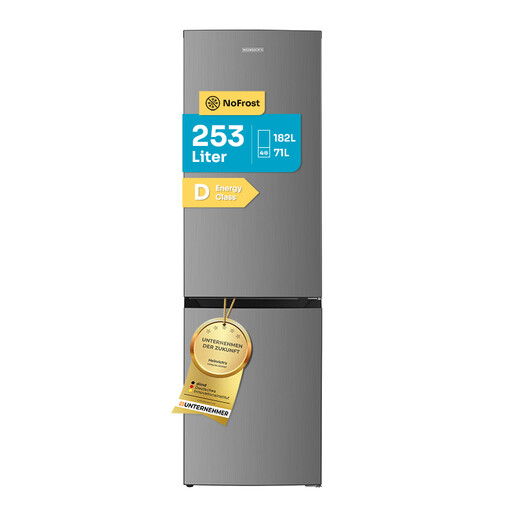 Image unavailable
Heinrich´s — 253 L fridge-freezer, stainless steel finish
If fridge space matters more to you than freezer space, compare the 182 L and 71 L capacities specified in the product name with your usual shopping. It also lists No Frost and a noise level of 39 dB. Check the installation dimensions and kWh/year figure before comparing it with other fridge-freezers.
View on Joybuy
Frequently asked questions
What should I look for on a fridge’s energy label?
Check the energy rating, annual energy consumption, compartment capacities and stated noise level. The European Commission says the labels for household fridges and freezers show these details. To compare two models, look at their kWh/year figures and choose appliances with similar types and capacities.
What temperature should I aim for to keep food fresh?
Anses recommends keeping food between 0 and +4 °C at the coldest point in the fridge. Check the temperature using the appliance’s display or a thermometer, especially if the kitchen is warm, the door is opened often or the appliance is very full.
Is the same ventilation clearance suitable for every model?
No. The clearances required depend on the appliance and how it’s installed, particularly for built-in models. Check the instructions before choosing a location, and make sure the housing space, access routes and door clearance are all suitable.


