Households that buy both fresh and frozen food
If your shopping includes fresh food as well as items to freeze, consider how much space each needs. A large overall capacity won’t help if the compartment you use most is too small.


If you mainly store fresh food and freeze very little, prioritise fridge space. A fridge-freezer combines both functions in one appliance; if you regularly freeze large quantities, consider a separate freezer instead. In each case, compare the capacity of each compartment, how easy it is to access food, the space available and annual energy consumption.
If your shopping includes fresh food as well as items to freeze, consider how much space each needs. A large overall capacity won’t help if the compartment you use most is too small.
If you regularly prepare portions to freeze, a dedicated space can make meals easier to organise and access. The choice between an upright and a chest freezer also depends on the size of your containers and how often you take them out.
In a narrow kitchen or an unheated room, the delivery route, door opening and installation conditions can all limit your options. Energy use and noise also matter for an appliance that runs continuously.
First decide how much space you need for fresh and frozen food, then choose a format that suits your everyday storage and installation needs.
Consider it: if most of your food is fresh and you freeze very little.
Bear in mind: a small freezer compartment may not meet your needs if you regularly store frozen meals.
Consider it: if you use both compartments regularly and want them in a single appliance.
Bear in mind: capacity is split between fresh and frozen food, so check that the freezer section has enough room for your prepared meals.
Consider it: if you often freeze portions that you want to organise and find easily in drawers.
Bear in mind: the tiered layout offers less flexibility for bulky containers than an open space.
Consider it: if you have a dedicated space and freeze large quantities or bulky items.
Bear in mind: it takes up more floor space and needs careful organisation to make it easy to find food at the bottom.
| Criterion | What to check | Who it matters to |
|---|---|---|
| Capacity split | Compare the usable litres in the fridge and freezer compartments separately. UFC-Que Choisir suggests allowing 100 to 150 litres for the fridge for one person, plus 50 litres for each additional person. | If my shopping includes as much fresh food as food to freeze, I want enough room in each compartment, not just a large overall capacity. Around 36% of consumers prioritise this balance. |
| Frozen food storage | Check the size and accessibility of drawers or baskets to make sure they suit your portions and containers. For a chest freezer, also consider how easy it is to reach the bottom. | When I often freeze meals, I want to find them without having to move everything else. This organisation is the top priority for around 29% of consumers. |
| Installation | Measure the space and the entire delivery route. Check the door opening, the clearances specified in the manual and the climate class if the room is unheated. | In a home with narrow access, I need to be able to get the appliance inside and use it once it’s installed. Making sure it fits the space is a priority for around 21% of consumers. |
| Energy use and maintenance | Compare kWh/year for appliances with the same capacity; also check the cooling system and noise level. According to ADEME, a larger size and unnecessary extra capacity can increase energy use. | If the appliance runs constantly near my living space, I pay attention to its energy use, noise and defrosting needs. Around 14% of consumers put these considerations first. |
A fridge-freezer may look spacious, but its freezer section might struggle to fit your meals, or its fridge section might not suit your usual shopping.
Work out separately how much fresh and frozen food you store, then compare your needs with the capacity listed for each compartment.
An appliance may fit in its intended space but still get stuck in a hallway or lack enough clearance for the door to open and for proper ventilation.
Measure the access route, the space where it will go and the clearance with the door open. Check the manual for the required clearances and installation conditions for your chosen model.
Fridges and freezers run continuously. ADEME notes that a larger size and unnecessary extra capacity can increase electricity consumption.
Choose a capacity that suits your usual shopping and meal preparation, then compare the kWh/year of appliances designed for the same use.
The permitted ambient temperature depends on the model. A feature listed for one model from a brand does not necessarily apply to its entire range.
Compare the temperature range in the appliance documentation with the temperatures in the room where you plan to install it.
These ranges can help you decide what to look for. Check the compartments, features and installation requirements for the specific model you’re considering.
Bosch’s range of freezers and fridge-freezers may appeal to households looking to compare interior layouts and how easy food is to access every day.
Beko’s range of chest and upright freezers offers formats worth exploring if you need separate frozen food storage.
Whirlpool’s fridge and fridge-freezer range includes No Frost models worth considering if frost management is important to you.
Liebherr fridges and fridge-freezers with specialist compartments are worth considering if you want to store certain fresh foods separately.
These appliances offer three ways to organise your food: keep fresh and frozen items together in a fridge-freezer, organise food in an upright freezer or use a separate chest freezer. Choose the right format first, then check the specifications and installation requirements for the specific model.
 Image unavailable
Worth considering if you regularly store fresh and frozen food in one appliance.
The product description lists four doors, Total No Frost and an E energy rating. Check the manual for the space needed to open the doors and ventilate the appliance.
 Image unavailable
A fridge-freezer to consider if you want space for both fresh and frozen shopping in your kitchen.
The product description lists an E energy rating. Before choosing where to put it, check its depth with the door open and the clearances specified in the manual. Also confirm the cooling system for this model.
 Image unavailable
Worth considering if you need a separate freezer and prefer to organise food on different levels.
The product description lists drawers, No Frost and a C energy rating. Check its dimensions, annual energy consumption and permitted ambient temperature range before deciding where to put it.
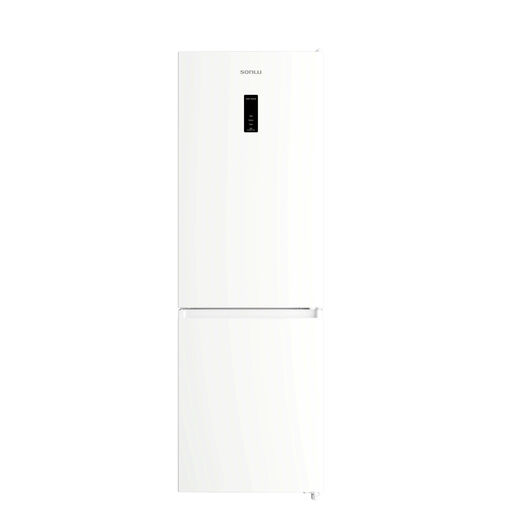 Image unavailable
Worth considering if you use both compartments and want to compare their capacities separately.
The product description gives a total capacity of 310 L, split between 211 L of fridge space and 99 L of freezer space. It also lists a width of 60 cm, a reversible door and an E energy rating. Check the other dimensions and kWh/year to compare it with an appliance for the same use.
 Image unavailable
Worth considering if you have floor space for a chest freezer and want a separate appliance that can be switched between fridge and freezer modes.
The product description lists a top-opening lid, a removable basket and a five-level digital control. Make sure you can access the contents from above and check the model’s ambient temperature range before installing it in an unheated room.
Compare the litres in each compartment, not just the overall capacity. The European Commission says that the energy label for fridges and freezers shows their storage volumes. Compare the fridge and freezer space with what you usually store.
A chest freezer is worth considering if you store bulky items and have enough floor space. An upright freezer makes it easier to organise food and access it on different levels. UFC-Que Choisir notes that chest freezers can offer very large capacities, but the format should also suit the way you store food.
Measure the entire route to its final position, then check the space available with the appliance door open. Also check the ventilation clearances and climate class in the manual for your chosen model. Electrolux’s installation guidance highlights the importance of air circulation.
Follow the waiting time given in the manual for the model you’ve bought rather than plugging it in as soon as it arrives. For its fridge-freezers, Electrolux recommends waiting at least four hours before plugging in.