Households that shop weekly
You need to store several days’ worth of fresh and frozen food. How the compartments are divided matters more than the total capacity alone.


For a big shop to last several days, compare the fridge and freezer capacities separately. A fridge-freezer may be right if both compartments meet your usual storage needs. If you mainly need more room for frozen food, consider a multi-door fridge or a separate freezer, provided you have the space. Two appliances need two spaces, and their energy consumption must be added together, as fridges and freezers run continuously, according to ADEME. Check the dimensions, the clearances specified for the model and its kWh/year figure on the EU energy label, as recommended by the European Commission.
You need to store several days’ worth of fresh and frozen food. How the compartments are divided matters more than the total capacity alone.
You mainly need more room for frozen food or pre-prepared portions, and want to compare a larger freezer compartment with a separate freezer.
Your choice also depends on the route into the kitchen, how the doors open and the clearances needed around the appliance.
Consider this if: you want both compartments in one appliance and the freezer section is large enough for your usual stock.
Check: the space set aside for frozen food varies by model; some fridge-freezers are LowFrost rather than No Frost.
Consider this if: you need separate storage areas and your kitchen and delivery route can accommodate this format.
Check: the dimensions, access route and door clearance. A larger capacity is only useful if its layout suits the way you shop.
Consider this if: you need to choose the capacity for fresh and frozen food separately and have room for two appliances.
Bear in mind: you’ll need two spaces, and you’ll need to add together the appliances’ annual energy consumption.
Consider this if: your current fridge still meets your needs for fresh food, but its freezer section limits your shopping.
Bear in mind: another appliance takes up space and runs continuously. If you plan to put it in an unheated room, check the permitted ambient temperature too.
| What matters | What to check | Who it matters most to |
|---|---|---|
| Room for fresh food | Unfrozen capacity in litres, shelf layout and space for the containers you usually use. | If your shopping needs to last several days, you’ll want room for fresh food without choosing an appliance that’s too large. Around 31% of consumers prioritise fresh food storage. |
| Room for frozen food | Freezer capacity in litres and drawer layout. If you freeze a lot of fresh food, also check the model’s stated freezing capacity. | If you stock up on frozen food or pre-prepared portions, check that the compartment can hold everything you need. Around 31% of consumers put freezing capacity at the top of their list. |
| Size and installation | Dimensions, delivery route, door opening and the ventilation instructions in the manual for the exact model. | If space or access in your kitchen is limited, you’ll want to make sure the appliance can be delivered and installed. Around 23% of consumers prioritise available space and installation. |
| Energy consumption | Annual consumption in kWh for each model; if you’re comparing two appliances, compare the sum of their figures on the same basis. | If several formats meet your storage needs, compare their stated annual consumption before deciding. Around 15% of consumers prioritise energy consumption. |
Capacity for fresh and frozen food meets different needs. A large total capacity doesn’t necessarily mean the freezer section will suit your stock.
Compare the usable capacity of each compartment separately, and check that the shelves and drawers can accommodate the packaging you usually buy.
The appliance dimensions alone won’t confirm that it will fit through your doors or work with the necessary clearances and door-opening space.
Measure the delivery route, the height and depth of the space, then follow the instructions in the manual for your chosen model rather than those for another brand.
ADEME reminds us that fridges and freezers run continuously, so an additional appliance will have its own energy consumption.
Compare the stated annual consumption in kWh. If you have two appliances, add their figures together before comparing them with a single-appliance option.
The brand’s fridge-freezers let you compare different splits between the fridge and freezer compartments.
Multi-door formats are worth considering if your kitchen and delivery route can accommodate a wide appliance.
The brand’s freestanding fridges and freezers let you explore having two separate appliances.
The brand’s multi-door formats should be checked against your kitchen dimensions and delivery access.
The official catalogue features several fridge-freezers to consider model by model for your household shopping needs.
These appliances combine fridge and freezer compartments, with side-by-side and multi-door formats to consider based on the capacity split and the space available.
 No image available
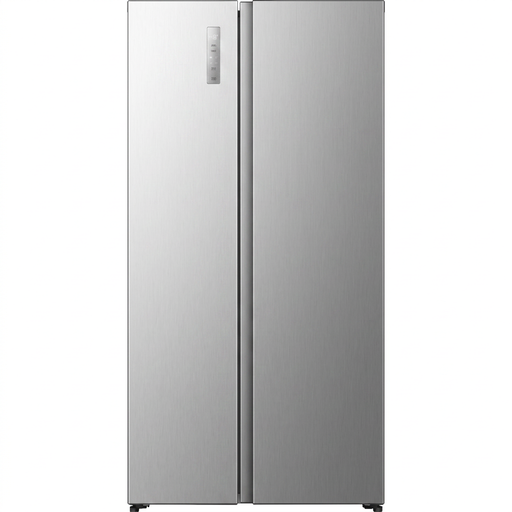
Worth considering if you want to store fresh and frozen food in a side-by-side appliance. Check the capacity of each section before choosing.
Stated total capacity: 544 L. The product description lists No Frost and a water dispenser.
Stated dimensions: 911 × 1786 × 615 mm. Allow for a stable installation, sufficient ventilation and enough space to open the doors.
 No image available
Worth considering if you want to compare the space for fresh and frozen food separately in a side-by-side appliance.
Stated capacities: 276 L for the fridge and 168 L for the freezer. The product description lists No Frost and an E energy rating.
Stated width: 83 cm. Also check access, door opening and the clearances needed for installation.
 No image available
Worth considering if you’re looking for a multi-door format and your kitchen dimensions allow for its installation.
Stated capacity: 495 L; E energy rating. The product description lists No Frost and a water and ice dispenser.
Follow the ventilation clearances specified for this model and check the door-opening space.
 No image available
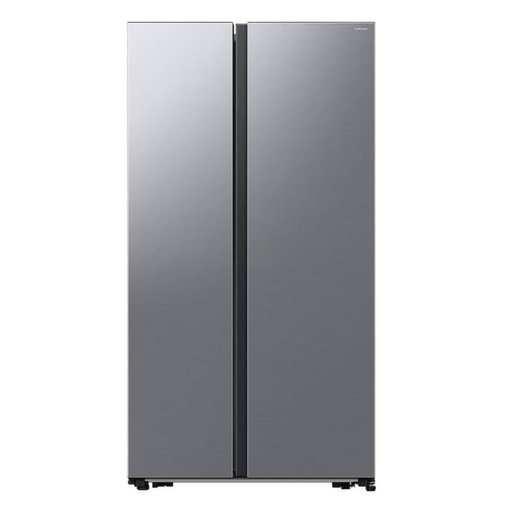
Worth considering if you’re comparing a large freestanding model for big shops. Check the capacity of each compartment.
Stated capacity: 583 L; E energy rating. The product description identifies it as an American-style fridge.
Stated dimensions: 91,2 × 178 × 65,4 cm. Allow for a stable installation and sufficient ventilation.
 No image available
Worth considering if you want separate compartments for fresh and frozen food. Compare their capacity with your usual storage needs.
Stated capacities: 333 L for the fridge and 192 L for the freezer. The product description lists No Frost and an E energy rating.
Compare the freezer and fridge capacities separately for the exact models you’re considering: the total capacity doesn’t show how it’s divided. The European Commission also states that annual energy consumption in kWh appears on the energy label.
Follow the instructions for your chosen model and check that the doors can open fully. For the appliances covered by its recommendation, Samsung specifies at least 5 cm at the back and 10 cm above. These distances don’t automatically apply to other models.
Yes, if your fridge still meets your needs for fresh food and its freezer section limits how much you can store. Check that you have a suitable space, and compare the freezer’s annual energy consumption with that of the other options you’re considering.
Compare the stated kWh/year figures on the labels for the models you’re considering. For a separate fridge and freezer, add their annual consumption together before comparing it with that of a single appliance. ADEME reminds us that these appliances run continuously.
Anses recommends checking that the coldest part of the fridge is between 0 °C and 4 °C, and not overfilling it so that air can circulate. Also follow the storage instructions on food packaging.