Households that do a big weekly shop
If you buy fresh and frozen food for several people in one go, check the available litres in each compartment. A large total capacity won’t help if the compartment that’s already overflowing is still too small.


When choosing a fridge-freezer for a family’s shopping and meals, first work out how much space you need for fresh and frozen food. Then check the capacity of each compartment, the appliance’s dimensions and its annual energy consumption. A fridge-freezer is a good choice when you need one appliance and have limited width; a multi-door or American-style fridge-freezer needs more room, and you’ll need to check that it can be brought all the way into your kitchen. If you need very different amounts of fresh and frozen storage, separate appliances let you choose each capacity independently, provided you have space for both.
If you buy fresh and frozen food for several people in one go, check the available litres in each compartment. A large total capacity won’t help if the compartment that’s already overflowing is still too small.
When storing ingredients, leftovers and prepared meals, look at the layout of the shelves, drawers and compartments. The interior should also make it easy to keep an eye on the temperature of sensitive foods, in line with advice from Anses.
Capacity isn’t everything if it’s difficult to get the appliance into your home, its doors can’t open fully or its noise level is disruptive in your living space. Measure the delivery route as well as the space where it will stand.
Consider it if: you want fresh and frozen food in one appliance and have limited width in your kitchen.
Bear in mind: check that the freezer compartment is large enough if you often store portions or prepared meals.
Consider it if: easy access to different types of food matters to you and your kitchen can accommodate a wide appliance.
Bear in mind: its width and depth mean you’ll need to check the delivery route and make sure the doors can open fully.
Consider it if: you want a large capacity in one appliance and have enough space for it.
Bear in mind: Que Choisir notes that this style uses more energy than standard fridge-freezers; compare the consumption of the specific model you’re considering.
Consider it if: you want to choose the capacity for fresh and frozen food independently.
Bear in mind: you’ll need two suitable spaces and should check the dimensions and energy consumption of each appliance.
For a household of several people, start by identifying what your current storage setup is missing. Then compare the models’ features rather than assuming what they can do from their format alone.
| Criteria | What to check | Who it matters to |
|---|---|---|
| Fresh and frozen capacity | Compare the usable litres in each compartment separately, as listed in the European EPREL database. Don’t look at the total capacity alone. | When I need the big shop to last until the next meals, I want enough space for both fresh ingredients and frozen supplies. Around 36% of consumers prioritise this usable capacity. |
| Interior layout | Check the layout and accessibility of the shelves, drawers and compartments once the appliance is installed. | If several people put the shopping away and prepare meals in advance, I want to find food easily and keep dishes separate. Interior layout is the top priority for around 29% of consumers. |
| Access and installation | Measure the delivery route, then check the space, door clearance and access to the drawers, following the model’s instructions. | With a narrow hallway or a unit near the space where the appliance will go, I need to be able to get it inside and use it once it’s in place. This compatibility comes first for around 21% of consumers. |
| Electricity and noise | Compare the kWh/year and noise level in dB(A) of models that meet your storage needs; the energy rating alone won’t tell you their annual consumption. | In an open-plan kitchen, I consider noise as well as the electricity used by an appliance that runs continuously. Around 14% of consumers put these everyday considerations first. |
A high figure can hide a freezer that’s too small for your prepared portions or a fridge that can’t hold your fresh shopping. The European EPREL database lists the capacities of the compartments separately.
Make a note of what you need to store in the fridge and freezer separately, then compare those needs with the usable litres of each model.
A large appliance also needs to fit through doors, hallways and any lifts. Samsung recommends checking the route for the packaged appliance.
Before you order, measure the entire route and ask the retailer for the packaged dimensions. Also allow room for the doors to open and the drawers to slide out.
In its testing protocol, Que Choisir says American-style fridge-freezers don’t perform better than traditional fridge-freezers for food preservation, freezing or temperature stability. So their appeal isn’t simply a promise of better preservation.
Choose a style that suits the way you want to organise and access your food, then check the features of the model you’re considering.
In France, a commercial warranty is optional and comes in addition to statutory guarantees, as the DGCCRF points out. An extended warranty on its own doesn’t determine the protection you have if something goes wrong.
Before taking out an extended warranty, compare what it actually adds: duration, exclusions, parts, labour, call-out charges and the claims process.
These brands offer styles worth comparing for a household; features vary from one model to another.
Bosch’s product information lets you compare a fridge-freezer such as the KGN39EXCF with a multi-door model such as the KFD96APEA.
Samsung France’s range includes fridge-freezers, multi-door models and American-style designs.
LG France’s product information includes the 628 L American-style GSXE80PYBD and the 517 L multi-door GML643PZ6F.
Haier’s French multi-door range includes freestanding four-door appliances and models described as No Frost.
These models let you compare several ways to store the family shop: multi-door appliances, a side-by-side model and a fridge-freezer. For each one, check the space for fresh and frozen food, then consider the constraints of your kitchen.
 Image unavailable
Worth considering if you want to keep fresh and frozen shopping separate in a multi-door appliance.
Listed total capacity of 467 L, Total No Frost and energy rating E.
Before buying, check the packaged dimensions, the route into your kitchen and the space needed to open the doors.
 Image unavailable
Consider this if you’re looking for a large appliance for your household’s fresh and frozen food.
Listed total capacity of 495 L and energy rating E.
Check the layout of the doors and compartments in your intended kitchen, along with the installation requirements for the water and ice dispenser if you plan to use it.
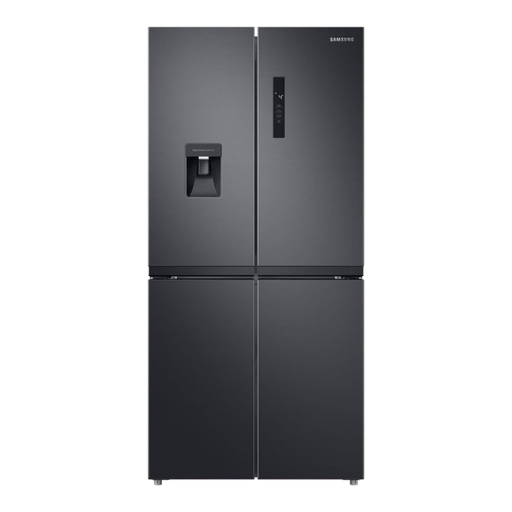 Image unavailable
Worth comparing if you need to store fresh and frozen shopping in one large appliance.
Listed total capacity of 488 L and energy rating E.
Check that the packaged appliance can get through the access route and that the doors can open fully. If you want to avoid manual defrosting, also check the model’s cooling technology.
 Image unavailable
Worth considering if you want to compare a large fresh-food section and a separate freezer section in a side-by-side appliance.
Listed total capacity of 525 L, including 333 L for the fridge and 192 L for the freezer; No Frost, energy rating E and a listed noise level of 37 dB.
Check the appliance and packaging dimensions for delivery and installation, then look at its annual consumption in kWh to compare energy use.
 Image unavailable
Consider this if you’d rather keep fresh and frozen food in one appliance with a more moderate total capacity.
Listed total capacity of 360 L, Total No Frost, energy rating E, Wi-Fi and My Zone.
Compare the space in each compartment with your usual shopping, and check the packaged dimensions for delivery.
No. Its large capacity is only useful if the compartments suit your shopping and the appliance can fit into your kitchen with enough room for the doors to open. Que Choisir also notes that American-style fridge-freezers use more energy than standard models, so compare the kWh/year of the models you’re considering.
Compare annual consumption in kWh, the energy rating, compartment capacities and noise information, taking into account how much storage your household needs. The European EPREL database lets you check fresh and frozen capacities separately: two appliances with the same total capacity may divide up their space differently.
Anses recommends a temperature between 0 and +4 °C at the coldest point in the fridge. Check it regularly, for example with a thermometer; choosing a larger model doesn’t remove the need to do this.
An extended warranty isn’t compulsory. In France, a commercial warranty is optional and comes in addition to statutory guarantees, according to the DGCCRF. If you’re buying from a professional retailer, check your legal options in the event of a lack of conformity, then see what the commercial warranty actually adds before deciding.