Which households is it for?

Households replacing an old fridge freezer

You already use a fridge freezer every day and want to limit its energy consumption without losing the useful capacity you need for your weekly shop and frozen food. Compare kWh/year, the capacity of each compartment and the installation format of the exact model.

Kitchens with limited space

You may need to work around a housing unit, a narrow access route or a fixed space. Check the dimensions, installation type and, for an integrated model, compatibility with the housing unit and cabinet door before prioritising an energy class.

Households concerned about noise and maintenance

You want to minimise noise and defrosting while keeping food properly stored. Use the stated noise level, cooling system and climate class as additional criteria alongside kWh/year.

Buying priorities

Freestanding

Consider it: if you do not have a designated housing unit and want to compare dimensions, capacities and annual energy consumption freely.

Check: the format alone is not enough to predict electricity costs; compare kWh/year for similar capacities and usage patterns.

Integrated

Consider it: when your kitchen requires a housing unit, specific dimensions and a compatible door system.

Check: the housing unit, required ventilation and door fixing system before comparing models by their kWh/year.

Two separate appliances

Consider it: only if your refrigeration and freezing needs must be sized separately and you have space for two appliances.

Check: add together the stated annual energy consumption and confirm that you will genuinely use the additional capacity.

Priority What to check Your needs
Annual energy consumption Compare the kWh/year of appliances with similar types and capacities. Read the energy class alongside this figure rather than considering it on its own. I want to compare a realistic annual cost rather than choosing a letter or a highlighted feature in isolation.
Usable capacity Check the capacity of the fridge and freezer compartments separately. Also confirm the external dimensions. My shopping habits and use of frozen food should determine the capacity, rather than buying a large space that will rarely be used.
Installation environment Check the climate class, recommended settings and installation requirements. A cooling technology alone does not prove lower energy consumption. The appliance must be suitable for the temperatures in my kitchen, utility room or garage.
Collection of the old appliance Check the arrangements offered at delivery or when ordering online, and keep confirmation of them. I want to organise the replacement without leaving my old appliance without a collection solution.

Mistakes to avoid

  • Choosing based solely on the energy-class letter

    Annual energy costs also depend on the stated kWh/year, capacity and how well the appliance matches your needs. Comparing very different formats can therefore be misleading.

    Make a shortlist of models that fit your space, then compare kWh/year, fridge and freezer capacities, as well as the noise level shown on the label or product information for the exact model.

  • Buying more capacity than you need for a rarely used feature

    ADEME states that size and unnecessary features can increase running costs. A large capacity makes sense when it genuinely matches your shopping and freezing habits.

    Work out how much space you need for fresh food and how much for frozen food before buying. Choose two appliances or a large freezer only if this usage is already established.

  • Ordering an integrated model without confirming the housing unit, door and installation

    An integrated appliance must match the dimensions of the housing unit and the specified door-fitting system. These requirements can vary from one model to another.

    Measure the housing unit and consult the instructions or technical information for the exact model before ordering. Also check the arrangements for collecting your old appliance at delivery.

  • Overlooking collection of your old appliance when ordering

    Replacing a large appliance requires suitable collection arrangements, particularly when your order is delivered to your home.

    Select collection of your old appliance before completing your order, and keep confirmation of the collection or delivery arrangements.

Brands to consider by model

Bosch

Worth considering for freestanding fridge freezers with fan-assisted cooling or No Frost when you want to compare capacity, noise and energy class precisely.

  • Bosch offers freestanding No Frost fridge freezers with VitaFresh in its range.
  • Bosch product information shows that energy class, capacities and consumption vary by model; compare the exact model rather than the brand as a whole.

Liebherr

A brand to compare when usable space, noise and food-preservation technologies matter just as much as kWh/year.

  • Liebherr offers NoFrost models as well as integrated appliances.
  • According to Liebherr, BluPerformance can increase usable capacity and energy efficiency within the same external dimensions; check these details on the label and product information for your chosen model.

Whirlpool

Worth considering when comparing freestanding and integrated models where installation constraints, capacity and noise are important.

  • Whirlpool sells integrated and freestanding fridge freezers in France, with features such as open-door alarms or rapid cooling on selected models.
  • Installation requirements, capacity, noise and energy class depend on the model; an integrated appliance is not automatically more efficient than a freestanding one.

Joybuy products

Joybuy options for comparing integrated and freestanding fridge freezers by usable capacity, installation type and stated annual energy consumption.

Hisense RB3B250SAWC integrated fridge freezer 252 L

Hisense RB3B250SAWC integrated 252 L

For a fitted kitchen looking for an integrated fridge freezer with separate space for fresh and frozen food.

Stated consumption of 150 kWh/year, 176 L fridge, 76 L freezer, class C, No Frost and 34 dB(A).

Check the housing-unit dimensions, cabinet ventilation and exact door compatibility before ordering.

Joybuy

CHiQ JR263LGE fridge freezer 262 L

CHiQ JR263LGE 262 L Low Frost

For a compact indoor space, with a stated width of 54 cm and a reversible door.

Stated consumption of 215 kWh/year, 187 L fridge, 75 L freezer, 39 dB(A), climate class N-ST and dimensions of 1760 × 540 × 550 mm.

The stated N-ST range is 16 to 38 °C. The Low Frost system requires manual defrosting, stated to be needed approximately once or twice a year.

Joybuy
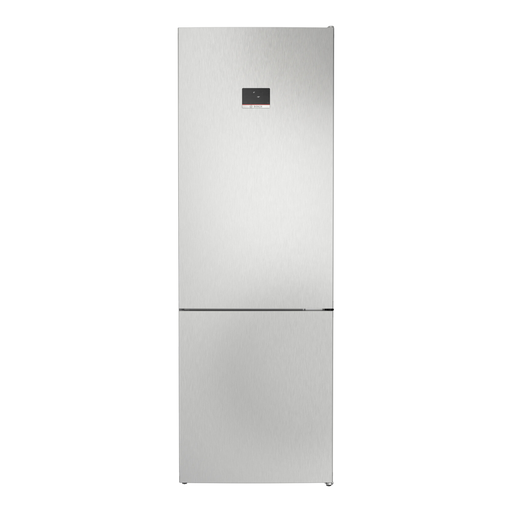
Bosch KGN497LDF fridge freezer 440 L

Bosch KGN497LDF 440 L class D

For a household that genuinely uses a large amount of fridge and freezer space in a kitchen with suitable room.

Stated consumption of 223 kWh/year, 311 L fridge, 129 L freezer, class D, 35 dB(A), climate class SN-T and dimensions of 70 × 203 × 66.7 cm.

Check the ventilation clearances specified in the instructions. This substantial capacity should be weighed against your actual needs.

Joybuy

Bosch KGN33NLEB fridge freezer 282 L

Bosch KGN33NLEB 282 L class E

For a medium-sized household capacity requirement, with three freezer drawers.

Stated consumption of 228 kWh/year, 193 L fridge, 89 L freezer, class E, NoFrost freezer, MultiAirflow and dimensions of 1760 × 600 × 660 mm.

Allow for the clearances specified in the instructions: at least 5 cm at the rear, 2 cm at the sides and 10 cm above. Also check the noise level and climate class for the room where it will be installed.

Joybuy
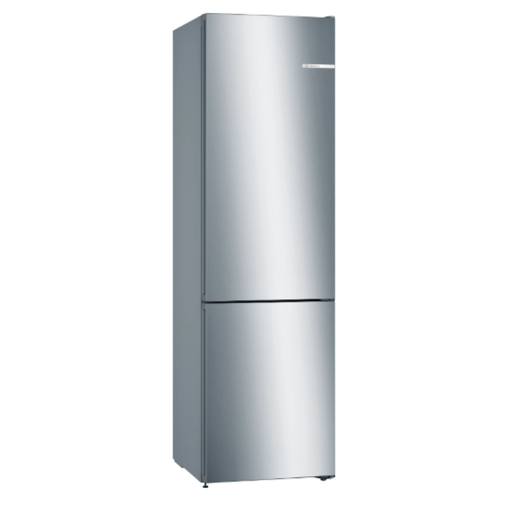
Bosch KGN39VLEB fridge freezer 368 L

Bosch KGN39VLEB 368 L class E

For a household that uses more fridge space than freezer space and has sufficient height available.

Stated consumption of 238 kWh/year, 279 L fridge, 89 L freezer, class E, NoFrost freezer, MultiAirflow and dimensions of 2030 × 600 × 660 mm.

At 2.03 m tall and with a stated weight of approximately 69 kg, check access routes, available height and delivery requirements. Also check the noise level and climate class.

Joybuy

Frequently asked questions

What should you compare on a fridge freezer’s energy label?

First compare the kWh/year of appliances with the same type and similar capacities, then compare the usable capacity of each compartment and the noise level. European regulations cover the labelling of mains-operated refrigeration appliances over 10 L and up to 1,500 L; ADEME recommends using the energy label to help guide your choice.

Does a better energy-label letter guarantee a lower bill?

No. Read the letter alongside the kWh/year, the capacity you genuinely need and the type of appliance. A larger appliance may meet a real need, but its consumption cannot be compared directly with that of a smaller model without taking their capacity and usage into account.

Does room temperature matter for a fridge freezer?

Yes. The climate class indicates the ambient operating temperature range. UFC-Que Choisir states, for example, that class N is designed for an ambient temperature of 16 to 32 °C; check the class of the exact model, especially if it will be installed in a garage, utility room or particularly warm room.

Does No Frost necessarily reduce energy consumption?

Not necessarily. No Frost can reduce the need for manual defrosting, but always compare the kWh/year, capacity and installation requirements of the specific model. The cooling technology does not replace checking the energy label.