Households that regularly use fresh and frozen food
You need two storage areas that are practical for everyday use. Compare the fridge freezer’s capacity, the split between refrigeration and freezing, and its annual energy consumption.


Start by choosing the usable capacity and the amount of space you genuinely need for frozen food. Then compare appliances of the same size based on their annual energy consumption in kWh, noise level and dimensions. A fridge freezer suits households that regularly use both fresh and frozen food; a fridge with a 4-star freezer compartment may be enough for a limited supply, while two separate appliances are mainly worthwhile when you consistently need substantial freezer capacity.
You need two storage areas that are practical for everyday use. Compare the fridge freezer’s capacity, the split between refrigeration and freezing, and its annual energy consumption.
A fridge with a 4-star freezer compartment may be suitable if you keep only a limited amount of frozen food and the freezer capacity genuinely matches your habits.
First assess whether the freezer compartment in a fridge freezer is large enough before adding a separate appliance. Two appliances require more space, and their combined annual energy consumption must be compared with the total.
Consider it: if you eat fresh and frozen food every week and want two compartments within a single footprint.
Check: total capacity is not enough on its own; compare the litres allocated to the fridge and freezer separately.
Consider it: if fresh food makes up most of your shopping and bulk frozen-food purchases are occasional.
Check: check the capacity of the 4-star compartment and the model’s exact freezing capacity.
Consider it: when your supply of frozen food consistently will not fit in a fridge freezer’s compartment.
Check: add together the annual energy consumption, check the overall footprint, and allow for access to and ventilation around both appliances.
| Priority | What to check | Your needs |
|---|---|---|
| Continuous energy use | Compare kWh/year between appliances with similar dimensions, usable capacities and freezing requirements. Read the energy class alongside this figure, not in isolation. | I want to reduce the energy consumption of an appliance that is always switched on without paying for a large capacity or rarely used features. ADEME points out that fridges and freezers run continuously, and that choosing more capacity or features than necessary can increase your bills. |
| Usable capacities | Check the fridge and freezer capacities separately, as well as the kg/24 h figure if you freeze large quantities of fresh food. | My shopping needs to fit without buying an unnecessarily large family-sized appliance. UFC-Que Choisir gives an average guideline of 100 to 150 L for one person, followed by an additional 50 L per person. |
| Noise and positioning | Compare the declared noise level in dB(A), the airborne acoustical noise emission class, the dimensions and the clearances specified in the instructions. | In an open-plan kitchen or a small home, I want to limit audible noise while keeping convenient access to the doors and drawers. |
| Maintenance and replacement | Ask about parts availability and the model’s service terms. Also check how the old appliance will be taken back or collected. | I would rather explore a suitable repair before replacing the appliance and make sure the outgoing equipment is disposed of through the correct route. |
Annual energy consumption should be considered alongside the appliance’s size, usable capacities and intended use. ADEME states that size and having more equipment or capacity than necessary can increase consumption.
Compare the kWh/year of models with similar refrigeration capacity, freezing capacity and installation requirements.
A lack of space may lead you to add a supplementary freezer later, resulting in a larger footprint and combined continuous energy consumption.
Assess the maximum amount of frozen food you keep and check the freezer capacity. If this supply is regularly substantial, compare a fridge freezer directly with a pair of separate appliances.
Declared noise levels can vary between models, and vibrations may be added if the appliance or its pipework touches a wall or cupboard.
Compare the exact model’s dB(A) rating and follow the installation, levelling and clearance instructions.
Refrigeration appliances contain fluids that require suitable collection and treatment.
Before buying, arrange collection by the retailer or delivery driver, an appropriate repair, or drop-off through the waste electrical and electronic equipment route.
According to ADEME, a €15 to €50 Repair Bonus may be available from a certified repairer, depending on the type of repair.
The range includes freestanding fridge freezers, including tall models with the freezer at the bottom. It provides a useful benchmark for households looking for detailed information on capacity, noise and energy class.
The brand offers fridge freezers and single-door fridges, making it useful for comparing a separate freezer with an integrated 4-star compartment.
The brand offers freestanding fridge freezers with clearly divided capacities for fresh and frozen food, suited to households looking for a family-sized configuration.
Joybuy options for fridge freezers that let you store fresh and frozen food for everyday use in a single appliance.
 Image unavailable
For regular fresh and frozen-food shopping in a compact kitchen.
187 L of refrigeration capacity, 75 L of freezer capacity, 215 kWh/year, 39 dB(A), a freezing capacity of 3.5 kg/24 h and a width of 54 cm. The stated ambient temperature range is 16 to 38 °C; the freezer requires manual defrosting.
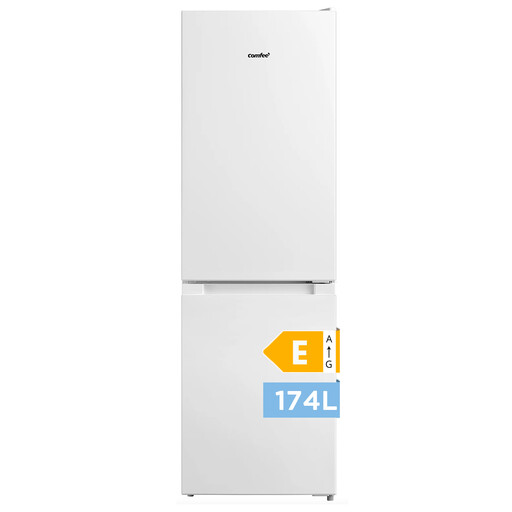 Image unavailable
For a small household wanting two compartments in a 50 cm-wide appliance.
115 L of refrigeration capacity, 59 L of freezer capacity, a 4-star compartment, a stated noise level of 39 dB and dimensions of 50 × 55 × 150 cm. Check the kWh/year and energy label for the exact model before comparing its running costs.
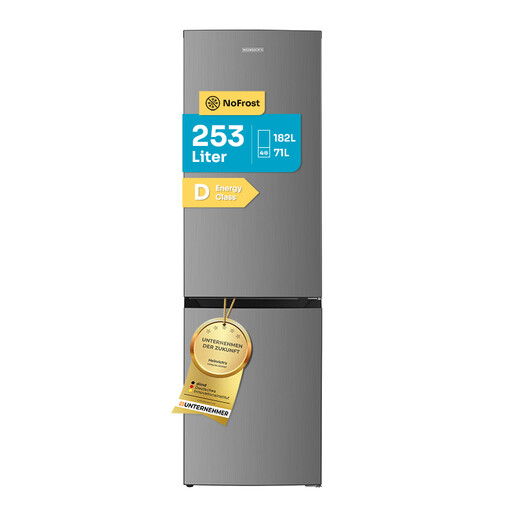 Image unavailable
For a household using separate areas for fresh and frozen food every day.
182 L of refrigeration capacity, 71 L of freezer capacity, a stated noise level of 39 dB, LED lighting and a reversible door. The product information states No Frost; confirm this feature, the annual energy consumption, the dimensions and the installation requirements for the supplied variant.
 Image unavailable
For a narrow kitchen with everyday fresh and frozen-food storage needs.
153 L of refrigeration capacity, 74 L of freezer capacity, a 4-star compartment, a width of 54 cm and a reversible door. The stated noise level is 39 dB; check the kWh/year and energy label before buying.
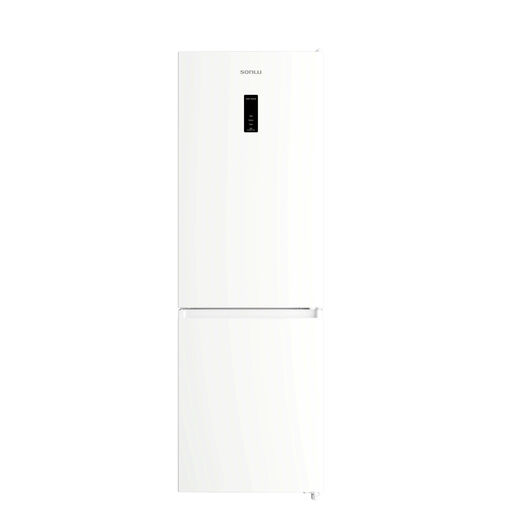 Image unavailable
For a household that regularly stores fresh and frozen food and has a standard-width installation space.
211 L of refrigeration capacity, 99 L of freezer capacity, a width of 60 cm, a reversible door and electronic controls. Check the annual energy consumption, noise level, full dimensions, climate class and required ventilation.
An energy label is compulsory for new fridges sold both in shops and online. In particular, compare the model reference, energy class and annual consumption in kWh between appliances with similar dimensions and usable capacities, as stated by the French Ministry of the Economy.
No. The categories listed by the French ministries responsible for Ecology, Energy and Territories for the repairability index do not include fridges or freezers. Instead, ask about parts availability, repair documentation and the service terms for the exact model.
Electrolux Support France recommends 4 °C or below in the fridge and -18 °C in the freezer. Also consult the model’s instructions, its position and its climate class before switching it on.
First check whether a suitable repair is possible. If not, ADEME states that you can hand the appliance to the retailer or delivery driver when it is replaced, take it to a waste electrical and electronic equipment collection point, or direct it towards reuse if it is still in working order.