How do you compare your options?
Single-door fridge
Consider this if: you mainly store fresh food and don’t need much space for frozen food.
Bear in mind: a small freezer compartment, if there is one, may not be suitable if you regularly buy frozen food.
Fridge-freezer
Consider this if: you want to store fresh and frozen food in two separate compartments in one appliance.
Bear in mind: each compartment needs to have enough space for your needs; the total capacity alone won’t tell you that.
Separate freezer
Consider this: as an additional appliance if your frozen food regularly exceeds the capacity of your fridge-freezer.
Bear in mind: it takes up extra space and also runs continuously. It won’t replace the fridge you need for fresh food.
Once you’ve chosen a type, compare usable capacity, stated annual energy use and installation requirements. The European Commission says that the energy label for fridges and freezers includes details such as capacity, kWh per year and noise levels.
| Criteria |
What to check |
Who this matters to |
| Stated energy use |
Compare the annual kWh figures and energy ratings for appliances with similar types, capacities and features. |
I want to replace an appliance that runs continuously without choosing a capacity that’s larger than I need. Around 40% of consumers put stated energy use at the top of their list of concerns. |
| Space for fresh and frozen food |
Check the fridge and freezer capacities separately, then check the external dimensions. |
I store both types of food at home and need enough room for each in one appliance; for around 30% of consumers, this balance is the priority. |
| Space for frozen food |
Work out how much freezer space you need before adding a separate freezer, and check its stated annual kWh figure. |
My bulk shopping or batch cooking regularly takes up more space than my current freezer compartment. A large freezer capacity comes first for around 20% of consumers. |
| Installation and replacement |
Measure the space and access route; check the manual for ventilation requirements and find out about the take-back service when you order. |
My new appliance needs to fit in my kitchen, be installed correctly and replace the old one without logistical difficulties. These requirements are a priority for around 10% of consumers. |
Brands to consider, model by model
These brands offer different ways to store food. Compare the specifications of the exact model you’re considering, rather than assuming that the figures or features of one model apply to the whole range.
Beko
Worth considering for a single-door fridge, particularly if you mainly store fresh food.
- Beko’s product information for the B1RMLNE444W lists an E energy rating and stated annual energy use of 142,90 kWh.
- These figures apply to the B1RMLNE444W. Check the capacity and features of the model you’re considering before comparing it with another appliance.
Bosch
Worth considering for fridge-freezers, and if you’re choosing between freestanding and integrated models.
- Bosch describes a fridge-freezer as an appliance with separate spaces for fresh and frozen food.
- For an integrated model, check the installation space and ventilation requirements in the manual for your chosen model. Installation guidance for one model won’t necessarily apply to every appliance.
Liebherr
Worth considering if usable capacity and noise levels are important when choosing a fridge-freezer.
- Liebherr’s product information for the CNgbc 5723 lists a total capacity of 371 L and a noise level of 35 dB.
- These figures are for this model, not all Liebherr fridge-freezers. Compare the labels of models that meet your storage needs.
Appliances for keeping fresh and frozen food
The appliances below combine refrigeration and freezing in one unit. If you’re considering a single-door fridge or a separate freezer instead, follow the same order when making your choice: work out the capacity you need, then compare stated energy use for appliances of a similar size.
 Image unavailable
Samsung RB33B612EBN 344 L black fridge-freezer
Worth considering if you want to store fresh and frozen food in one appliance. The product title lists an E energy rating; check the label for the capacity split and annual kWh figure before comparing it with another fridge-freezer.
View on Joybuy
 Image unavailable
Candy CFQQ5T817EPS 467 L silver four-door fridge-freezer
Worth considering if your needs justify a total capacity of 467 L for fresh and frozen food. The title mentions Total No Frost and an E energy rating; check the capacity of each compartment, annual energy use and the space needed for this four-door design.
View on Joybuy
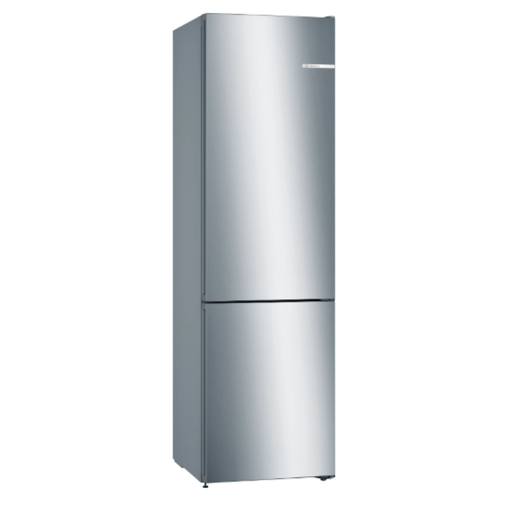 Image unavailable
Bosch KGN39VLEB 368 L stainless steel fridge-freezer
Worth considering if a 368 L fridge-freezer meets your storage needs. Joybuy’s product information for this model lists an E energy rating and 238 kWh/year; this stated figure isn’t a prediction of your actual energy use. Also measure the space and delivery access.
View on Joybuy
 Image unavailable
Bosch KGN33NLEB 282 L stainless steel fridge-freezer
Worth considering if you’re looking for an appliance with a bottom freezer for fresh and frozen food. The title lists a total capacity of 282 L and an E energy rating; check the label for the separate compartment capacities and annual kWh figure before choosing.
View on Joybuy
 Image unavailable
Samsung RF50C530EB1 495 L black multi-door fridge-freezer
Worth considering if a large capacity for fresh and frozen food suits your storage habits. The title lists a capacity of 495 L and an E energy rating; check the door and compartment layout, then confirm the annual kWh figure on the label for the exact model.
View on Joybuy
Frequently asked questions
Is the energy rating enough to help me choose?
No. When comparing appliances that meet the same needs, also compare their annual kWh figures, capacities and features. The European Commission shows these details separately on the label; the rating alone doesn’t tell you the capacity available or the stated annual energy use.
What should I check before ordering an integrated fridge?
Check the dimensions of the housing unit, the installation type and the ventilation clearances specified in the manual for the exact model. Bosch provides installation instructions for its appliances, but ventilation dimensions for one model shouldn’t be applied to every other model.
How do I arrange for my old appliance to be taken away?
Check the options offered by the retailer when you order your new appliance, including where and when the old one will be collected if it’s being delivered. For replacing a household appliance with an equivalent new one, ecosystem describes a free take-back service. Check the details when you place your order.
What should I do with a fridge that no longer works?
Take it to a suitable collection point for refrigeration appliances rather than putting it out with your general rubbish. ecosystem says that collected appliances are depolluted before their materials are sorted. You can check which take-back or collection services are available near you.


