First, choose a format that suits your kitchen and the amount of fresh and frozen food you store. Then compare the kWh/year, usable capacity and noise levels of models with a similar format and capacity. A fridge freezer combines both compartments; a larder fridge is suitable if you don’t need a freezer in the same appliance, while a larger format meets greater storage needs. For an integrated model, compatibility with the cabinet housing and installation instructions is crucial. According to ADEME and UFC-Que Choisir, the energy rating or a cooling feature alone is not enough to make your decision.
Who is this choice for?
Households mindful of continuous energy use
If you’re replacing an appliance that runs day and night, compare its stated annual energy consumption without compromising on the capacity you need. ADEME points out that refrigeration appliances run continuously.
Kitchens with a cabinet housing or open to the living area
A designated space means checking the appliance dimensions and door clearance. If it’s near a living area, noise level is also worth checking on the model’s product details.
Households organising fresh and frozen food
How the compartments are divided matters just as much as the total capacity. Consider frost-free cooling or dedicated zones if these features suit the way you store food.
Which criteria should you consider?
Start by working out how much space you have and whether you need a freezer: a fridge freezer, a larder fridge and a larger format are designed for different needs. If the appliance is to be integrated, also check the installation requirements for the exact model before comparing energy labels.
| Criterion |
What to check |
Who it matters to |
| Continuous energy use |
Compare the kWh/year and energy rating of models with a similar format and capacity. |
If my appliance runs all the time, I want to keep energy use down without choosing one that’s too small. Around 36% of consumers make this their top priority. |
| Format and capacity |
Measure the space and door clearance; check the capacity in litres for the fridge and freezer compartments. |
If my kitchen has limited space or I store lots of frozen food, the appliance needs to fit the space and provide the compartments I need. Around 29% of consumers put this need first. |
| Food storage and noise |
Check the cooling system, compartments and the model’s noise level in dB. |
If it’s near the living area, I want to keep noise to a minimum. Depending on my habits, frost management or storage space may also matter more. Around 21% of consumers prioritise these features. |
| Maintenance and long-term use |
Check the warranty terms, maintenance instructions, spare parts available for the model and after-sales service. |
Before buying an appliance I plan to use for a long time, I want to know how to maintain and repair the model I choose. Around 14% of consumers make this their top criterion. |
Mistakes to avoid
-
Choosing based only on the energy rating letter
The letter doesn’t tell you whether two appliances offer the same capacity. ADEME points out that size and usage also affect actual energy consumption.
Compare the kWh/year, capacity in litres for each compartment and noise levels of models designed for similar needs.
-
Choosing a larger format just for its features
Extra capacity is only useful if you need it. UFC-Que Choisir describes American-style and side-by-side models as more energy-intensive than standard fridges, though that doesn’t allow you to draw conclusions about every multi-door model.
Check how much capacity you really need, then compare the kWh/year, overall dimensions and door clearance of the model you’re considering.
-
Assuming No Frost means lower energy use
Frost management and annual energy consumption are two separate criteria: having No Frost doesn’t prove that an appliance uses less energy.
Choose this feature if it suits your maintenance needs, then check the kWh/year separately on the energy label.
-
Ordering an integrated model based on height alone
Compatibility depends on the cabinet housing and installation requirements for each model. For example, Whirlpool specifies a 178 cm housing for one particular model, not for all its integrated appliances.
Check the installation instructions against your kitchen’s width, depth, ventilation and door system.
Brands to consider across different ranges
Bosch
Worth considering for fridge freezers and other formats with storage zones that suit the way you use your appliance.
- Bosch offers freestanding No Frost fridge freezers and VitaFresh zones in some ranges.
- Bosch says some fridge freezers achieve an A energy rating. Check the exact model, its kWh/year, capacity and noise level.
Samsung
Worth a look if capacity distribution or noise level is important when choosing a fridge freezer.
- Samsung states that models in its RB7300 range have a noise level of 35 dB.
- This figure doesn’t apply to other ranges. Also check the capacity and energy consumption of the model you choose.
Whirlpool
Worth considering if you’re choosing between a freestanding fridge freezer and an integrated model.
- Whirlpool offers fridge freezers with different configurations and cooling technologies.
- The 178 cm housing and 35 dBA stated by Whirlpool apply to one specific integrated model. Check the instructions and energy label for any other model.
Fridge freezers at Joybuy
This selection includes multi-door freestanding appliances, a side-by-side model and integrated fridge freezers. First, choose a format that fits your kitchen, then compare the energy labels and capacity of models that meet your needs.
 Image unavailable
Candy CFQQ5T817EPS, four-door, 467 L
Worth considering if you’d like to organise your food across a four-door appliance. The model name indicates 467 L, Total No Frost and an E energy rating. Check the dimensions and how the capacity is divided before choosing this larger format.
View at Joybuy
 Image unavailable
Samsung RF50C530EB1, multi-door, 495 L
This multi-door model may suit you if you’re looking for a total capacity of 495 L and have enough space for it. The model name indicates an E energy rating. Check the delivery access, clearance around the appliance and the installation requirements for any equipment you plan to use.
View at Joybuy
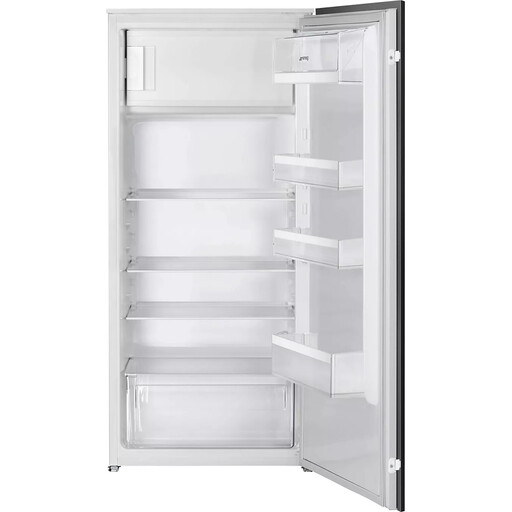 Image unavailable
SMEG S4C122E, integrated, 188 L
This model combines a fridge and an upper freezer compartment in an integrated format. The model name indicates a total capacity of 188 L and an E energy rating. Check the space available for frozen food, the installation instructions and whether the door panel is compatible with your kitchen.
View at Joybuy
 Image unavailable
Sonlu CC-520WE, 444 L
Worth a look if you’re after a large capacity in a freestanding appliance. The model name indicates 444 L, a frost-free system, 40 dB and an E energy rating. Check the dimensions, capacity of each compartment and kWh/year on the model’s product details.
View at Joybuy
 Image unavailable
AEG NSC6M18FES, integrated, 249 L
This integrated fridge freezer is worth considering if your kitchen can accommodate this model. Its name indicates 249 L, TwinTech No Frost and an E energy rating. Check the cabinet housing against the installation instructions and consult the kWh/year on the energy label.
View at Joybuy
Frequently asked questions
Is the energy rating enough to compare two fridges?
No. Also compare the kWh/year and usable capacity of models designed for similar needs. ADEME points out that size and usage affect actual energy consumption, so the same rating letter doesn’t replace comparing appliances that meet your needs.
Does No Frost automatically reduce electricity use?
No. The presence of No Frost doesn’t mean a model uses less energy. Choose this feature based on your frost management needs, then check the kWh/year on the energy label for the exact model.
Should every fridge have a repairability index?
Don’t assume that every fridge has a repairability index. When choosing a model, check its warranty terms, information about compatible spare parts and after-sales service options.
What should you check before ordering an integrated fridge?
Compare your kitchen cabinet housing and installation setup with the model’s instructions: dimensions, ventilation, door clearance and fixing system all matter. The 178 cm housing specified by Whirlpool for one particular model doesn’t guarantee that another integrated model will fit the same space.


